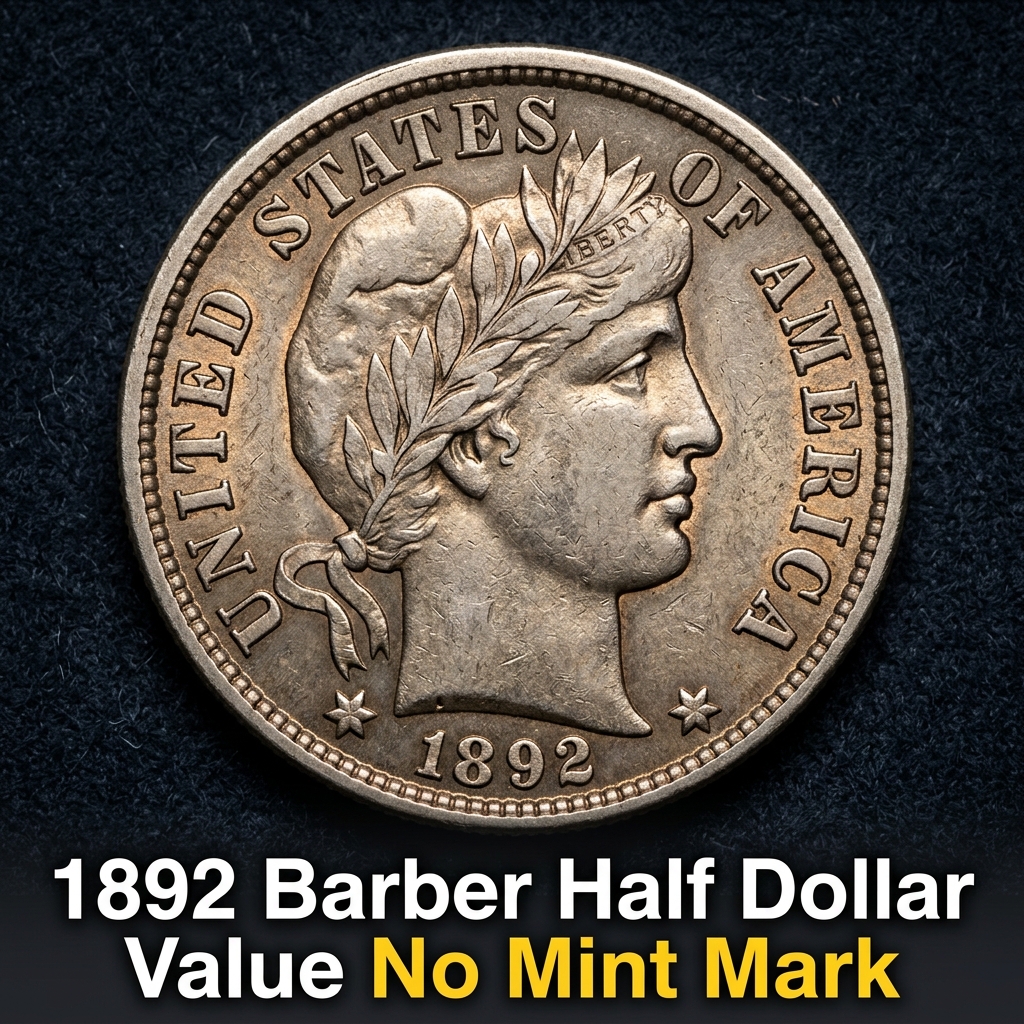
The 1892 Barber Half Dollar with no mint mark is worth anywhere from $20 in heavily worn condition to over $1,000 or more in higher mint states — and if you just found one in an old collection or tucked away in a drawer, you may be holding something genuinely valuable.
What Is the 1892 Barber Half Dollar?
The 1892 Barber Half Dollar was the very first year of issue for this iconic series, designed by U.S. Mint Chief Engraver Charles E. Barber. The obverse features Lady Liberty in a classical Greco-Roman style helmet, while the reverse displays a heraldic eagle — a design that would continue until 1915.
The “no mint mark” version means the coin was struck at the Philadelphia Mint, which was standard practice at the time. Philadelphia coins carry no mint mark, so don’t worry if you don’t see a letter under the eagle on the reverse. That’s completely normal for this issue.
Being the first year of a new design series, 1892 Barber Half Dollars have always attracted serious collector interest. The Philadelphia issue had a mintage of around 935,000 coins — not the rarest coin out there, but certainly not common in good condition today.
If you’re not sure what you have, using a free coin identifier app can be a great first step to narrow down exactly which coin is in your hand before you do anything else.
How to Grade Your 1892 Barber Half Dollar
Coin value is almost entirely dependent on condition, and Barber Half Dollars are notoriously difficult to find in high grades because they circulated heavily. Here’s a basic breakdown of what to look for:
Good (G-4 to G-6): The coin is heavily worn. The word LIBERTY on Lady Liberty’s headband is nearly flat or completely gone. These are the most commonly found examples.
Fine (F-12 to F-15): You can see some detail returning. LIBERTY is partially visible. The eagle’s feathers show some definition.
Extremely Fine (EF-40 to EF-45): Most design elements are sharp. Light wear appears only on the high points. These coins are noticeably more attractive and more valuable.
Mint State (MS-60 and above): No wear at all. Luster is present. These are rare for this date and can bring premium prices at auction.
1892 Barber Half Dollar Value Chart (No Mint Mark)
Here’s a general value table based on current market trends:
| Grade | Estimated Value |
|---|---|
| Good (G-4) | $20 – $35 |
| Very Good (VG-8) | $35 – $60 |
| Fine (F-12) | $60 – $100 |
| Very Fine (VF-20) | $100 – $175 |
| Extremely Fine (EF-40) | $200 – $350 |
| About Uncirculated (AU-50) | $400 – $650 |
| Mint State (MS-63) | $900 – $1,500+ |
Note: Values fluctuate with the silver market and collector demand. Always check recent auction records for the most accurate figures.
Silver Content and Melt Value
Even in the most worn condition, the 1892 Barber Half Dollar has real intrinsic value because it’s made of 90% silver. Each coin contains approximately 0.3617 troy ounces of pure silver.
With silver prices hovering around $28–$30 per troy ounce (as of recent market data), the melt value alone sits at roughly $10–$11. That means even the most beat-up example you find is worth something beyond face value.
Of course, collector value almost always exceeds melt value for a coin like this, so you should never melt one. It’s always worth identifying the grade and researching the full numismatic value first.
For a deeper look at how 1892 silver coins are valued across different issues from that year, check out this detailed 1892 silver coin value guide that covers related coins from the same era.
Should You Get It Professionally Graded?
If your 1892 Barber Half Dollar looks like it’s in Very Fine condition or better, professional grading through PCGS or NGC could be worth the investment. A certified coin in a graded holder often sells for significantly more than a raw (ungraded) coin of the same quality because buyers trust the assessment.
Grading fees typically run $30–$50 per coin for standard submissions, so it makes financial sense once your coin is likely worth $200 or more. For coins in lower grades, selling raw is usually fine.
You can also use CoinHix to get a quick preliminary idea of your coin’s grade before deciding whether professional certification is worthwhile. CoinHix lets you scan your coin with your phone camera and instantly receive an estimated grade and value range — it’s a practical tool for everyday collectors and first-time finders alike.
—
Frequently Asked Questions
Q: How do I know if my 1892 half dollar is a Barber Half Dollar?
A: Look at the obverse (heads side). If you see Lady Liberty wearing a helmet or tiara with LIBERTY inscribed across it, and the date reads 1892, you have a Barber Half Dollar. The reverse shows an eagle with a shield on its chest.
Q: My coin has no mint mark — does that make it less valuable?
A: Not necessarily. The no-mint-mark 1892 Barber Half Dollar was struck in Philadelphia and is actually one of the more collectible issues from the series. Value depends much more on condition than on the absence of a mint mark.
Q: Is there an easy way to find out what my coin is worth without going to a dealer?
A: Yes — CoinHix is a popular app that lets you photograph your coin and get an instant estimated value. It’s a great starting point before you decide whether to sell, hold, or get it professionally graded.