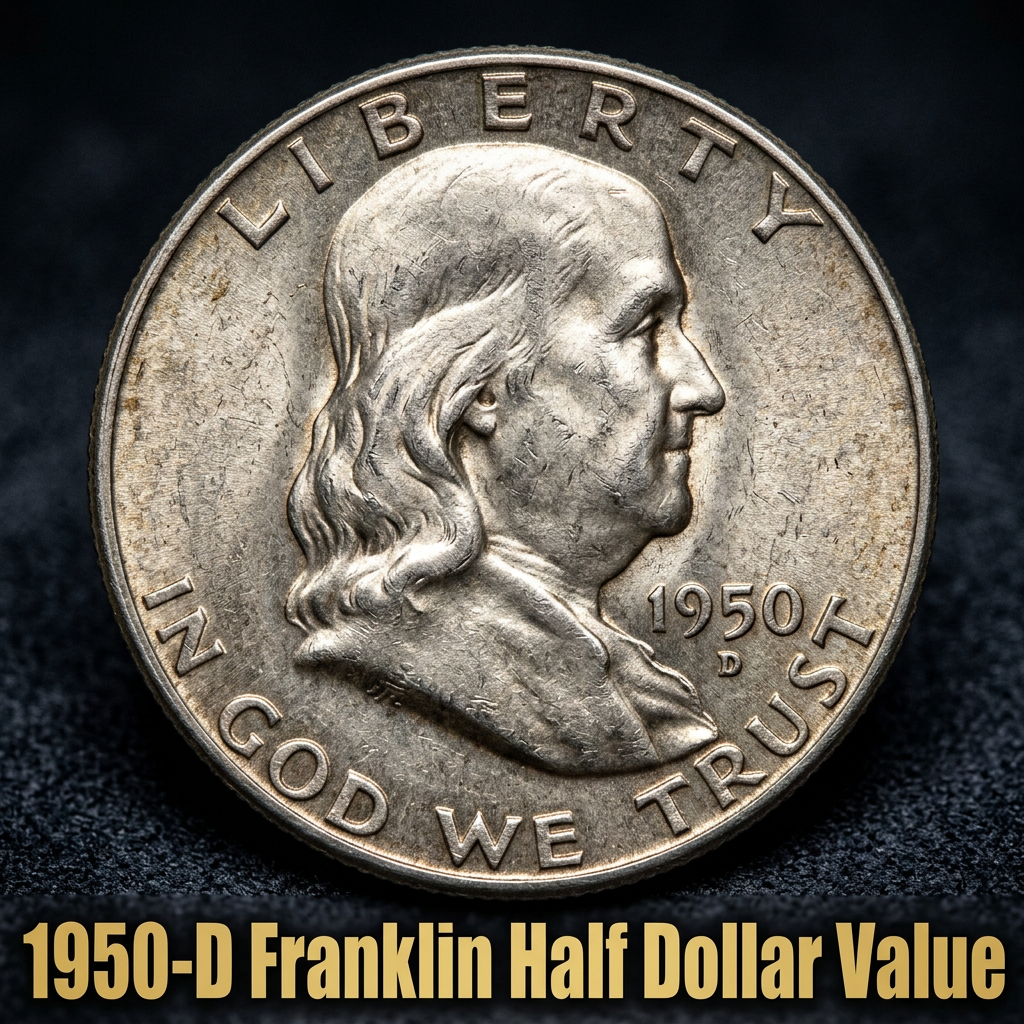
The 1950-D Franklin Half Dollar is worth anywhere from $12 in heavily worn condition to well over $500 or more in high-grade mint state — and a few exceptional examples have sold for thousands at auction. If you just found one of these silver coins in a drawer, a collection, or an old family estate, you’re in the right place. Let’s break down exactly what you’ve got and how much it might be worth.
What Makes the 1950-D Franklin Half Dollar Special
The 1950-D Franklin Half Dollar was struck at the Denver Mint, making it one of the earlier issues in the Franklin Half Dollar series, which ran from 1948 to 1963. The “D” mintmark appears on the reverse side of the coin, just above the Liberty Bell’s beam.
These coins are made of 90% silver and 10% copper, giving them an intrinsic silver melt value even in worn condition. As of current silver prices, a circulated example is worth at least $10–$12 just for its silver content alone.
While the 1950-D isn’t considered a rare key date, coins in higher grades — especially those with Full Bell Lines (FBL) on the reverse — command serious collector premiums. If you’re not sure what you’ve got, using a free coin identifier app is a quick and easy way to get started before paying for a professional appraisal.
1950-D Franklin Half Dollar Value by Grade
The condition of your coin makes an enormous difference in its value. Coin grading runs from Poor (P-1) at the bottom to Mint State (MS-70) at the top. Here’s a general value guide for the 1950-D Franklin Half Dollar:
| Grade | Condition Description | Estimated Value |
|---|---|---|
| Good (G-4) | Heavy wear, outline visible | $12–$14 |
| Fine (F-12) | Moderate wear, major details clear | $14–$16 |
| Extremely Fine (EF-40) | Light wear on high points | $18–$25 |
| About Uncirculated (AU-55) | Slight traces of wear | $28–$45 |
| Mint State (MS-63) | Uncirculated, some marks | $55–$90 |
| Mint State (MS-65) | Gem uncirculated | $150–$300+ |
| MS-65 FBL (Full Bell Lines) | Gem with sharp bell lines | $400–$700+ |
For the most up-to-date auction results and market data, you can check out live 1950-D Franklin Half Dollar prices in mint state grades to see what collectors are actually paying right now.
The Full Bell Lines Designation and Why It Matters
One of the most important factors in Franklin Half Dollar valuation is whether the coin has Full Bell Lines, abbreviated as FBL. This refers to the complete, uninterrupted horizontal lines at the bottom of the Liberty Bell on the reverse side.
Because of the way these coins were struck and stacked, the bell lines often came out weak or incomplete — even on coins that were never circulated. A coin graded MS-65 without FBL might sell for $150–$200, while the same coin with FBL can jump to $400–$700 or beyond.
If you think your coin might qualify, it’s worth getting it professionally graded by PCGS or NGC. CoinHix is a great tool to check current graded coin values before you decide whether submitting for grading makes financial sense.
How to Check Your Coin’s Condition at Home
You don’t need to be a professional numismatist to get a rough idea of your coin’s grade. Start by looking at the high points of the design — Benjamin Franklin’s cheek, hair, and the top of the Liberty Bell. If those areas are flat and featureless, you’re looking at a heavily circulated coin in the Good to Fine range.
If the coin still has some detail and luster but shows light wear on the highest points, you may have an About Uncirculated example worth $30–$45 or more.
If the coin appears completely shiny with no wear but has a few small scratches or contact marks, that’s likely Mint State — which is where real value starts building.
The CoinHix app lets you scan your coin and get an instant grade estimate, which can help you decide your next step before heading to a dealer or submitting to a grading service. For a full breakdown of what your 1950 half dollar could be worth across different conditions, this detailed 1950 half dollar value guide covers everything in plain language.
Should You Clean or Sell Your 1950-D Franklin Half Dollar
Please don’t clean it. This is one of the most common mistakes people make with old coins, and it can instantly destroy a coin’s collector value. Even a light polish can drop a coin from MS-63 to a “details” grade that dealers will pay almost nothing for.
If you’re thinking about selling, your best options are coin dealers, online auction platforms like eBay or Heritage Auctions, or coin shows. For a coin in average circulated condition, a dealer might offer $10–$13 (slightly below melt). For higher-grade or FBL examples, auction is usually the way to maximize your return.
Use CoinHix to research recent sale prices so you walk into any negotiation knowing what your coin is actually worth on the open market.
Frequently Asked Questions
Q: How much silver is in a 1950-D Franklin Half Dollar?
A: Each Franklin Half Dollar contains 0.3617 troy ounces of pure silver. At current silver prices, that gives even a worn coin a base melt value of around $10–$14, regardless of collector premium.
Q: What does the “D” mintmark mean on a Franklin Half Dollar?
A: The “D” mintmark indicates the coin was produced at the Denver Mint in Colorado. You’ll find it on the reverse of the coin, located above the Liberty Bell’s horizontal beam. Denver-minted Franklin halves are common, but high-grade examples with Full Bell Lines can still command strong prices.
Q: Is the 1950-D Franklin Half Dollar rare?
A: No, it’s not considered a rare coin. The Denver Mint struck over 8 million examples in 1950. However, coins in gem uncirculated condition — especially those with Full Bell Lines — are genuinely scarce and can be worth several hundred dollars or more to the right collector.