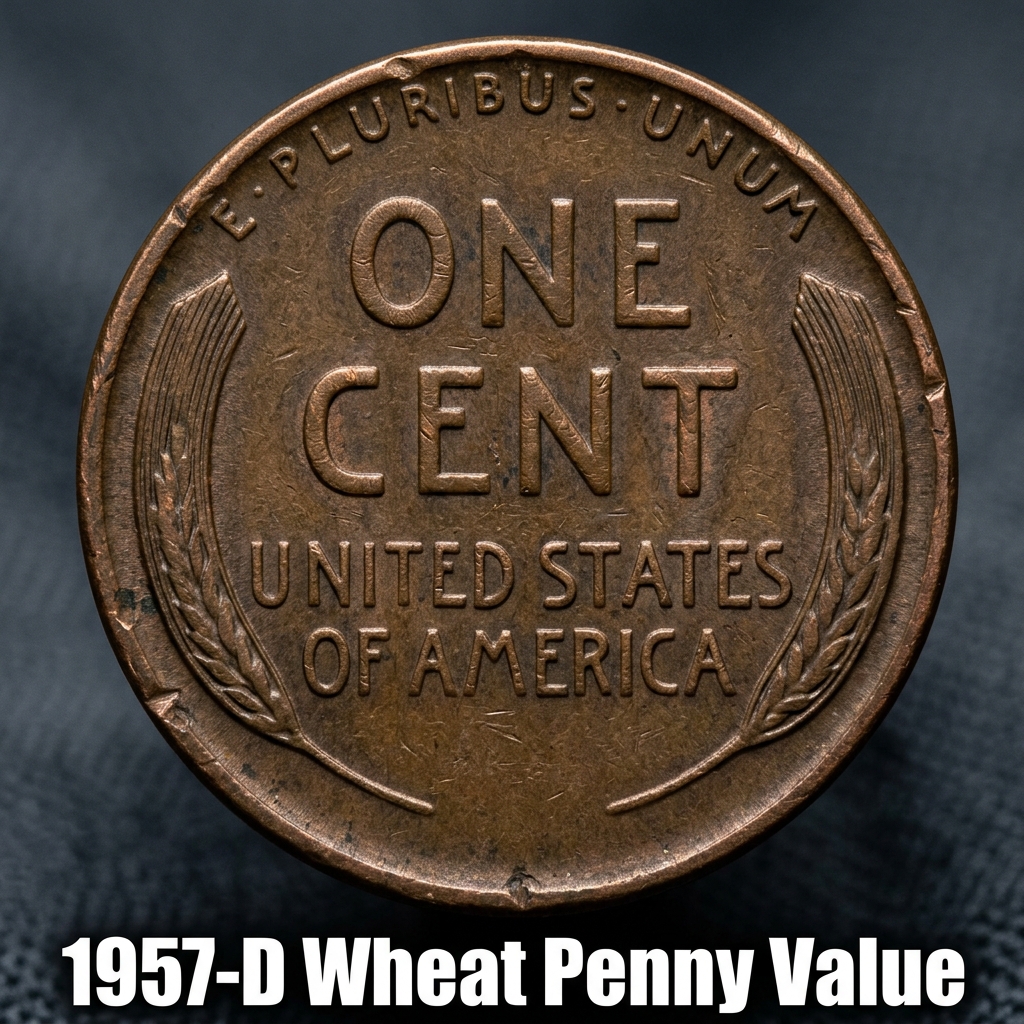
The 1957-D Wheat Penny is worth anywhere from $0.10 in heavily worn condition to over $25 or more in uncirculated mint state grades. If you found one of these old Lincoln cents in a jar, a drawer, or inherited coin collection, you’re in the right place — let’s break down exactly what it’s worth and why.
—
What Makes the 1957-D Wheat Penny Special
The 1957-D Wheat Penny was struck at the Denver Mint, indicated by the small “D” mintmark you’ll find on the obverse (front) of the coin, just below the date. In 1957, the Denver Mint produced over 1.05 billion of these coins — making it one of the most common Wheat Pennies ever made.
That high mintage means most 1957-D cents you find in everyday pocket change or old coin jars aren’t going to be worth a fortune. However, condition is everything in the coin world. A heavily circulated coin with worn details might only fetch a few cents to a dime, while a perfectly preserved uncirculated example can surprise you with a much higher price tag.
If you’re not sure what grade your coin falls into, a free coin identifier app can help you get a quick read on its condition and estimated value using just your smartphone camera. It’s a great starting point before you take your coin to a dealer.
—
1957-D Wheat Penny Value by Grade
Coin value depends heavily on its condition, which collectors call “grade.” Here’s a simple breakdown of what your 1957-D Lincoln Wheat Penny might be worth depending on how well it’s been preserved:
| Grade / Condition | Description | Estimated Value |
|---|---|---|
| Good (G-4) | Heavy wear, major details visible | $0.05 – $0.15 |
| Fine (F-12) | Moderate wear, clear lettering | $0.15 – $0.35 |
| Extremely Fine (EF-40) | Light wear on high points | $0.50 – $1.50 |
| Uncirculated (MS-63) | No wear, some bag marks | $3 – $8 |
| Gem Uncirculated (MS-65 RD) | Full original red luster, sharp strike | $15 – $30+ |
| MS-67 RD (Top Grade) | Near-perfect, certified by PCGS/NGC | $100 – $300+ |
For a deeper look at certified auction results and up-to-date price data, you can browse 1957-D Wheat Penny MS-RD price records on CoinHix — it’s one of the most detailed databases available for tracking real sale prices across different grade levels.
—
How to Identify a High-Value 1957-D Penny
Most 1957-D Wheat Pennies are worth face value in circulated condition, but there are a few things that can push the value significantly higher.
Color designation plays a big role. Uncirculated Lincoln cents are graded as Red (RD), Red-Brown (RB), or Brown (BN). Red coins, which retain their original copper luster, are the most valuable. A Brown uncirculated coin might grade MS-63 BN and sell for just $2–$3, while the same coin in MS-65 RD could be worth $20 or more.
Strike quality and surface preservation also matter. Look closely at Lincoln’s hair and beard details — sharp, fully struck coins command a premium. Any signs of original mint luster (a swirling shine you can see when you tilt the coin) are a great indicator that you have something better than average.
If your coin looks like it’s never been touched and still has that bright orange-copper glow, it could be worth getting it professionally graded by PCGS or NGC. The CoinHix app makes it easy to compare your coin’s appearance against certified examples before you send it off.
—
Are There Any Rare 1957-D Wheat Penny Errors Worth Money
Error coins are where everyday finds can suddenly become exciting. While the 1957-D Wheat Penny doesn’t have a famous major error like a doubled die obverse (unlike the 1955 cent), there are still minor varieties and errors that show up from time to time.
Doubled die errors — where design elements appear slightly doubled — can occur on any date. Check the lettering on “LIBERTY” and “IN GOD WE TRUST” under magnification. Even minor doubling can add $10–$50 or more to the value depending on strength.
Off-center strikes are another find worth noting. If Lincoln’s portrait isn’t centered on the coin — with part of the design missing — collectors pay premiums for these oddities. A 10–15% off-center 1957-D can be worth $20–$50, while a dramatic 50% off-center example might fetch $100 or more.
Repunched mintmarks (RPM) were common in the 1950s when mint workers punched the “D” mintmark into each die by hand. If you see a shadow or second “D” mark under magnification, you may have an RPM variety. Check out detailed 1957 penny value and variety information to identify which RPM variety you might have and what it could sell for.
—
Tips for Selling or Storing Your 1957-D Wheat Penny
If you think your coin has value, the first rule is: don’t clean it. Cleaning a coin — even with mild soap — removes the natural patina and can destroy its numismatic value instantly. Collectors and dealers can always spot a cleaned coin, and it significantly lowers what they’ll pay.
Store the coin in a non-PVC coin flip or a 2×2 cardboard holder to protect it from further wear and environmental damage. Avoid touching the face of the coin — hold it by the edges only.
When you’re ready to sell, you have several options: local coin dealers, online auction platforms like eBay, or coin shows. For higher-grade coins, consider submitting to PCGS or NGC for professional grading first — it can dramatically increase buyer confidence and final sale price.
CoinHix is also a great resource to check current market prices before you walk into any dealer. Knowing the going rate puts you in a much stronger position to negotiate fairly.
—
FAQ
Q: Is a 1957-D Wheat Penny rare?
A: No, the 1957-D Wheat Penny is not considered rare. Over one billion were minted at the Denver facility that year, making it one of the most common Wheat cents. That said, examples in high uncirculated grades with full red color are genuinely scarce and can be worth $30 to several hundred dollars.
Q: What does the “D” mintmark mean on a 1957 penny?
A: The “D” mintmark stands for the Denver Mint in Colorado. It’s located on the obverse of the coin, just below the year “1957.” A 1957 penny without a mintmark was made at the Philadelphia Mint, and both versions carry similar values in most grades.
Q: How do I know if my 1957-D penny is uncirculated?
A: An uncirculated coin shows no signs of wear on any of its high points — Lincoln’s cheekbone, the top of his ear, and the wheat stalks on the reverse should all be sharp and unscuffed. The coin should also show some degree of original mint luster (a reflective, flowing shine). If in doubt, the CoinHix app lets you compare your coin to graded examples side by side.