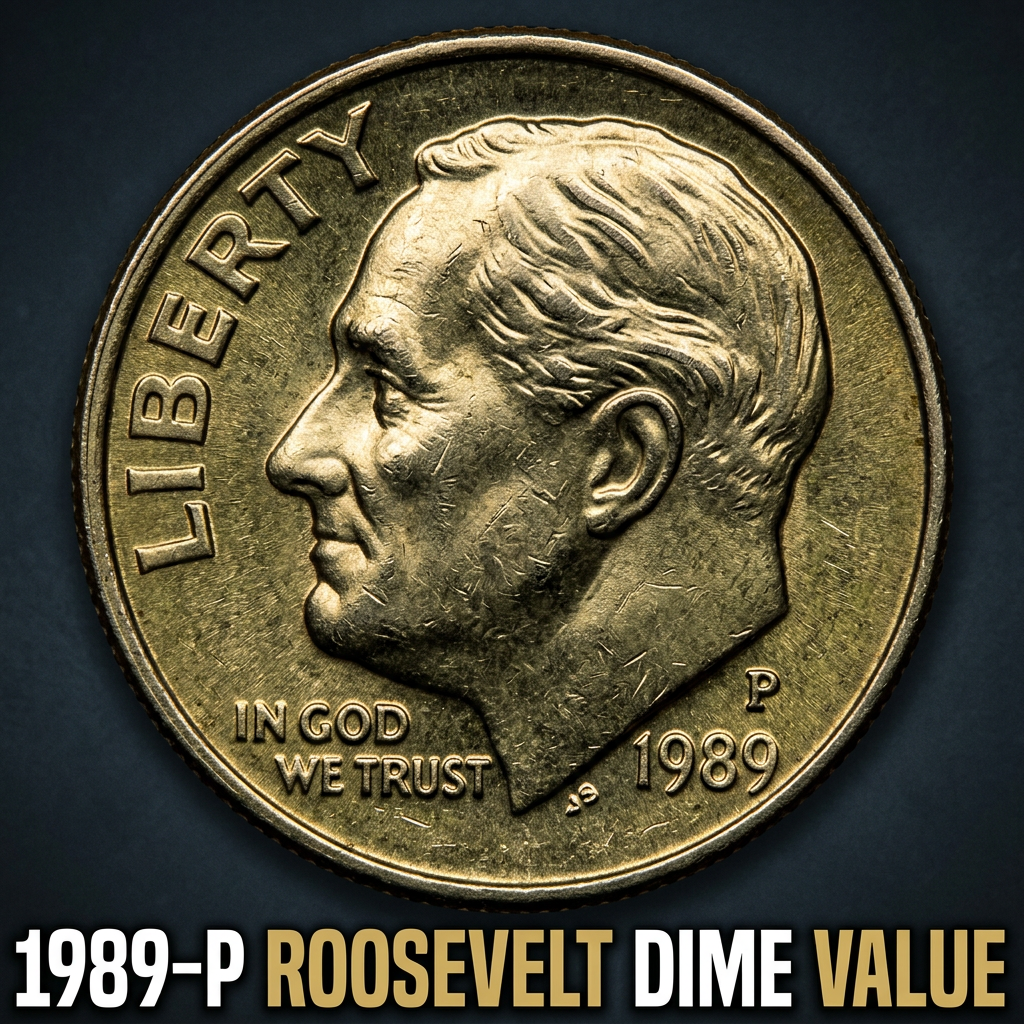
The 1989-P Roosevelt Dime is worth anywhere from face value (10 cents) in circulated condition to $10 or more in pristine, uncirculated grades — and rare high-grade examples have sold for well over $20 at auction. If you recently stumbled across one of these dimes in your change jar or inherited a coin collection, you’re in the right place to find out exactly what you’ve got.
What Is the 1989-P Roosevelt Dime?
The “P” in 1989-P tells you this dime was struck at the Philadelphia Mint, one of the busiest mints in U.S. history. In 1989, Philadelphia produced over 1.2 billion Roosevelt dimes — yes, billion with a “B.” That enormous mintage is the main reason most 1989-P dimes you find in circulation aren’t worth much above face value.
Roosevelt dimes have been minted since 1946, honoring President Franklin D. Roosevelt shortly after his death. They’re made of a copper-nickel clad composition (since 1965), which means they contain no silver. So if you’re hoping for a silver windfall, this particular coin won’t deliver that.
That said, condition is everything in the coin world. A dime that has been bouncing around in pockets and piggy banks for decades looks very different from one that went straight from the mint into a collector’s hands — and that difference can mean real money.
If you want a quick and easy way to identify and evaluate coins from your collection, try a free coin identifier app before you spend hours doing the research yourself.
1989-P Roosevelt Dime Value by Grade
Here’s a simple breakdown of what the 1989-P dime is generally worth across different conditions. Coin grading uses a numeric scale from 1 (barely identifiable) to 70 (perfect), and even a few points can make a surprising difference in value.
| Grade | Condition Description | Estimated Value |
|---|---|---|
| G-4 (Good) | Heavy wear, major details visible | $0.10 (face value) |
| VF-20 (Very Fine) | Moderate wear, clear design | $0.10 – $0.25 |
| MS-63 (Uncirculated) | No wear, some bag marks | $1 – $3 |
| MS-65 (Gem Uncirculated) | Sharp strike, minimal marks | $5 – $10 |
| MS-67 or Higher | Near-perfect, collector grade | $20 – $50+ |
For up-to-date collector prices and auction records, you can check out the 1989-P Roosevelt Dime MS price data on CoinHix to see what these coins are actually selling for right now.
Errors and Varieties That Can Make Your 1989-P Dime Worth More
Here’s where things get exciting. Even a common coin like the 1989-P dime can be worth significantly more if it carries a mint error. These errors happen when something goes wrong during the striking process, and collectors love them.
Some errors to look for include:
Double Die Obverse (DDO): Look closely at Roosevelt’s profile, the date, and the lettering. If anything appears doubled or slightly blurred in a way that looks intentional, you may have a double die variety. Some DDO Roosevelt dimes have sold for $50 to $150+.
Off-Center Strike: If the design appears shifted to one side, leaving a blank crescent of metal on the other side, that’s an off-center strike. A 10–20% off-center 1989-P dime can be worth $15 to $40 or more depending on severity.
Clipped Planchet: A curved or straight edge cut-out on the coin’s blank before striking. These are visually striking errors that collectors actively seek.
Use CoinHix to scan your coin and instantly compare it against known error varieties — it’s a fast way to spot something that could be worth real money.
How to Check Your 1989-P Dime’s Condition at Home
You don’t need to be a professional numismatist to get a basic sense of your coin’s grade. Start with good lighting — natural daylight or a simple desk lamp works well. Hold the coin at a slight angle and tilt it slowly to see how the surface reflects light.
Uncirculated coins will have original mint luster, a kind of cartwheel-like shine that moves across the surface as you tilt the coin. Circulated coins will look flat and dull, with raised areas like Roosevelt’s cheekbones and hair worn smooth.
Look at the torch design on the reverse — the fine lines on the flame are among the first details to wear away. If those lines are sharp and clear, your coin is in excellent shape.
For a full breakdown of the 1989 dime value across all mint marks and grades, that resource covers everything in one place and is worth bookmarking.
Once you’ve assessed it yourself, consider downloading CoinHix to get a second opinion — the app uses real market data to give you a fair, current estimate without any guesswork.
Is the 1989-P Dime Worth Keeping?
For most people, a worn 1989-P dime pulled from a change jar is worth exactly 10 cents and nothing more. But if your coin shows no signs of wear, has sharp detail under magnification, and still carries that original mint shine, it’s absolutely worth holding onto — or even getting professionally graded by PCGS or NGC if it looks like MS-65 or better.
Errors are always worth investigating further. Even if your dime turns out to be common, learning to examine coins carefully is a skill that pays off every time you come across an old collection.
FAQ
Q: Does the 1989-P Roosevelt Dime contain silver?
A: No. Roosevelt dimes minted from 1965 onward — including the 1989-P — are made of a copper-nickel clad composition with no silver content. Only Roosevelt dimes dated 1946 through 1964 were struck in 90% silver.
Q: How do I know if my 1989-P dime is uncirculated?
A: An uncirculated dime will show no signs of wear on the high points of the design — specifically Roosevelt’s cheek, the hair above the ear, and the flame detail on the torch on the reverse. The coin should also have a bright, flowing luster when tilted under a light source.
Q: Where can I sell a valuable 1989-P Roosevelt Dime?
A: Options include eBay (great for reaching active collectors), local coin shops, and coin shows. For certified high-grade or error coins, Heritage Auctions and Stack’s Bowers are reputable platforms. Before selling, use CoinHix to get a current market value estimate so you know what price to expect.