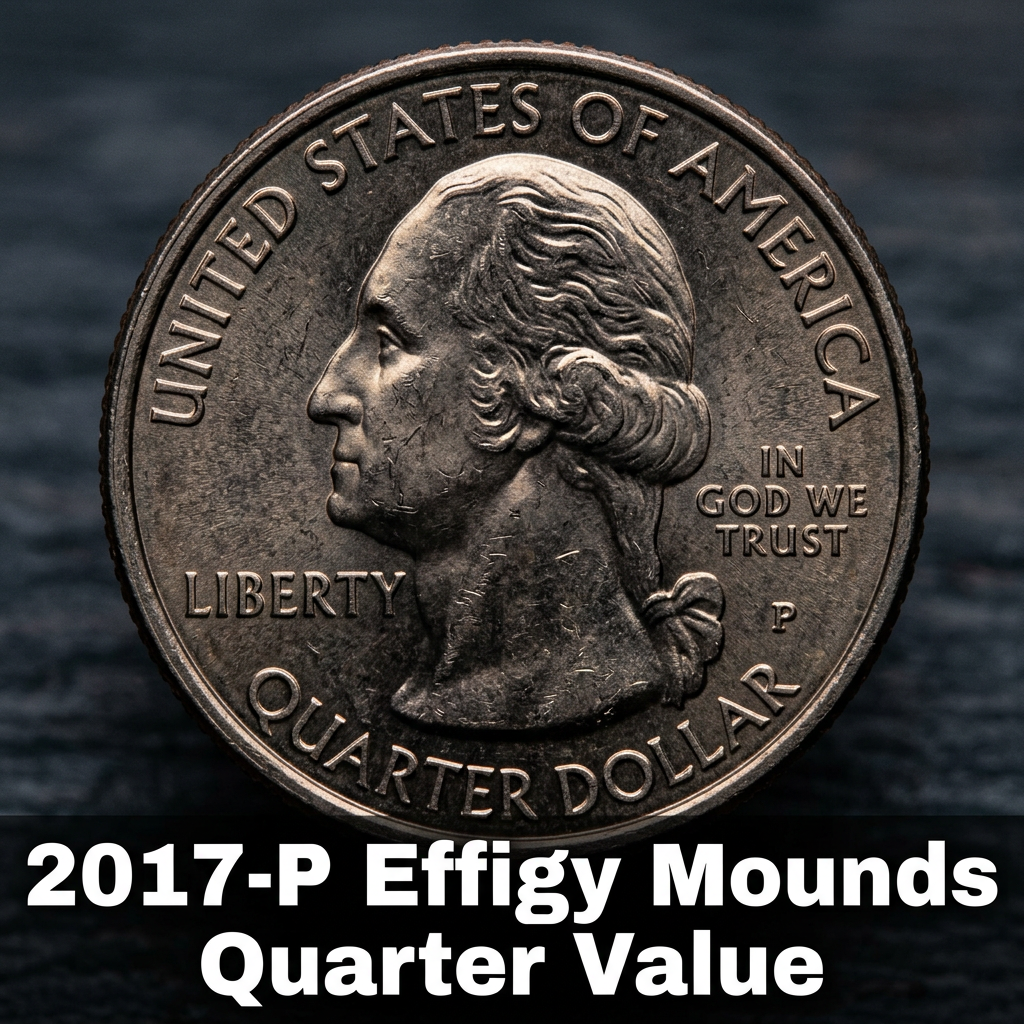
The 2017-P Effigy Mounds Quarter is worth anywhere from 25 cents in circulated condition to $10 or more in pristine mint state — and a few high-grade examples have sold for even higher at auction. If you found one in your change or inherited a coin collection, this guide will walk you through exactly what it’s worth and why.
What Is the 2017-P Effigy Mounds Quarter?
The Effigy Mounds Quarter was released in 2017 as part of the America the Beautiful Quarters Program, a U.S. Mint series honoring national parks and historic sites across the country. This particular coin represents Effigy Mounds National Monument in Iowa, known for its ancient Native American burial mounds shaped like animals and birds.
The “P” in 2017-P means it was struck at the Philadelphia Mint. That’s important because different mint marks can affect a coin’s collector value. The Philadelphia Mint produced over 214 million of these quarters — which means they’re not rare by any stretch, but high-quality examples are still sought after by collectors.
If you’re not sure what mint mark you’re looking at or want to identify your coin quickly, you might want to try a free coin identifier app that can scan your coin and give you instant details. It’s one of the easiest ways for everyday people to get started in coin collecting without needing expert knowledge.
2017-P Effigy Mounds Quarter Value by Grade
Most of these quarters you find in pocket change are going to be worth face value — just 25 cents. But condition matters a lot in the coin world. A coin in “circulated” condition (worn, scratched, dull) typically has no premium over face value for this issue.
However, coins that never entered circulation — called “mint state” coins — can carry real premiums. The higher the grade (on a scale from MS60 to MS70), the more a coin is worth. An MS65 example might fetch $3 to $6, while a flawless MS67 or MS68 can sell for $10, $30, or even more depending on demand.
You can check current market prices for the 2017-P Effigy Mounds Quarter in mint state grades to see what collectors are actually paying right now. Prices shift based on recent auction results and overall collector demand.
| Condition / Grade | Estimated Value | Notes |
|---|---|---|
| Circulated (worn) | $0.25 | Face value only |
| MS60 – MS63 | $0.50 – $1.50 | Minor blemishes or contact marks |
| MS64 – MS65 | $2 – $6 | Nice luster, few marks |
| MS66 | $6 – $12 | Strong eye appeal |
| MS67 | $15 – $35 | Near-perfect surfaces |
| MS68+ | $50+ | Exceptional, auction-driven prices |
How to Tell If Your Quarter Is High Grade
You don’t need to be a professional numismatist to do a basic check. Start by looking at the coin under good lighting — ideally a single light source like a lamp. Tilt the coin back and forth and look for the “cartwheel” luster effect, that flowing, reflective sheen that moves across a coin’s surface. If you see it, your coin likely hasn’t been heavily worn.
Next, look for contact marks — small scratches or nicks from coins hitting each other in bags or rolls. The fewer of those, the better. Coins that never made it to circulation, pulled straight from mint rolls or sets, tend to be in the best shape.
For a more accurate assessment, many collectors use CoinHix to look up recent sale prices by grade, so they know if their coin is worth submitting to a professional grading service like PCGS or NGC. Grading costs money, so it only makes sense if your coin could realistically grade MS66 or higher.
Is the 2017-P Effigy Mounds Quarter Rare?
In terms of mintage, no — over 214 million were produced at the Philadelphia Mint alone. That’s a large number, and it means finding one in circulation isn’t a special event. But “common” doesn’t always mean “worthless.”
What’s actually scarce are high-grade examples, especially MS67 and above. Even though millions were made, most coins end up banged up. A gem-quality coin with no handling marks and full luster is harder to come by than you’d think.
If you want a broader look at what 2017 quarters are worth across different mint marks and conditions, that resource breaks it down in a way that’s easy to follow — especially helpful if you have a mixed batch of quarters you’re sorting through.
The CoinHix app is also a handy tool for tracking values like this over time, especially if you’re building a set of America the Beautiful Quarters and want to know when prices rise or fall.
Should You Hold On to Your 2017-P Effigy Mounds Quarter?
If your coin looks shiny, sharp, and uncirculated, it might be worth keeping — or at least getting a second opinion before you spend it. A coin in MS67 or better could be worth $20 to $50 or more, which is a nice return on a 25-cent investment.
On the other hand, if the coin is worn down and dull, it’s probably just worth a quarter. There’s no shame in that — most coins are. The fun of coin hunting is finding that one gem in the mix.
Use tools like CoinHix to stay informed, and don’t be afraid to look things up before making decisions. The more you know about your coins, the better positioned you are to spot real value when it shows up.
—
FAQ
Q: How many 2017-P Effigy Mounds Quarters were made?
A: The Philadelphia Mint struck approximately 214,400,000 of these quarters in 2017. That’s a high mintage, which makes circulated examples worth only face value. However, high-grade mint state examples are far less common and carry collector premiums.
Q: Is there a 2017-P Effigy Mounds Quarter error coin I should look for?
A: There are no widely recognized major errors for this issue, but minor die varieties and strike errors do occasionally surface. If your coin has something unusual — like a doubled image, off-center strike, or missing design element — it could be worth having examined by a professional or running it through an app like CoinHix for initial research.
Q: What’s the best way to find out the current value of my 2017-P Effigy Mounds Quarter?
A: The most reliable method is to check recent auction records and dealer sale prices by grade. Apps and websites that track live market data give you the most up-to-date picture. You can also compare your coin’s condition to graded examples online to estimate where it might fall on the MS scale.