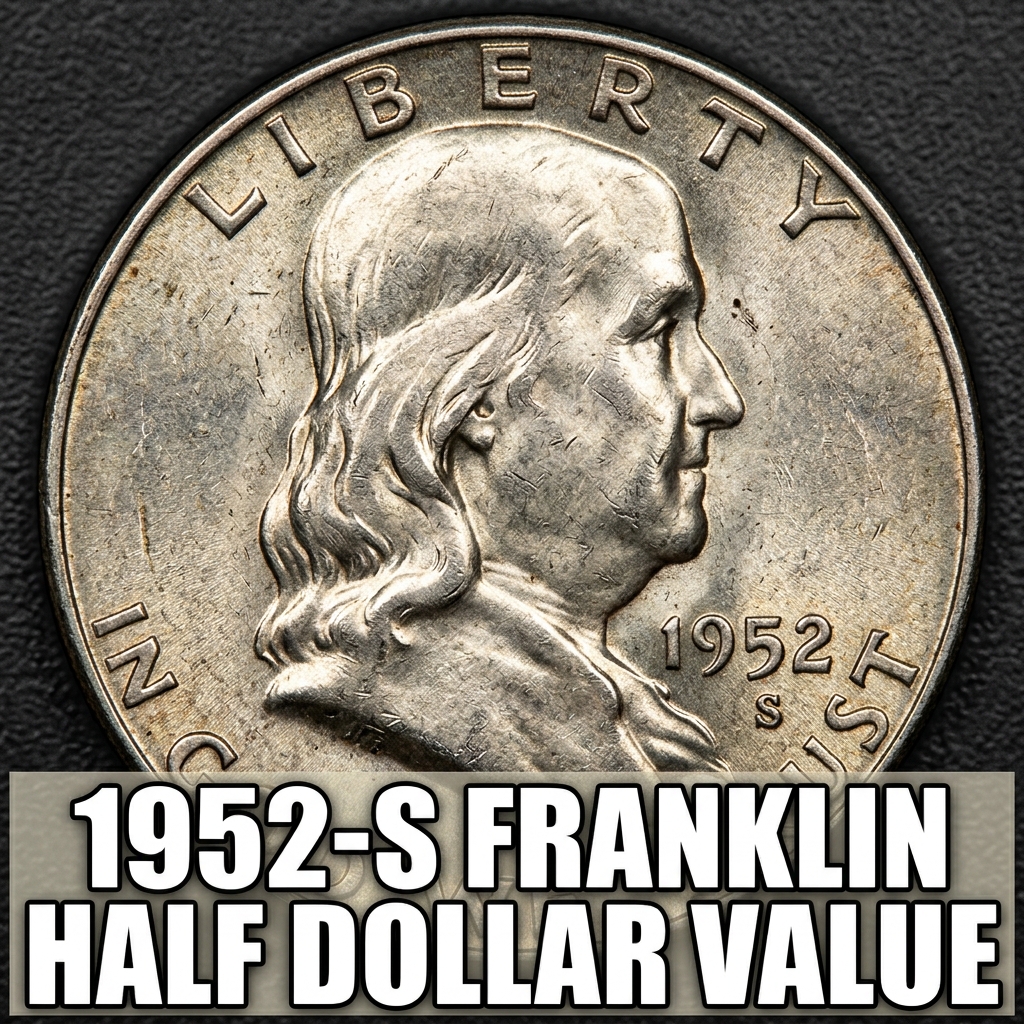
The 1952-S Franklin Half Dollar is worth anywhere from $12 in heavily worn condition to over $500 or more in pristine mint state, making it one of the more interesting mid-century coins to find in an old collection or coin jar.
What Is the 1952-S Franklin Half Dollar?
The Franklin Half Dollar series ran from 1948 to 1963, featuring Benjamin Franklin on the obverse and the Liberty Bell on the reverse. The “S” mint mark means this coin was struck at the San Francisco Mint, which produced 5,526,000 of these coins in 1952 — a relatively modest mintage that gives this coin a bit more collector appeal than some other dates in the series.
If you found one of these in an old box of coins or inherited a collection, you’re in luck. These are not rare coins in the traditional sense, but they do carry real value — especially in higher grades.
To get a quick read on what you have, try a free coin identifier app that can scan your coin and give you an instant estimate based on grade and condition.
How Condition Affects the 1952-S Franklin Half Dollar Value
Condition is everything when it comes to coin values, and the 1952-S Franklin Half Dollar is no exception. Collectors use a grading scale from 1 to 70, where circulated coins fall in the lower range and uncirculated (mint state) coins sit at the top.
A heavily worn example with flat details might only bring $10–$15, essentially just its silver melt value. A coin in Fine (F-12) condition, where you can still see most of the design but there’s obvious wear on the high points, typically sells for around $12–$15.
Move up to About Uncirculated (AU-50 to AU-58), where the coin shows only light wear on Franklin’s hair and the Liberty Bell, and you’re looking at $20–$35 or more.
The big jumps happen in mint state. An MS-63 example might sell for $50–$80, while a gem MS-65 can reach $150–$300. Top-pop MS-66 and MS-67 specimens have sold for well into the hundreds, even crossing $1,000 at major auctions.
| Grade | Description | Estimated Value |
|---|---|---|
| G-6 (Good) | Heavy wear, major details visible | $10–$12 |
| F-12 (Fine) | Moderate wear, design clear | $12–$15 |
| VF-30 (Very Fine) | Light wear on high points | $15–$20 |
| AU-55 (About Uncirculated) | Slight wear, most luster intact | $22–$35 |
| MS-63 (Mint State) | Uncirculated, minor contact marks | $50–$80 |
| MS-65 (Gem Mint State) | Excellent luster, few blemishes | $150–$300 |
| MS-66+ (Premium Gem) | Near perfect, sharp strike | $400–$1,000+ |
Silver Content and Melt Value
One thing that gives every Franklin Half Dollar a floor value is its silver content. These coins are composed of 90% silver, containing 0.3617 troy ounces of pure silver per coin.
With silver prices fluctuating around $27–$30 per troy ounce in recent times, the base melt value of a 1952-S Franklin Half Dollar sits around $9–$11. That means even a beat-up, barely recognizable example is still worth a few dollars as raw silver.
This is important to know — never spend these as pocket change or sell them at face value (50 cents). Even the most worn circulated 1952-S Franklin Half Dollar is worth many times its face value.
You can check up-to-date 1952-S Franklin Half Dollar price data by grade at CoinHix, which tracks real auction results and dealer prices in real time.
Where to Sell or Get Your 1952-S Franklin Half Dollar Appraised
If you think you might have a nice example, it’s worth getting a second opinion before you sell. Options include local coin dealers, coin shows, or online platforms like eBay and Heritage Auctions.
For a quick at-home assessment, CoinHix is a great starting point. The app lets you look up actual sales data by grade so you know what real buyers are paying — not just what dealers want you to think.
If you want a more detailed breakdown of your specific coin, check out this comprehensive guide on 1952 Half Dollar values including mint mark variations, which covers all three mint marks from that year in one place.
For coins that appear to be in high grade (MS-63 or above), professional grading through PCGS or NGC is worth considering. A certified MS-65 or MS-66 coin can sell for significantly more than a raw ungraded one, and buyers will pay a premium for that peace of mind.
CoinHix also has tools to help you understand grading basics so you can walk into any dealer conversation feeling confident.
—
FAQ
Q: Is the 1952-S Franklin Half Dollar rare?
A: It’s not considered rare, but with a mintage of just over 5.5 million, it’s one of the lower-production dates in the series. High-grade examples (MS-65 and above) are genuinely scarce and can command strong prices at auction.
Q: How do I know if my 1952-S Franklin Half Dollar is uncirculated?
A: Look for original mint luster — a soft, cartwheel-like sheen that flows across the coin’s surface. If the coin looks flat or dull on Franklin’s cheek and hair, it’s likely been circulated. A magnifying glass and good lighting will help you spot wear on the high points.
Q: Is it worth getting my 1952-S Franklin Half Dollar professionally graded?
A: If your coin appears to be in MS-63 or higher condition, professional grading through PCGS or NGC is usually worth the cost. Certified coins sell faster and for more money. For circulated examples, the grading fee typically exceeds the value gain, so it’s generally not necessary.