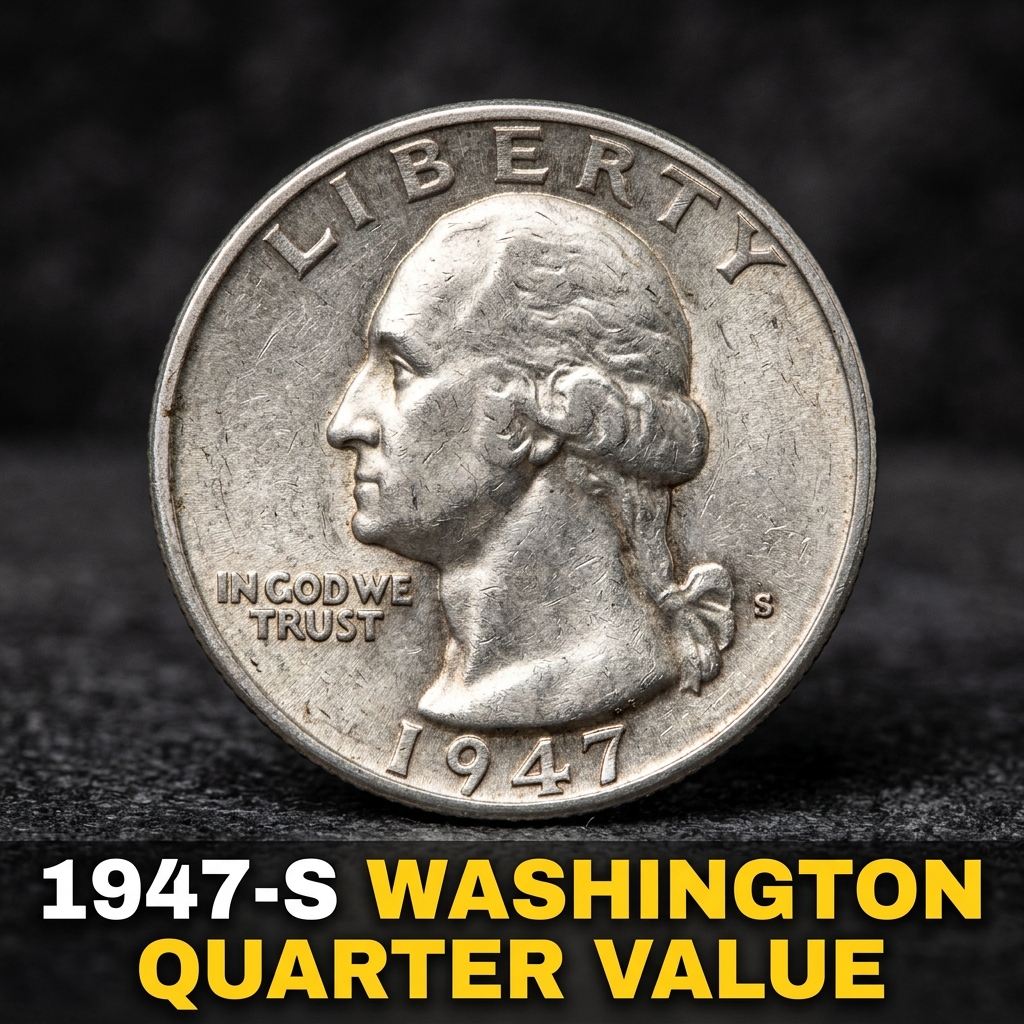
The 1947-S Washington Quarter is worth anywhere from $5 in lightly circulated condition to well over $200 or more in higher mint state grades. If you found one of these coins in an old jar, a coin collection, or tucked in a drawer, you’re in the right place — let’s break down exactly what it’s worth and what to look for.
What Makes the 1947-S Washington Quarter Special
The 1947-S Washington Quarter was struck at the San Francisco Mint, which is where that small “S” mintmark comes from — you’ll find it on the reverse side of the coin, just below the eagle. In 1947, the United States Mint was still producing quarters made of 90% silver, which alone gives these coins real melt value even in worn condition.
The “S” mintmark coins from this era tend to attract solid collector interest because San Francisco often produced coins with strong strikes and good luster. That said, the 1947-S had a relatively high mintage of about 5.5 million coins, so finding one isn’t incredibly rare — but finding one in excellent condition absolutely is.
If you’ve got one of these and want a quick idea of what it might be worth, try using a free coin identifier app to get started. It can help you identify the coin and give you a ballpark figure right from your phone.
1947-S Washington Quarter Value by Grade
The value of a 1947-S quarter depends heavily on its condition, which coin collectors call the “grade.” A heavily worn coin that’s been in circulation for decades will show flat details on Washington’s hair and the eagle’s feathers. A lightly worn coin, on the other hand, will still show most of the design clearly.
Here’s a general breakdown of what the 1947-S Washington Quarter is worth across different grades:
| Grade / Condition | Description | Estimated Value |
|---|---|---|
| Good (G-4) | Heavy wear, outline visible | $5 – $7 |
| Fine (F-12) | Moderate wear, details visible | $7 – $9 |
| Extremely Fine (EF-40) | Light wear on high points | $10 – $15 |
| About Uncirculated (AU-55) | Slight trace of wear, strong luster | $18 – $30 |
| Mint State (MS-63) | No wear, some bag marks | $35 – $60 |
| Mint State (MS-65) | Gem quality, great luster | $100 – $250+ |
For more detailed and up-to-date pricing data, you can check out the 1947-S Washington Quarter price history and mint state values on CoinHix, which tracks real auction results and market trends.
How to Check Your Coin’s Condition at Home
You don’t need to be a professional numismatist to get a rough idea of your coin’s grade. Start by looking at Washington’s hair above his ear and along the top of his head. If those details are sharp and well-defined, you’ve likely got a higher-grade coin. The eagle’s breast feathers on the reverse are another key area to inspect.
Hold the coin under a single light source and tilt it gently. A coin in uncirculated condition will show a full cartwheel luster — that flowing, reflective shine moving across the surface as you rotate it.
Avoid cleaning your coin at all costs. Many people think a shiny coin is a better coin, but cleaning actually destroys the original surfaces and can drop the value significantly. Leave it as you found it.
CoinHix is a great tool if you want to go deeper — the app lets you track values across multiple grades and see what similar coins have actually sold for at auction, giving you real-world data rather than just estimates.
Silver Value and Why It Matters
Even a beat-up 1947-S Washington Quarter has value beyond just being a collectible. These quarters contain 0.1808 troy ounces of pure silver. With silver prices fluctuating around $25–$30 per ounce in recent times, the base melt value of any 1947-S quarter is roughly $4.50 to $5.50.
That means even the most worn example is worth more than face value — and that’s just from the metal content. Collector demand pushes values even higher, especially for nicer examples.
If you want a full picture of the 1947 Washington Quarter value across all mint marks and grades, that resource breaks it down in a way that’s easy to follow for beginners and experienced collectors alike.
You can also use CoinHix to monitor silver prices and see how fluctuating spot prices affect your coin’s melt value in real time — a helpful feature if you’re deciding whether to sell or hold.
Is the 1947-S Washington Quarter Rare?
In circulated grades, the 1947-S is common enough that it’s easy to find. But in gem mint state — grades like MS-65 and above — it becomes significantly harder to track down. Coins certified by PCGS or NGC in MS-65 or better regularly sell for $100 to $250 or more, and top-pop examples with full strike and perfect surfaces can go even higher at major auctions.
The key distinction here is strike quality. Some 1947-S quarters came through with soft, mushy details on Washington’s hair lines, which collectors call a “weak strike.” A fully struck example with crisp hair lines (sometimes called Full Head) commands a premium and is genuinely rare at higher grades.
If you suspect you have a high-grade example, it’s worth submitting to a professional grading service like PCGS or NGC before selling.
—
FAQ
Q: How do I know if my 1947-S Washington Quarter is valuable?
A: Check the condition first — look at the sharpness of Washington’s hair details and the eagle’s feathers. If the coin shows strong detail, original luster, and no signs of cleaning, it could be in the higher grade range where values really climb. Using CoinHix or a free coin identifier app can help you get a quick estimate.
Q: Where is the mintmark on a 1947-S Washington Quarter?
A: Flip the coin to the reverse side (the eagle side). Look just below the eagle, above the word QUARTER. You’ll see a small “S” — that’s the San Francisco mintmark that tells you where the coin was made.
Q: Should I clean my 1947-S Washington Quarter before selling it?
A: No — never clean a coin you’re thinking about selling. Cleaning removes the original surface patina and luster, which are things collectors specifically look for. Even a gentle polish can reduce the value by 50% or more. Sell it exactly as it is and let the buyer or grading service assess the natural surfaces.