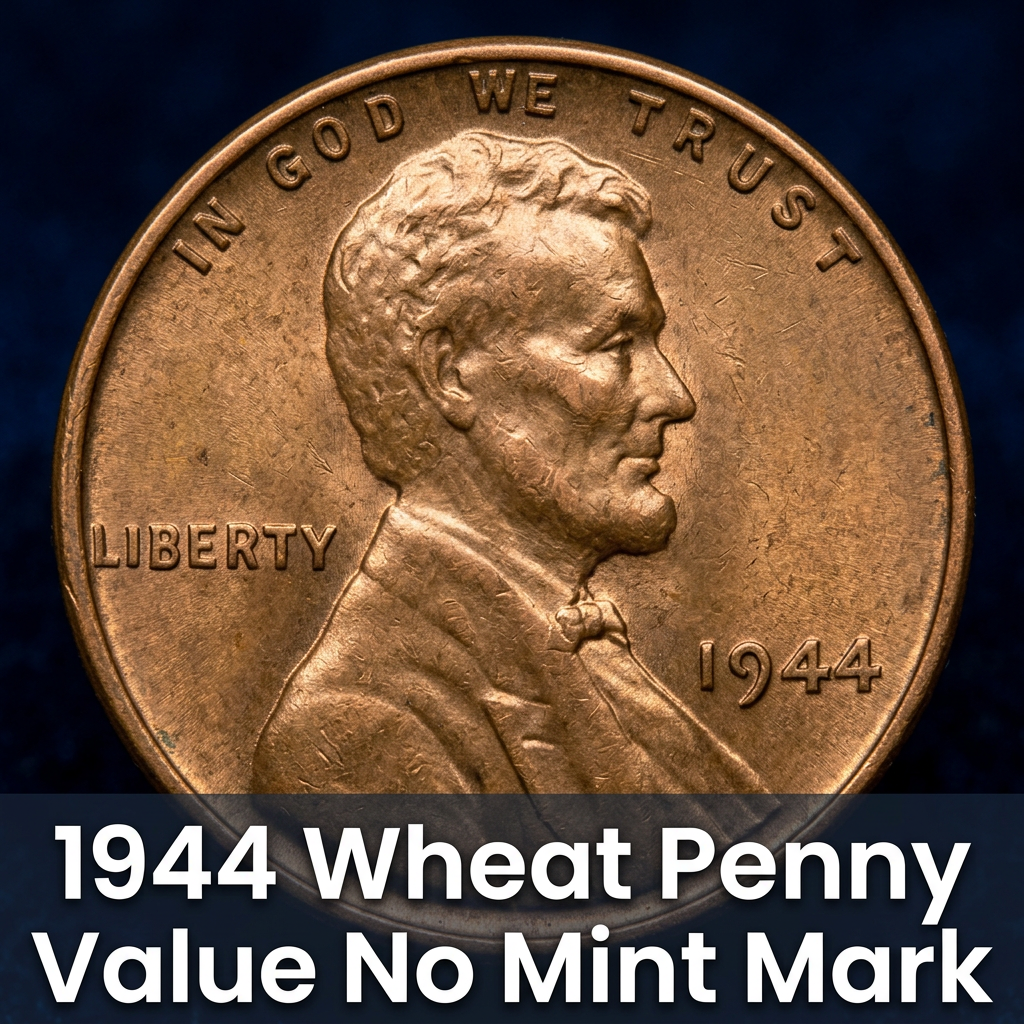
If you’ve come across a 1944 wheat penny with no mint mark, you’re probably wondering what it’s worth. The 1944 no mint mark wheat penny is worth anywhere from $0.10 in heavily worn condition to over $8 in uncirculated grades — and rare error versions can fetch hundreds or even thousands of dollars.
What Does “No Mint Mark” Mean on a 1944 Wheat Penny?
When a coin has no mint mark, it simply means it was struck at the Philadelphia Mint. During 1944, the Philadelphia Mint produced over one billion Lincoln wheat pennies — making it one of the most common dates in the entire wheat penny series.
So before you get too excited, know that the majority of 1944 no mint mark cents in average circulated condition are worth only a few cents to around a dime. But condition matters a lot. A coin that looks shiny, shows sharp details on Lincoln’s portrait, and hasn’t been cleaned or damaged can be worth significantly more.
If you’re not sure what condition your coin is in, you can use a free coin identifier app to get a quick read on your coin’s grade and approximate value. It’s a fast and easy way to get started without needing expert knowledge.
1944 Wheat Penny Value Chart by Grade
The value of a 1944 no mint mark wheat penny depends heavily on its grade. Here’s a simple breakdown to help you figure out what your coin might be worth:
| Grade | Description | Estimated Value |
|---|---|---|
| Good (G-4) | Heavy wear, outline visible | $0.10 – $0.25 |
| Fine (F-12) | Moderate wear, details clear | $0.25 – $0.50 |
| Extremely Fine (EF-40) | Light wear on high points | $0.75 – $1.50 |
| Uncirculated (MS-63) | No wear, minor marks | $3.00 – $5.00 |
| Gem Uncirculated (MS-65) | Sharp strike, strong luster | $6.00 – $8.00+ |
For more detailed 1944 wheat penny price data across all mint state grades, it’s worth checking a dedicated coin pricing resource to see real market values.
The Famous 1944 Steel Penny Error — Could You Have One?
Here’s where things get really exciting. In 1944, the U.S. Mint accidentally struck a small number of pennies on leftover steel planchets from 1943, instead of the copper planchets they were supposed to use.
These 1944 steel wheat pennies are among the most valuable Lincoln cents ever made. A genuine example can sell for anywhere from $75,000 to over $100,000 depending on condition.
How do you know if you have one? The easiest test is a magnet. A standard 1944 copper wheat penny will not stick to a magnet. If yours does, you may have an error coin worth having professionally evaluated. Be aware that fake 1944 steel cents exist — copper coins that have been plated — so professional authentication is essential.
You can use CoinHix to scan your coin and quickly identify whether the weight, color, and details match a genuine 1944 steel cent.
Other Value Factors for Your 1944 No Mint Mark Penny
Beyond grade and rare errors, a few other things can affect how much your 1944 wheat penny is worth.
Color designation plays a surprisingly big role. Uncirculated wheat pennies are graded not just by condition but by their surface color: Red (RD), Red-Brown (RB), or Brown (BN). A Red example means the original mint luster is still largely intact, and these coins command the highest premiums. A fully red MS-65 example is worth more than double a brown example in the same grade.
Strike quality matters too. Some 1944 cents were weakly struck, meaning details like Lincoln’s hair or the wheat stalks on the reverse look soft or flat. Well-struck coins are more desirable to collectors.
For a comprehensive look at what your 1944 wheat penny is worth based on grade and color, reviewing a detailed value guide is a smart move before buying or selling.
And if you want to check multiple coins quickly at home, CoinHix makes it simple — just snap a photo and get an instant identification and estimated value. It’s especially handy when you’re going through a jar of old coins.
Should You Hold On to Your 1944 Wheat Penny?
For most people, a worn 1944 Philadelphia wheat penny is a fun piece of history but not a retirement fund. That said, it’s always worth taking a closer look before tossing it aside.
Check the mint mark (or lack of one), test it with a magnet, assess the condition honestly, and note the color. Even a common date in exceptional condition can be a nice find. And if you have a coin that sticks to a magnet or shows unusual characteristics, take it seriously.
Use CoinHix or visit a local coin dealer to get a professional second opinion. The difference between a $0.25 coin and a $100,000 coin can come down to just one detail you almost overlooked.
FAQ
Q: Is a 1944 no mint mark wheat penny rare?
A: No, it’s actually one of the most common wheat pennies ever made. Over a billion were produced in Philadelphia in 1944. Most circulated examples are worth only a few cents to about a dollar, depending on condition.
Q: How do I tell if my 1944 penny is the valuable steel error?
A: Use a magnet. A genuine 1944 steel cent will stick to a magnet because it’s made from steel, not copper. If your coin does not stick, it’s almost certainly the standard copper version. If it does stick, have it authenticated by a professional grading service like PCGS or NGC.
Q: What is the most a 1944 wheat penny has ever sold for?
A: A 1944 steel wheat penny (the rare error coin) has sold for over $100,000 at auction. For standard 1944 copper wheat pennies with no mint mark, top-grade certified examples in MS-67 Red condition have sold for several hundred dollars at major coin auctions.