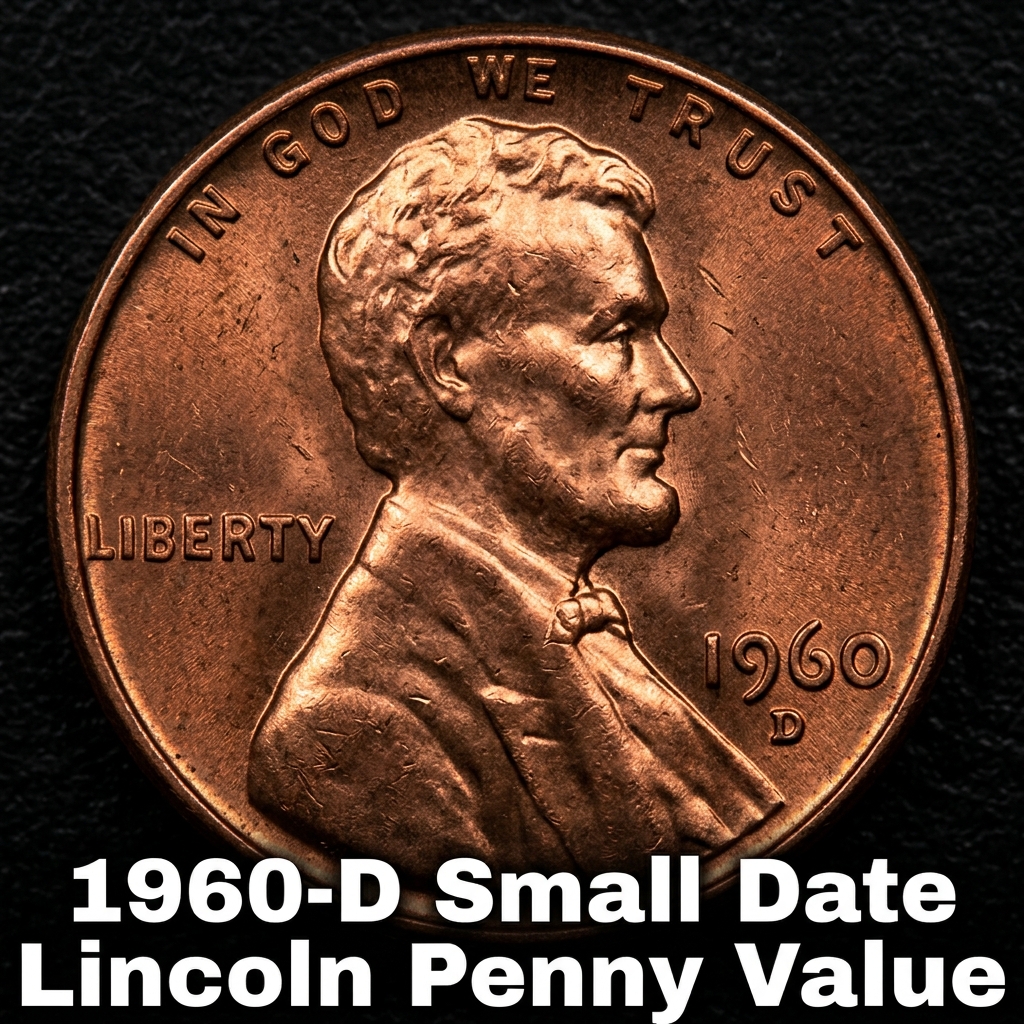
The 1960-D Small Date Lincoln Penny is worth anywhere from $0.25 in heavily worn condition to well over $100 or more in pristine, uncirculated grades — and in top mint state examples, it can reach into the hundreds. If you just found one of these coins in an old jar or inherited collection, you might be sitting on something worth a second look.
What Makes the 1960-D Small Date So Special?
Not all 1960 Lincoln pennies are created equal. The Denver Mint produced two distinct varieties that year — a Large Date and a Small Date — and the difference comes down to the size and style of the numerals on the coin’s obverse (the front side).
On the Small Date variety, the “6” in 1960 sits higher and appears slightly thinner compared to the Large Date version. The top of the “1” also looks more delicate and refined. These subtle differences might seem minor, but to collectors, they matter enormously.
The 1960-D Small Date is considered the scarcer of the two Denver varieties. While millions were still minted, far fewer survived in high-grade condition, which is what drives up the price for well-preserved examples. If you’re not sure which variety you have, a free coin identifier app can help you compare your coin against known examples in seconds.
How to Tell the Large Date from the Small Date
Identifying your coin correctly is the most important step before you try to sell or grade it. Grab a magnifying glass and look closely at the date on the front of the penny.
On the Small Date version, the top of the “9” curves more gently, and the overall numerals appear slightly smaller and more compact. The “6” doesn’t drop as far below the baseline as it does on the Large Date.
Some collectors hold two coins side by side under good lighting to compare. If you only have one coin, a high-resolution photo and a reference image from a coin guide will do the trick. CoinHix is a great tool for this — it lets you pull up side-by-side variety comparisons quickly and accurately.
1960-D Small Date Lincoln Penny Value by Grade
Here’s where it gets interesting. The condition (or “grade”) of your penny plays a huge role in determining value. A coin that’s been rattling around in someone’s pocket for decades is worth far less than one that’s been carefully stored since the day it was minted.
| Grade | Condition Description | Estimated Value |
|---|---|---|
| Good (G-4) | Heavy wear, details faded | $0.25 – $0.50 |
| Fine (F-12) | Moderate wear, main details visible | $0.50 – $1.00 |
| Extremely Fine (EF-40) | Light wear on high points only | $1.00 – $5.00 |
| MS-63 (Uncirculated) | No wear, some minor marks | $15 – $40 |
| MS-65 Red (Gem) | Bright original red luster, sharp strike | $60 – $150+ |
| MS-67 Red (Superb Gem) | Near-perfect, virtually flawless | $500+ |
For detailed current market prices on certified examples, you can check the latest auction and grading data for 1960 Lincoln pennies in MS Red grades to see how similar coins have recently sold.
What Condition Is Your Penny In?
Most pennies found in old coin jars or piggy banks fall into the “circulated” category — meaning they’ve been used as actual money and show wear. That typically means your 1960-D Small Date is worth face value to maybe a dollar or two.
But don’t toss it just yet. If the coin still has a bright reddish-orange color and sharp details with no scratches or dents, it might be uncirculated. These coins were often saved by collectors shortly after they were minted.
Collectors classify copper Lincoln pennies by color: Red (RD), Red-Brown (RB), and Brown (BN). A full Red designation means the coin has retained its original mint luster, which significantly increases its value. CoinHix can help you identify the color designation and compare your coin’s appearance to graded examples.
Should You Get It Graded?
If your 1960-D Small Date penny looks sharp and still has its original red color, professional grading from PCGS or NGC could be worth the investment. A certified MS-65 Red example is far more sellable and often fetches two to three times what a raw (ungraded) coin would bring.
Grading fees typically start around $20–$40 per coin, so it only makes sense if you believe your penny has real mint-state potential. Before spending the money, do your homework. You can explore a complete breakdown of 1960 penny values across all grades and varieties to help you decide whether grading is worth it for your specific coin.
If you’re still unsure about the variety or condition, download CoinHix and use its coin lookup and comparison features to get a clearer picture before making any decisions.
—
FAQ
Q: How do I know if my 1960-D penny is the Small Date variety?
A: Look at the numerals in the date with a magnifying glass. On the Small Date, the numbers appear slightly smaller and more compact, and the “6” sits higher relative to the other digits. Comparing your coin to reference images online or using a coin identification app makes this much easier.
Q: Is the 1960-D Small Date penny rare?
A: It’s not extremely rare in circulated grades, but it is scarcer than the Large Date version and significantly harder to find in high mint state condition with full Red luster. That’s where the real collector value lies.
Q: Where is the best place to sell a 1960-D Small Date Lincoln penny?
A: For circulated examples, local coin shops or online marketplaces like eBay work fine. For uncirculated or high-grade coins, consider getting it certified first and then selling through a reputable coin auction house or dealer who specializes in Lincoln cents.