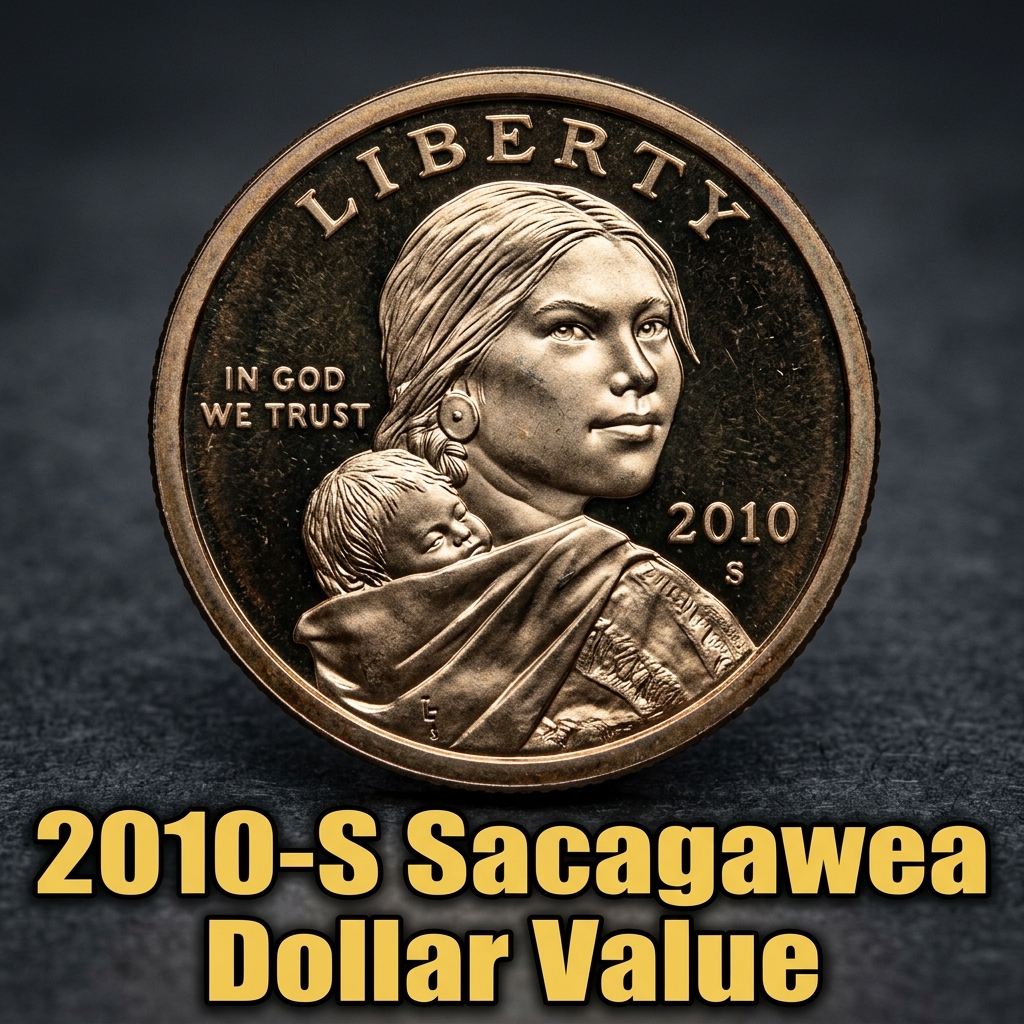
The 2010-S Sacagawea Dollar is worth anywhere from $3 to $15 for most examples, with top-grade Proof 70 Deep Cameo coins selling for $50 or more to serious collectors. If you found one of these golden dollars in a collection or old box, you’re in the right place — let’s break down exactly what it’s worth and why.
What Makes the 2010-S Sacagawea Dollar Different
The 2010-S Sacagawea Dollar was struck at the San Francisco Mint specifically for collectors. Unlike the Philadelphia and Denver versions made for general circulation, the “S” mint mark tells you this coin was produced as a Proof coin — meaning it was made with specially polished dies and planchets to give it that mirror-like finish you might notice on the surface.
These coins were sold directly by the U.S. Mint in annual Proof sets and were never intended to be used as everyday pocket change. That’s actually a good thing for value, because it means most surviving examples are in excellent condition.
The 2010 design also carries special meaning. That year, the reverse of the Sacagawea Dollar featured a Native American woman planting crops — part of the ongoing “Native American Dollar” series honoring the contributions of Native Americans to the United States. So beyond the gold-colored appeal, there’s genuine historical significance packed into this small coin.
If you’re not sure which version you have or want a fast answer, a free coin identifier app can help you confirm the mint mark and condition in seconds using your phone’s camera.
2010-S Sacagawea Dollar Value by Grade
The value of your 2010-S Sacagawea Dollar depends heavily on its grade — that is, how well-preserved it is. Proof coins are graded on a scale from PR60 to PR70, with PR70 Deep Cameo (DCAM) being perfect.
Here’s a general value breakdown:
| Grade | Description | Estimated Value |
|---|---|---|
| PR63 DCAM | Minor contact marks, nice contrast | $3 – $5 |
| PR65 DCAM | Strong cameo, few blemishes | $6 – $10 |
| PR67 DCAM | Nearly perfect, high eye appeal | $10 – $18 |
| PR69 DCAM | Exceptional, nearly flawless | $20 – $35 |
| PR70 DCAM | Perfect in every way | $50 – $100+ |
For the most current market prices, you can check live auction data for the 2010 Sacagawea Dollar across recent sales to see what buyers are actually paying right now.
CoinHix is a great tool for tracking real-time coin prices if you want to stay updated without digging through auction archives manually.
How to Tell If Your 2010-S Dollar Is Valuable
First things first — check that mint mark. Flip the coin over and look at the edge or just below the date on the obverse. You should see a small “S” if it’s a San Francisco Proof issue.
Next, look at the surfaces under a good light source. Proof coins should have deeply frosted raised design elements (the portrait of Sacagawea and the baby she carries) against a brilliantly mirrored flat background. This contrast is called “Deep Cameo” and is a big factor in value.
Avoid touching the surfaces with bare fingers — skin oils can leave permanent haze marks that reduce a coin’s grade significantly. If yours is still in the original Mint packaging or a hard plastic holder, keep it there.
A coin that shows heavy hairlines, haze, or spotting will grade lower and bring in less money. But even a lightly handled PR63 example is still worth a few dollars above face value, which is better than spending it at a vending machine.
How Many Were Minted and Why That Matters
The U.S. Mint produced approximately 1,689,216 of the 2010-S Sacagawea Dollars. That might sound like a lot, but compared to the hundreds of millions of business-strike dollars made for circulation, it’s actually a relatively limited mintage.
Lower mintages can support higher values over time, especially as coins get lost, damaged, or dispersed into collections around the world. The coins that survive in top grades become increasingly scarce and tend to hold their value or even appreciate as years pass.
If you have a full 2010 Proof Set still sealed in its original Mint packaging, that context adds appeal to buyers as well. Sets in original packaging often command a small premium over raw coins.
For a detailed breakdown of what the 2010 Sacagawea Dollar is worth across all grades and conditions, that resource gives a thorough look at the numbers collectors care about.
You can also use CoinHix to quickly compare your coin against recent sold listings so you’re never guessing when it comes time to sell or insure your collection.
Should You Have It Graded?
If your 2010-S Sacagawea Dollar looks absolutely flawless — mirror surfaces, no spots, no fingerprints, crisp cameo contrast — it might be worth submitting to a third-party grading service like PCGS or NGC. A PR70 DCAM holder from a top grader can push the value into the $50–$100 range, which more than covers the grading fee.
However, for coins that are just “nice” but not perfect, grading costs usually aren’t worth it. A PR65 coin graded by a top service might bring $8 to $10 — but grading could cost you $20 or more per coin. In those cases, selling raw or as part of a Proof Set makes more financial sense.
CoinHix can help you evaluate whether grading is worth the investment based on current market data before you spend any money on fees.
—
FAQ
Q: Is the 2010-S Sacagawea Dollar rare?
A: Not especially rare, but it has a modest collector mintage of about 1.69 million. Most examples are common in lower Proof grades, but pristine PR70 Deep Cameo coins are harder to find and worth significantly more.
Q: Can I spend my 2010-S Sacagawea Dollar as regular money?
A: Technically yes — it’s legal tender worth $1. But since most examples are worth at least $3–$5 to collectors (and much more in top grades), spending it would mean losing that premium. It’s better to sell it to a coin dealer or through an online marketplace.
Q: Where is the mint mark on the 2010-S Sacagawea Dollar?
A: Look at the obverse (front) of the coin near the date. The “S” mint mark should appear just to the right of the year, confirming it was struck at the San Francisco Mint as a Proof coin.