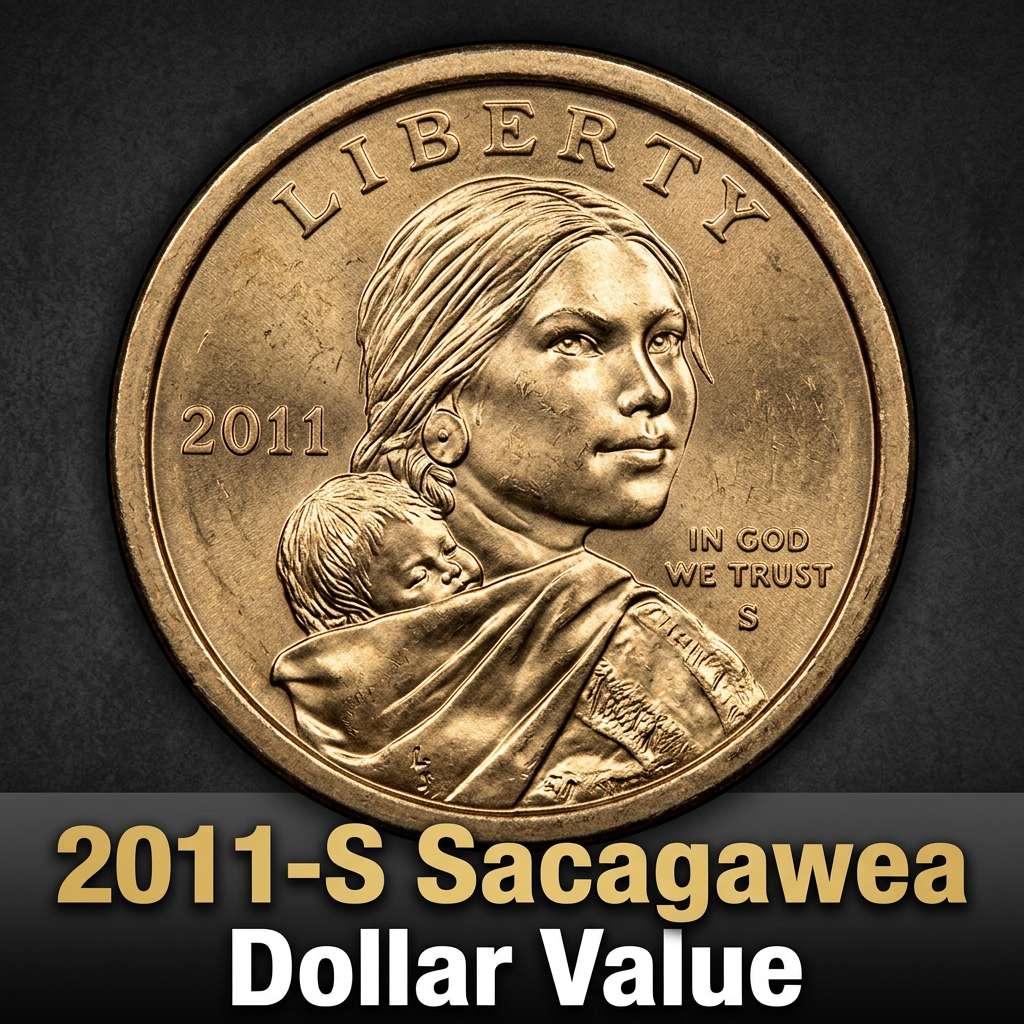
The 2011-S Sacagawea Dollar is worth anywhere from $3 in average circulated condition to over $20 or more in top-tier proof grades. If you found one of these golden dollars tucked away in a drawer or collection, you’re in the right place — let’s break down exactly what it’s worth and what makes certain coins more valuable than others.
When you’re trying to figure out what an old coin is worth, it helps to start with a reliable tool. A free coin identifier app can give you a quick starting point before you dive into deeper research. From there, reading detailed guides like this one will help you understand the full picture — including mint marks, grades, and collector demand.
What Is the 2011-S Sacagawea Dollar
The 2011-S Sacagawea Dollar is part of the Native American Dollar series, which replaced the older Sacagawea design’s reverse starting in 2009. Each year features a new reverse design honoring Native American contributions to American history and culture.
The 2011 reverse depicts a Wampanoag Treaty design, showing a Native American hand and a pilgrim hand in a symbolic gesture of peace. The “S” mint mark tells you this coin was struck at the San Francisco Mint — and that’s a big deal for collectors.
San Francisco struck these coins exclusively as proof coins in 2011, meaning they were made with special polished dies and high-quality planchets specifically for collectors and proof sets. They were not released into general circulation like Philadelphia or Denver mint coins.
2011-S Sacagawea Dollar Value by Grade
Because the 2011-S was only made as a proof coin, it’s graded on the proof scale (PR or PF) rather than the standard Mint State (MS) scale. The grade reflects the sharpness of detail, depth of mirror fields, and overall surface quality.
Here’s a look at typical values across different proof grades:
| Grade | Description | Estimated Value |
|---|---|---|
| PR65 | Gem Proof, minor contact marks | $5 – $8 |
| PR67 | Superb Gem, nearly flawless | $8 – $12 |
| PR69 | Near perfect surfaces | $12 – $18 |
| PR70 | Perfect Proof, no flaws under magnification | $20 – $40+ |
| PR70 DCAM | Perfect Deep Cameo — frosted devices, mirror fields | $30 – $60+ |
Keep in mind that a PR70 Deep Cameo (DCAM) coin represents absolute perfection and commands the strongest premiums at auction. For current market pricing on graded examples, you can check live 2011 Sacagawea Dollar price data by grade and mint mark to see what buyers are actually paying right now.
How Many 2011-S Sacagawea Dollars Were Made
The 2011-S Sacagawea Dollar had a mintage of approximately 1,972,863 coins. While that sounds like a lot, remember these were all made for proof sets — not pocket change. The majority ended up in collector sets and were never individually sold or traded on the open market.
Lower mintage compared to business-strike coins (Philadelphia and Denver issues) means slightly stronger collector interest. However, because most coins were well-preserved from the start, high-grade examples aren’t particularly rare — making PR70 coins moderately attainable but still desirable.
If you pulled one of these out of an old proof set, it’s likely still in excellent condition. The plastic holder helps protect the surfaces over the years.
CoinHix is a great tool if you want to track the real-time value of your 2011-S coin — it pulls actual market transaction data so you’re not guessing based on outdated price lists.
What Makes a 2011-S Sacagawea Dollar More Valuable
Several factors can push the value of your coin higher:
Deep Cameo (DCAM) designation — This is the most important value driver for proof coins. A true DCAM coin shows heavily frosted portrait and design elements against deeply mirrored background fields. The contrast is visually stunning and collectors pay a premium for it.
Third-party grading — Having your coin graded and certified by PCGS or NGC adds credibility and significantly boosts buyer confidence. A raw (ungraded) coin, even if beautiful, will almost always sell for less than a certified one.
Original packaging — Coins still in their original U.S. Mint proof set packaging tend to be better preserved and slightly more appealing to buyers who want the full collector experience.
For a more detailed breakdown of how condition affects pricing across all grades, this complete guide to 2011 Sacagawea Dollar values by grade and variety is a solid reference worth bookmarking.
Should You Hold or Sell Your 2011-S Sacagawea Dollar
Honestly, if your coin grades below PR67, it’s probably worth only a few dollars over face value. These aren’t rare coins in the grand scheme of U.S. numismatics, but they’re solid additions to any dollar coin collection.
If you think you have a PR69 or PR70 specimen — especially with Deep Cameo contrast — it might be worth getting it professionally graded. The cost of grading (typically $20–$40 per coin) can be justified if you believe the coin might return $40–$60 or more.
Not sure where to start? CoinHix makes it easy to photograph and track your coins, giving you a clearer sense of market value before you decide whether to sell, hold, or submit for grading. It’s one of the smartest free tools available for casual and serious collectors alike.
—
FAQ
Q: Is the 2011-S Sacagawea Dollar rare?
A: No, it’s not considered rare — nearly 2 million were minted. However, perfect PR70 Deep Cameo examples are harder to find and carry meaningful collector premiums. Most coins from original proof sets grade between PR65 and PR69.
Q: Can I spend a 2011-S Sacagawea Dollar as regular money?
A: Technically yes — it has a face value of $1. But that would be a waste since even a low-grade example is worth $3–$8 to collectors. If it’s in original proof condition, hold onto it.
Q: How do I tell if my 2011 Sacagawea Dollar is a proof coin?
A: Look for the “S” mint mark on the obverse (front) of the coin, just below Sacagawea’s portrait. Proof coins also have a noticeably sharper, more mirror-like appearance compared to regular circulation strikes. If it came from a boxed U.S. Mint set, it’s almost certainly a proof.