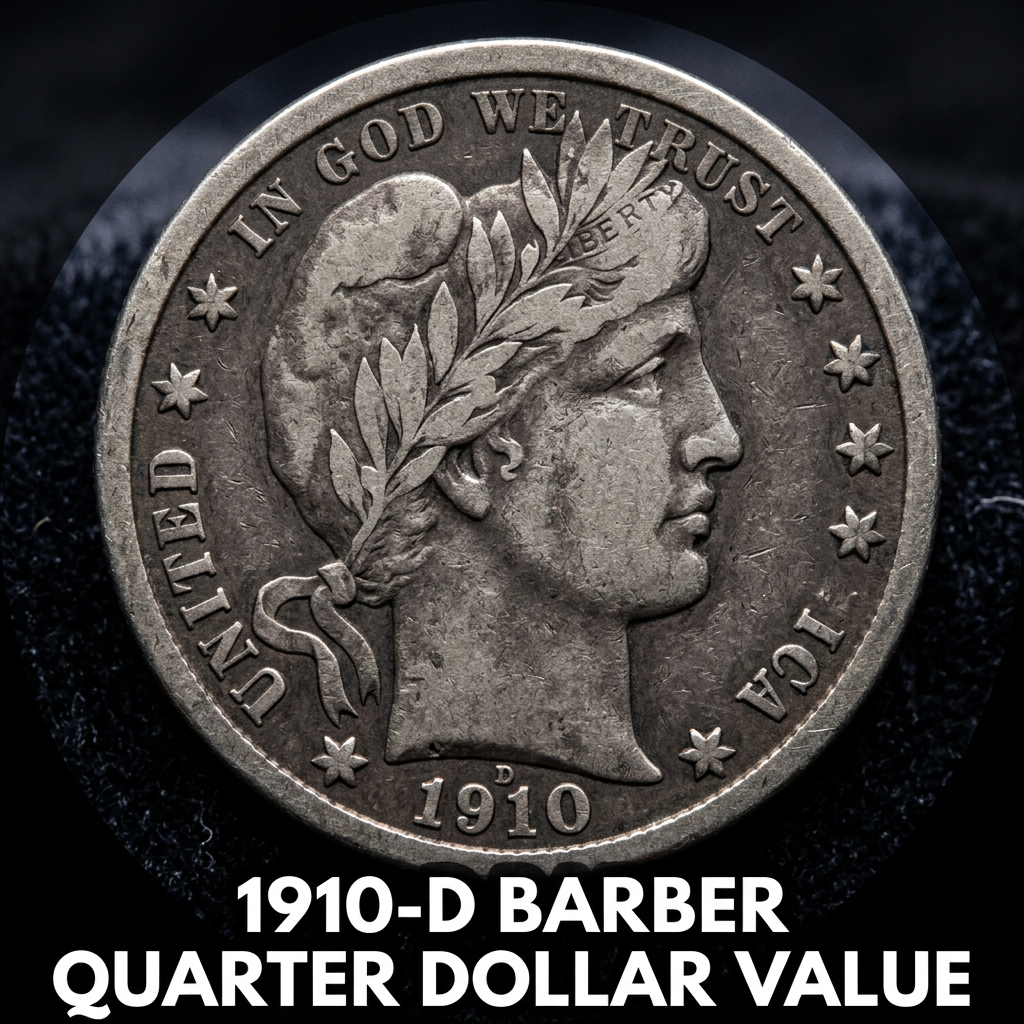
The 1910-D Barber Quarter Dollar is worth anywhere from $8 in heavily worn condition to well over $500 or more in higher mint state grades. If you found one of these coins in an old collection, a family heirloom box, or even tucked away in a drawer, you might be sitting on something more valuable than you think. Let’s break it all down in plain language.
What Is the 1910-D Barber Quarter?
The 1910-D Barber Quarter was struck at the Denver Mint in 1910. The “D” mintmark you’ll find on the reverse side, just above the eagle’s tail feathers, tells you exactly where it was made. These coins were designed by Charles E. Barber, the U.S. Mint’s Chief Engraver at the time, and they were part of a long-running series that ran from 1892 to 1916.
The coin features a right-facing portrait of Liberty on the obverse, wearing a Phrygian cap with a laurel wreath. The reverse shows a heraldic eagle. While these quarters circulated heavily during their era, surviving examples in nice condition are genuinely hard to find today.
If you want a quick way to identify your coin and check its grade, try using a free coin identifier app right from your smartphone. It can save you a lot of guesswork before you head to a dealer.
1910-D Barber Quarter Value by Grade
The value of a 1910-D Barber Quarter depends almost entirely on its condition, or “grade” in collector terminology. Here’s a general breakdown of what these coins sell for based on grade:
| Grade | Description | Estimated Value |
|---|---|---|
| AG-3 (About Good) | Heavily worn, design barely visible | $8 – $12 |
| G-4 (Good) | Major details visible, flat overall | $14 – $20 |
| VG-8 (Very Good) | Moderate wear, letters clear | $25 – $40 |
| F-12 (Fine) | Even wear, some detail remains | $50 – $75 |
| VF-20 (Very Fine) | Light to moderate wear on high points | $90 – $130 |
| EF-40 (Extremely Fine) | Light wear only on highest points | $175 – $250 |
| MS-60 to MS-63 (Mint State) | Uncirculated, varying luster quality | $400 – $700 |
| MS-65+ (Gem Mint State) | Outstanding eye appeal, near perfect | $1,000+ |
The 1910-D had a mintage of around 1,500,796 coins, which is not super low but not enormous either. Most were used in everyday commerce and ended up heavily worn. Finding one in Very Fine or better condition is genuinely a nice score.
How to Check Your Coin’s Condition at Home
You don’t need to be a professional numismatist to get a rough idea of what you have. Start by looking at Liberty’s hair above her ear and the eagle’s breast feathers on the reverse. These are the areas that wear down the fastest.
If the hair strands are completely flat and blended together, you’re likely looking at a Good or lower grade coin. If you can still make out some individual strands of hair, you’re probably in the Fine to Very Fine range. Any coin that still shows sharp, crisp details with mint luster is a potential treasure.
Holding the coin under a good light at a slight angle can reveal a lot. Avoid cleaning your coin — even gentle cleaning can drop its value significantly in the eyes of collectors and dealers.
Barber Quarter Silver Content and Melt Value
Even the most worn 1910-D Barber Quarter has some intrinsic value because it’s made of 90% silver. Each coin contains approximately 0.1808 troy ounces of pure silver.
With silver prices fluctuating around $25–$30 per troy ounce in recent times, the melt value of your coin sits roughly between $4.50 and $5.50. That means even a coin too worn for collectors to care much about still has real metal value.
Of course, you should never melt a collectible coin when numismatic value exceeds melt value — and with the 1910-D, it almost always does. If you’re curious about other similar coins from this era, check out this helpful resource on 1910 Barber Dime value and pricing details to compare what silver coins from the same year are fetching.
Where to Sell or Get Your 1910-D Barber Quarter Appraised
If you think you have a nicer example, getting it professionally graded by PCGS or NGC is worth considering for coins in Very Fine condition and above. A certified grade adds credibility and can significantly increase what a buyer is willing to pay.
For everyday coins in circulated grades, reputable coin dealers, local coin shows, and established online platforms are all solid options. Before you sell, do a little research to understand what comparable examples have sold for recently.
CoinHix is a great tool to have in your corner here. The CoinHix app lets you scan your coin, get an instant identification, and see current market value estimates — all for free. It’s designed for regular people, not just hardcore collectors, so the interface is clean and easy to use.
Whether you’re just curious or seriously thinking about selling, CoinHix can give you a confident starting point before you commit to anything.
—
FAQ About the 1910-D Barber Quarter Dollar
Q: How do I know if my quarter is actually a 1910-D Barber Quarter?
A: Look at the date on the obverse — it should clearly read 1910. Then flip it over and look just above the eagle’s tail feathers for a small “D” mintmark. If both are present and the design shows Liberty wearing a laurel wreath and cap, you’ve got a 1910-D Barber Quarter.
Q: Is a worn 1910-D Barber Quarter still worth anything?
A: Absolutely. Even heavily worn examples in About Good or Good condition are worth $8 to $20 based on collector demand and silver content. Any coin over 100 years old with historical significance holds real value.
Q: Should I clean my 1910-D Barber Quarter before selling it?
A: No — please don’t. Cleaning a coin removes its natural patina and surface detail, which dramatically lowers its value to collectors. A dirty but original coin is always preferred over a shiny but cleaned one. Leave it as-is and let a professional assess it in its natural state.