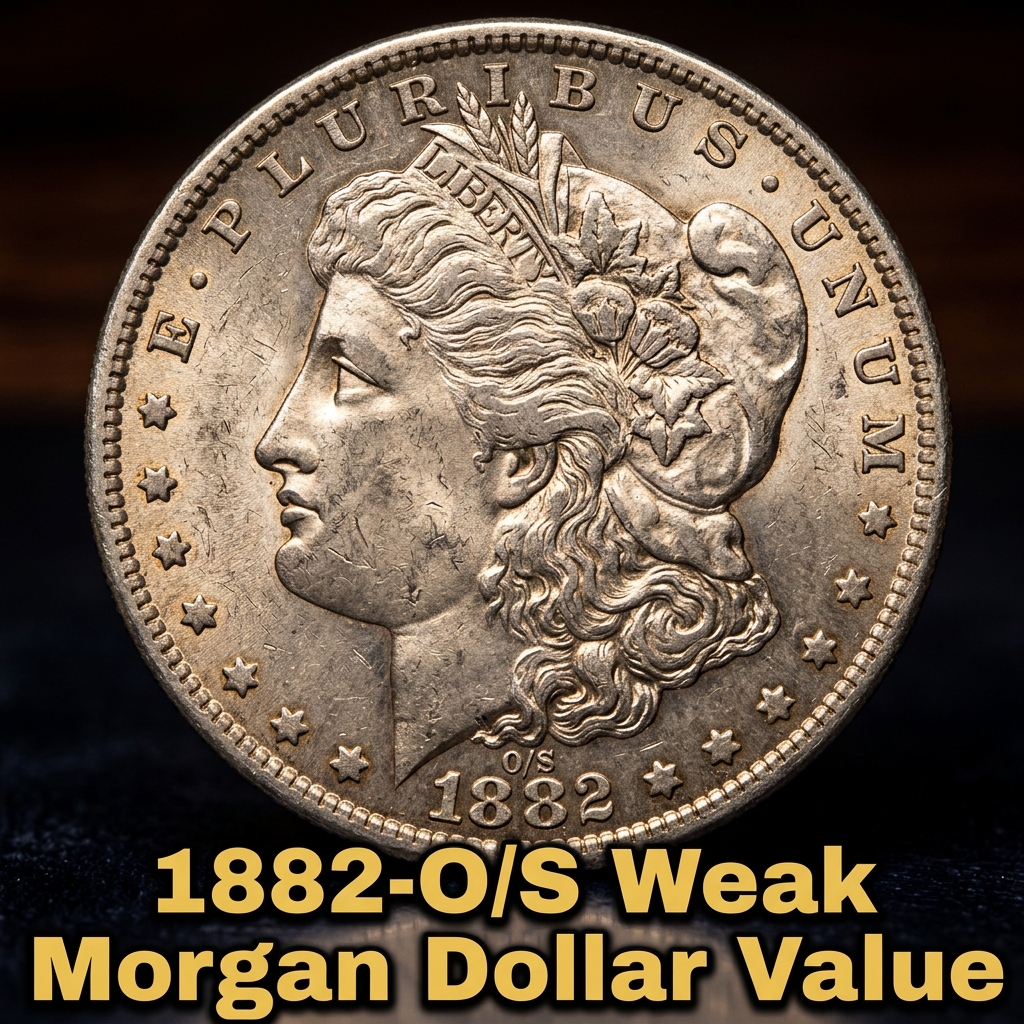
The 1882-O/S Weak Morgan Dollar is worth anywhere from $30 in heavily worn condition to well over $300 in higher mint state grades — and certain certified examples have sold for thousands at auction. If you recently found one of these silver dollars in a collection or old family box, you may be sitting on something genuinely special.
What Makes the 1882-O/S Weak Different From a Regular Morgan Dollar
The 1882-O/S Weak is what’s called an overmintmark variety. That means the New Orleans mint punched an “S” mintmark into the die first — likely a leftover San Francisco die — and then punched an “O” mintmark on top of it. The result is a coin where, if you look closely, you can still see traces of the “S” hiding beneath the “O.”
The “Weak” part of the name refers to how faint those traces are. On the stronger O/S variety, the underlying “S” is very obvious. On the Weak version, it takes a bit more attention — and sometimes a magnifying glass — to spot it clearly.
This kind of variety is popular with collectors because it tells a real story about how the mint operated in the 1880s. Using a free coin identifier app can help you quickly check whether your coin matches this specific variety before assuming it’s just a common 1882-O Morgan Dollar.
How to Identify the 1882-O/S Weak on Your Coin
Identifying this coin starts with the mintmark on the reverse side — the side showing the eagle. Look just below the bow of the wreath, and you’ll see either an “O” or an “S.” On the 1882-O/S Weak, you’re looking for an “O” that has a faint ghost of an “S” beneath it.
Use a 5x to 10x magnifier if you have one. The “S” shape will appear as a slightly wider or misshapen letter peeking out from behind the “O.” On the Weak variety specifically, the remnants of the “S” are subtle — look for a slight serif or curved line that doesn’t quite match the round shape of a standard “O.”
If you’re unsure, CoinHix makes it easy to scan your coin and compare it against known varieties in their database. This is especially helpful for Morgan Dollar varieties, where small differences in mintmarks can mean a big jump in value.
1882-O/S Weak Morgan Dollar Value by Grade
The value of this coin rises significantly as the grade improves. A worn example in Good (G-4) condition might fetch around $30–$50, mostly for its silver content plus a small variety premium. Once you get into Extremely Fine (EF-40) territory, values jump noticeably. In uncirculated grades, certified coins become much more desirable to serious collectors.
Here’s a general value guide based on current market trends:
| Grade | Estimated Value | Notes |
|---|---|---|
| Good (G-4) | $30 – $50 | Heavy wear, variety still identifiable |
| Very Fine (VF-20) | $65 – $110 | Moderate wear, clear detail on eagle |
| Extremely Fine (EF-40) | $130 – $200 | Light wear only on high points |
| About Uncirculated (AU-55) | $200 – $300 | Slight wear, strong luster visible |
| Mint State (MS-63+) | $350 – $1,000+ | Fully uncirculated, certified examples command top prices |
For the most up-to-date auction results and dealer pricing, you can check 1882 Morgan Dollar price data across mint state grades to see how the market is currently trending for this coin and its close relatives.
Should You Get It Certified
If your coin appears to be in Very Fine condition or better, getting it certified by PCGS or NGC is worth considering. Certification not only confirms the grade but also officially attributes the variety — meaning the label will actually say “O/S Weak,” which adds credibility and can significantly boost resale value.
Dealers and serious collectors are much more willing to pay top dollar for a certified overmintmark variety versus one that’s raw. The cost of grading typically ranges from $30 to $65 depending on the service tier, so it makes financial sense once the coin is worth $100 or more.
Not sure how to get started? CoinHix walks users through the certification process step by step and helps you decide whether it’s worth submitting based on your coin’s estimated grade.
Where to Sell the 1882-O/S Weak Morgan Dollar
If you’ve confirmed what you have and want to sell, you have several solid options. Online platforms like eBay, Heritage Auctions, and Great Collections are all popular choices for Morgan Dollar varieties. Coin shows are another great venue, especially if your coin is certified.
You can also visit a local coin dealer for a quick appraisal — just know that dealers typically offer 60–80% of retail value since they need to make a margin on resale. For a more complete look at what your 1882 silver dollar might be worth before you walk into any shop, reviewing detailed 1882 silver dollar value breakdowns by grade and variety will give you a confident starting point in any negotiation.
Using CoinHix to scan comparable recent sales can also help you set realistic expectations and avoid leaving money on the table.
—
FAQ
Q: How do I know if my 1882-O Morgan Dollar is the O/S Weak variety?
A: Look at the mintmark on the reverse under magnification. If you can see a faint “S” shape beneath the “O,” it’s likely the O/S variety. The Weak version has subtler traces than the stronger O/S. A coin identification app or professional dealer can help confirm it.
Q: Is the 1882-O/S Weak rarer than a regular 1882-O Morgan Dollar?
A: Yes, it’s considered a variety coin and is significantly less common than a standard 1882-O. Collectors specifically seek out overmintmark varieties, which adds a premium to its value beyond the base silver content.
Q: Does silver content affect the value of the 1882-O/S Weak?
A: Yes, but only as a floor. Each Morgan Dollar contains about 0.7734 troy ounces of silver, so the coin’s melt value provides a baseline. However, the variety premium — especially in higher grades — far exceeds the silver value alone, making it important to assess the full numismatic value before selling.