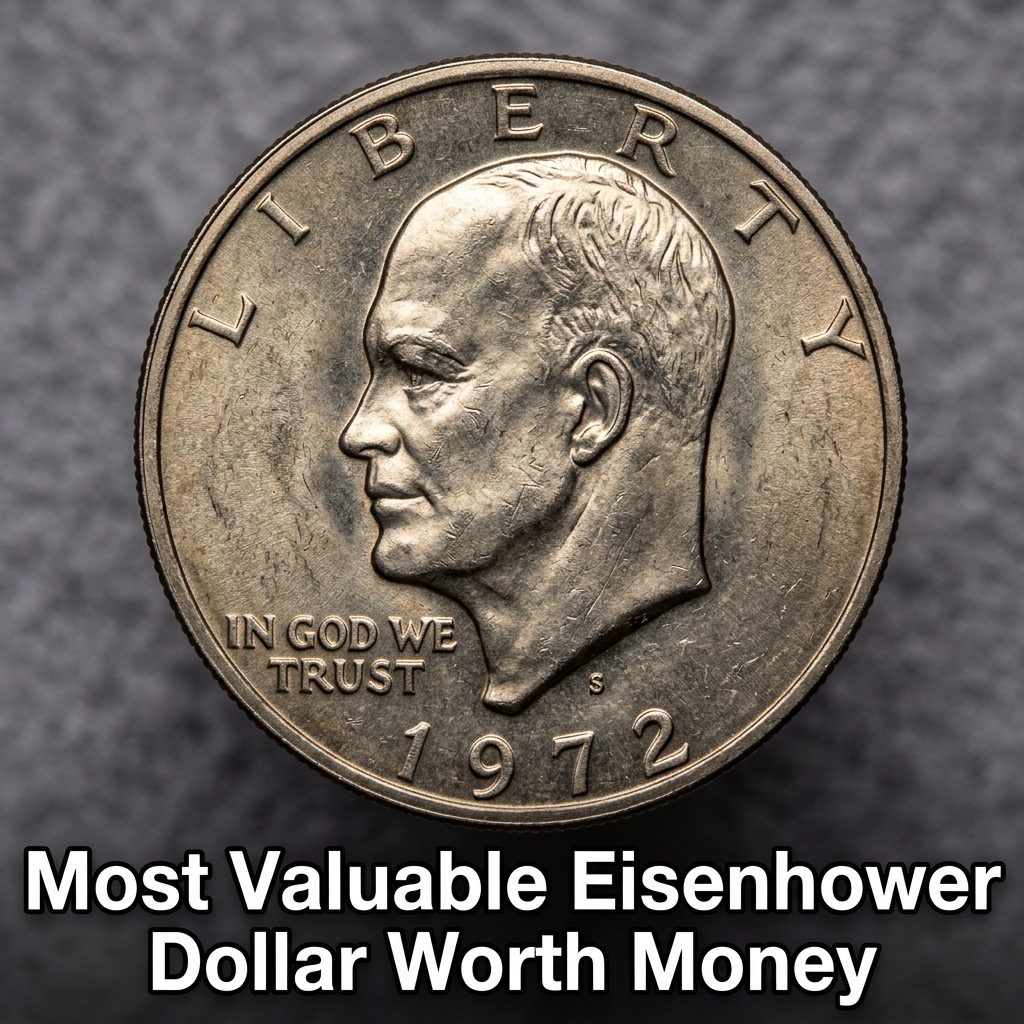
The Eisenhower Dollar is worth anywhere from $1 in well-worn condition to over $15,000 or more for rare mint-state specimens. If you’ve got one of these big silver-dollar coins sitting in a drawer or inherited from a relative, you might be holding onto more than pocket change — and this guide will help you figure out exactly what you’ve got.
If you’re just getting started and want a fast answer, the easiest move is to download a free coin identifier app and snap a photo of your coin. You’ll get an instant estimate before diving deeper into the details. From there, this article will walk you through which Eisenhower Dollars are truly valuable, what makes them rare, and how to tell the difference between a common coin and a hidden gem.
What Is an Eisenhower Dollar and Why Does It Matter
The Eisenhower Dollar was minted from 1971 to 1978, honoring President Dwight D. Eisenhower. It was the first large dollar coin issued by the U.S. Mint since the Peace Dollar of 1935, and it brought back that classic, hefty feel of old-school American currency.
Most of these coins were made of copper-nickel clad, but special collector versions were struck in 40% silver. That difference alone can change a coin’s value dramatically — a common 1971 clad dollar might be worth just $1 to $3 in circulated condition, while a silver-clad proof version can easily fetch $20 to $50 or more.
The coins were produced at three mints: Philadelphia (no mint mark), Denver (D), and San Francisco (S). San Francisco issues — especially the silver ones — tend to be the most sought-after by collectors today.
Most Valuable Eisenhower Dollars Worth Real Money
Not all Eisenhower Dollars are created equal. A few key dates and varieties stand out as the ones actually worth serious money. The 1972 Type 2 Reverse is one of the most famous varieties — it was struck using a Proof die by mistake and is quite rare in circulation. High-grade examples have sold for thousands of dollars.
The 1973-S Silver Proof and 1974-S Silver Proof are also popular with collectors. These were sold directly to collectors by the Mint in special packaging, and in pristine condition they can bring $30 to $80 or more depending on the grade.
For the absolute top values, check out a detailed breakdown of rare Eisenhower dollar values by date and variety — it covers all the key dates you should watch for and what each one is realistically worth today.
| Coin | Mint Mark | Type | Estimated Value |
|---|---|---|---|
| 1971-S Silver Uncirculated | S | 40% Silver | $15 – $40 |
| 1972 Type 2 Reverse | None (Philly) | Clad / Variety | $50 – $3,000+ |
| 1973-S Silver Proof | S | 40% Silver Proof | $25 – $80 |
| 1974-S Silver Proof | S | 40% Silver Proof | $20 – $70 |
| 1976-S Silver Proof (Bicentennial) | S | 40% Silver Proof | $20 – $60 |
| 1977-D MS66+ | D | Clad / High Grade | $200 – $1,500+ |
| 1978-D MS66+ | D | Clad / High Grade | $150 – $800+ |
How Condition and Grade Affect Eisenhower Dollar Prices
Here’s the thing most people miss: coin condition makes an enormous difference in value. A 1972-D Eisenhower Dollar in average circulated condition might be worth $1 to $2. The exact same coin in MS65 (Mint State 65) grade? Easily $50 to $150 or more.
Grading uses a 70-point scale. Coins graded MS60 to MS65 are uncirculated but may have minor marks. MS66 and above are where the big money lives — the surfaces must be nearly perfect with outstanding luster and no visible contact marks.
If you want to see up-to-date Eisenhower Dollar price data by grade and year, including MS values for the 1971 issue, that’s a great place to understand exactly how grade translates into dollars.
For coins you think might be in high grade, getting them professionally certified by PCGS or NGC is worth the cost — it protects your investment and makes the coin much easier to sell.
How to Check Your Eisenhower Dollar Value at Home
Start by looking at the mint mark on the reverse (back) of the coin, just above the word DOLLAR, near the eagle’s tail. No mark means Philadelphia; D means Denver; S means San Francisco.
Next, check the edge. If it shows alternating silver and copper layers, it’s clad. If the edge looks consistently silver-colored, it might be 40% silver — weigh it if you can. A silver Ike weighs about 24.59 grams vs. 22.68 grams for clad.
Then, use CoinHix to look up your specific date, mint mark, and condition. CoinHix pulls real market data so you’re not guessing — you’re seeing what coins like yours actually sold for recently. It’s one of the fastest ways to go from “I wonder if this is worth anything” to a real dollar estimate.
Should You Clean or Sell Your Eisenhower Dollar
Please don’t clean your coin — ever. Even gentle cleaning destroys the original mint luster that collectors pay a premium for. A cleaned MS65 coin can drop to a fraction of its uncleaned value almost instantly.
If you think you have a high-value coin, your best path is to use CoinHix to get a value estimate, then consider submitting the coin to PCGS or NGC for grading. Once graded and slabbed, you can list it on eBay, sell it through a coin dealer, or auction it at a major numismatic auction house.
For common circulated Eisenhower Dollars, they’re worth face value or just slightly over. But don’t dismiss them too quickly — the 1972 Type 2 and silver S-mint coins are easy to overlook and can be genuinely valuable.
—
Frequently Asked Questions
Q: How do I know if my Eisenhower Dollar is silver?
A: Check the edge of the coin. A 40% silver Eisenhower Dollar will look uniformly silver along the edge, while a clad coin will show a reddish-copper layer sandwiched in the middle. You can also weigh it — silver Ikes are slightly heavier at 24.59 grams.
Q: What is the most valuable Eisenhower Dollar ever sold?
A: The 1972 Type 2 Reverse is among the most valuable in high grades, with certified MS65 and above examples selling for thousands of dollars at major auctions. Extremely high-grade clad specimens from any year can also surprise sellers with strong bids.
Q: Is it worth getting my Eisenhower Dollar graded by PCGS or NGC?
A: It depends on the coin. For common dates in circulated condition, grading fees won’t pay off. But for potential high-grade coins (MS65+), silver varieties, or key-date pieces, professional grading can significantly increase the coin’s verified value and marketability.