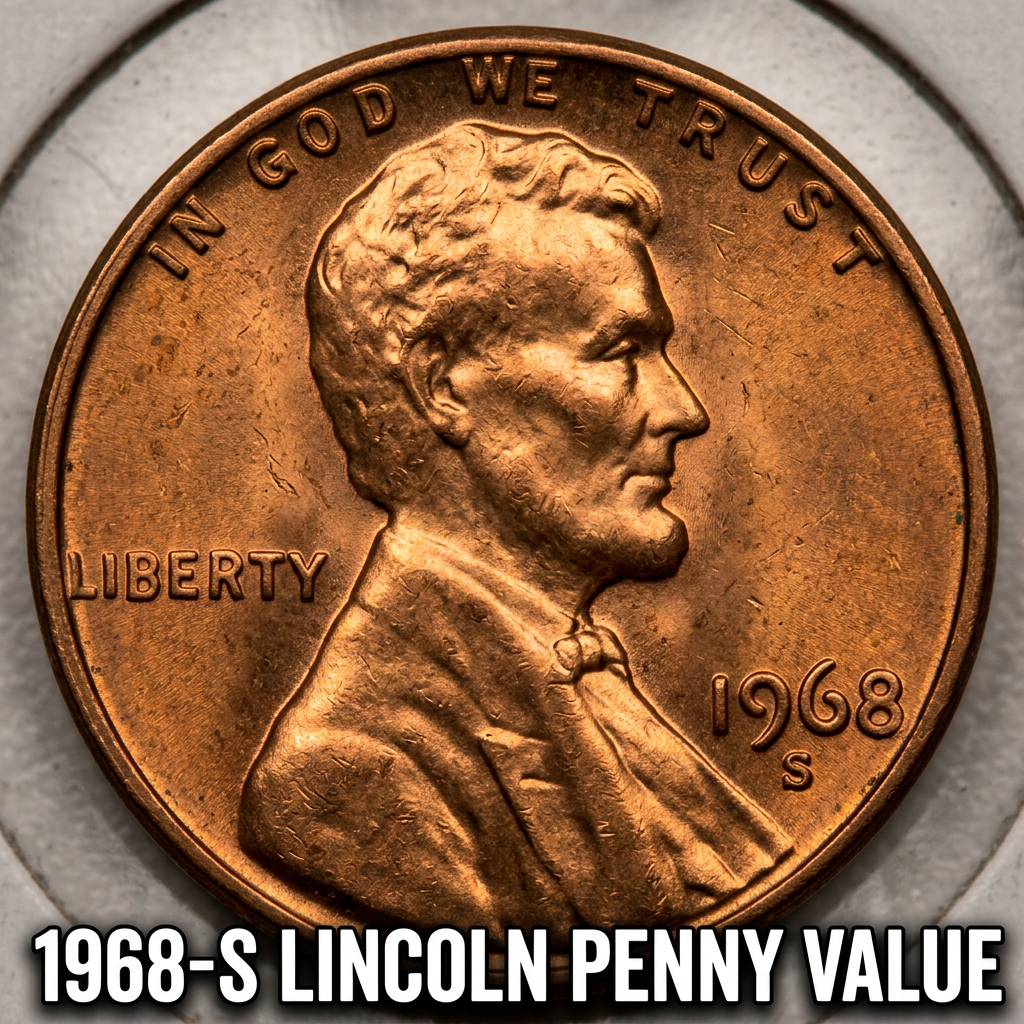
The 1968-S Lincoln Penny is worth anywhere from a few cents in heavily worn condition to over $3,000 or more in top mint state grades. If you found one of these coins in an old jar or collection, you’re in the right place — let’s break down exactly what it might be worth and why.
The 1968-S penny was minted at the San Francisco Mint, which is why it carries the small “S” mintmark just below the date on the obverse side. That little letter makes a bigger difference than most people realize. Whether your coin is a circulated spare or a pristine gem, understanding the details can turn a lucky find into real money. If you’re not sure how to identify what you have, a free coin identifier app can help you get started quickly before you even leave the house.
—
What Makes the 1968-S Lincoln Penny Special
The 1968-S cent holds a unique place in Lincoln penny history. During this era, the U.S. Mint was struggling with coin shortages, and San Francisco — which had been dormant for years — was brought back into full production. The “S” mintmark on these pennies connects them to a specific moment in American coinage history.
Beyond the history, the 1968-S was produced in large numbers: over 258 million were struck for circulation. That might sound like bad news for value, but condition is everything in coin collecting. A coin that spent decades in a pocket or purse might be worth face value. The same coin preserved in a folder or proof-quality holder could be worth hundreds or even thousands.
It’s also worth noting that 1968-S Proof pennies were specially struck for collectors. These have a mirror-like finish and sharper details than regular business strikes, and they can command significantly higher prices.
—
1968-S Penny Value by Grade
Here’s a general breakdown of what collectors and dealers typically pay for a 1968-S Lincoln Penny depending on its condition:
| Grade / Condition | Estimated Value |
|---|---|
| Good (G-4) | $0.05 – $0.25 |
| Fine (F-12) | $0.10 – $0.50 |
| Extremely Fine (EF-40) | $0.50 – $2.00 |
| Mint State MS-63 (Red) | $5 – $15 |
| Mint State MS-65 (Red) | $15 – $75 |
| Mint State MS-67 (Red) | $500 – $3,500+ |
| Proof PR-65 (Red Cameo) | $10 – $50 |
| Proof PR-69 (Deep Cameo) | $200 – $800+ |
For a deeper look at certified 1968-S Lincoln Penny prices across multiple grades and recent auction results, it’s worth checking current market data — values can shift based on collector demand and population reports from grading services like PCGS and NGC.
—
How Condition and Color Affect the 1968-S Penny Price
One thing that surprises a lot of everyday coin finders is the role of color in penny grading. Lincoln cents struck in copper are graded not just on wear, but also on how much original red luster they retain.
A coin labeled “RD” (Red) has kept most of its original copper color and is the most desirable — and the most valuable. “RB” (Red-Brown) means some color loss, and “BN” (Brown) means the coin has fully toned. The difference between a Red and Brown example of the same grade can be dramatic, sometimes 10x or more in value.
This is why storage matters so much. Pennies that were kept in albums with acid-free holders often look far better decades later than those left loose in a drawer. If your 1968-S penny still has that warm reddish glow, that’s a very good sign.
CoinHix is a smart tool to use when evaluating your penny’s grade and color category — it pulls real market data so you’re not guessing based on outdated price lists.
—
What About Errors and Varieties on the 1968-S Penny
Error coins are always exciting, and the 1968-S Lincoln cent is no exception. While this issue doesn’t have one single famous variety like some other years, there are still things to look for.
Doubled die errors — where the design elements appear slightly doubled due to a misalignment during the hubbing process — can add significant premium. Look closely at the lettering on “LIBERTY” and “IN GOD WE TRUST” using a loupe or magnifying glass. Any noticeable doubling could push the value well above a normal example.
Strike doubling (also called mechanical doubling) is common and not as valuable, so it’s important to know the difference. Off-center strikes, where Lincoln’s portrait isn’t centered on the coin, can also command premiums depending on how dramatic the offset is.
For a full breakdown of 1968 penny values including errors and variety premiums, you’ll want to cross-reference your find with detailed reference guides and grading images.
CoinHix makes this easier by letting you scan your coin and compare it to authenticated examples in their database — a great shortcut if you’re not an experienced numismatist.
—
FAQ
Q: Is the 1968-S penny rare?
A: In circulated condition, no — over 258 million were made, so they’re easy to find. However, in very high mint state grades (MS-67 and above) with full red color, they become genuinely scarce and can sell for thousands of dollars.
Q: How do I know if my 1968-S penny is a proof coin?
A: Proof coins have a sharp, mirror-like background with frosted design elements. They were only sold in collector sets, not released into circulation. If your 1968-S looks unusually shiny and pristine, it might be a proof — but you’ll want to have it professionally verified to be sure.
Q: Should I clean my 1968-S penny before selling it?
A: Absolutely not. Cleaning a coin — even gently — removes the original surface and dramatically lowers its collector value. A cleaned coin will always be worth less than an uncleaned one in the same grade. Leave it exactly as you found it and let a professional assess it as-is. Apps like CoinHix can help you get a quick value estimate without risking any damage.