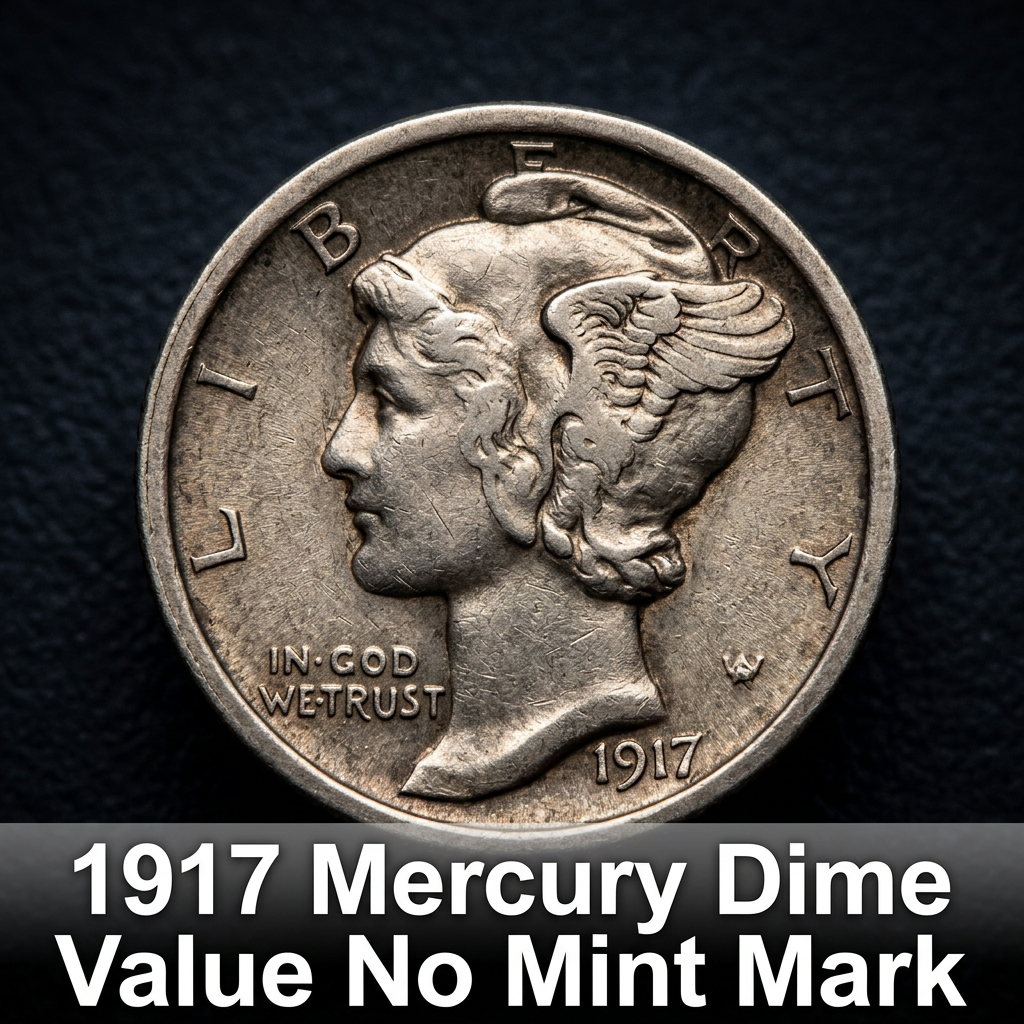
The 1917 Mercury Dime with no mint mark is worth anywhere from $3 to $5 in heavily worn condition, but can fetch $25 to $100 or more in uncirculated grades — and top-tier examples have sold for hundreds at auction. If you found one of these old silver dimes in a coin jar or inherited collection, you’re in the right place to find out exactly what it’s worth.
Before we dive in, it helps to have the right tools on hand. A free coin identifier app can help you quickly identify what you’re holding and get a ballpark value before you read any further. It’s a great first step, especially if you’re new to coin collecting.
What Is the 1917 Mercury Dime No Mint Mark?
The 1917 Mercury Dime with no mint mark was struck at the Philadelphia Mint, which was standard practice at the time — Philadelphia coins didn’t carry a mint mark. The Mercury Dime, officially called the Winged Liberty Head Dime, was designed by sculptor Adolph Weinman and first released in 1916.
This coin features a young Liberty wearing a winged cap on the obverse — often mistaken for the Roman god Mercury, which gave it the nickname that stuck. The reverse displays a fasces bundled with an olive branch, symbolizing unity and peace.
The 1917 Philadelphia issue had a large mintage of over 55 million coins, making it one of the more common Mercury Dimes in the series. That said, “common” in coin collecting doesn’t mean worthless — condition is everything.
1917 Mercury Dime No Mint Mark Value by Grade
The value of a 1917 Mercury Dime depends heavily on its condition, or grade. Coins that have been passed through circulation for decades will show wear on the high points — Liberty’s face, the bands on the fasces, and the eagle’s feathers.
Here’s a breakdown of typical market values:
| Grade | Description | Estimated Value |
|---|---|---|
| G-4 (Good) | Heavy wear, major details visible | $3 – $4 |
| VG-8 (Very Good) | Moderate wear, lettering clear | $4 – $6 |
| F-12 (Fine) | Some detail visible on bands | $6 – $10 |
| VF-20 (Very Fine) | Light wear, fasces bands partially split | $10 – $18 |
| EF-40 (Extremely Fine) | Slight wear on high points only | $18 – $30 |
| MS-63 (Uncirculated) | No wear, some bag marks | $60 – $90 |
| MS-65 (Gem Uncirculated) | Sharp strike, minimal marks | $100 – $200+ |
| MS-65 FB (Full Bands) | Complete split bands on fasces | $200 – $500+ |
For the most up-to-date auction results and pricing data, you can view live 1917 Mercury Dime price trends across mint state grades on CoinHix’s database. The “Full Bands” designation is especially important for this date — it can multiply value several times over.
Why Full Bands Matter So Much on the 1917 No Mint Mark Dime
One of the most unique aspects of Mercury Dime grading is the Full Bands (FB) designation. On the reverse, the fasces is wrapped with two horizontal bands. When a coin is struck with full detail and the bands appear completely separated, it earns the FB label from grading services like PCGS or NGC.
For the 1917 Philadelphia issue, Full Bands coins are not as rare as some other Mercury Dime dates, but they’re still significantly more valuable than non-FB examples. A coin graded MS-65 without Full Bands might sell for around $100, while the same coin with Full Bands could bring $300 to $500 or more.
This is why it pays to examine your coin closely — or better yet, use CoinHix to look up recent sales. The app gives you real data from actual auctions, so you’re not guessing at values.
Silver Content and Melt Value of the 1917 Mercury Dime
Even if your 1917 Mercury Dime is worn smooth, it still has intrinsic value because it’s made of 90% silver. Each coin contains 0.07234 troy ounces of pure silver.
With silver prices hovering around $27 to $30 per troy ounce (prices fluctuate, so always check current rates), the melt value of a 1917 Mercury Dime sits around $2.00 to $2.20. That means even the most beat-up example is worth more than face value — and most examples in collector grade are worth significantly more.
If you want a detailed look at the full 1917 Mercury Dime value picture — including both circulated and uncirculated examples and how silver content factors in — this complete 1917 Mercury Dime value guide breaks it all down in plain terms.
How to Check Your 1917 Mercury Dime with an App
If you’re not sure of the grade or condition of your coin, don’t worry — you don’t need to be an expert to get started. CoinHix is one of the most user-friendly tools available for everyday collectors. Just enter the coin details and it pulls up current market values, recent auction prices, and population reports from certified coins.
For brand-new collectors, pairing CoinHix with a basic coin loupe (10x magnification) will help you see surface details and determine if the fasces bands are split. Look for any luster (a cartwheel-like sheen) on the surface — that’s a sign your coin may be uncirculated.
Always store your Mercury Dimes in individual coin flips or hard plastic holders to preserve whatever grade they have. Even a slightly better grade can double or triple the value on this coin.
FAQ
Q: How do I know if my 1917 Mercury Dime has no mint mark?
A: Look at the reverse of the coin near the bottom of the fasces. Coins made in Denver carry a “D” and San Francisco coins show an “S.” If there’s no letter, it was made in Philadelphia — that’s your no mint mark coin.
Q: Is a 1917 Mercury Dime with no mint mark rare?
A: Not particularly — over 55 million were minted in Philadelphia that year. However, finding one in uncirculated condition with Full Bands is genuinely scarce and can be worth several hundred dollars to serious collectors.
Q: Should I clean my 1917 Mercury Dime before selling it?
A: Absolutely not. Cleaning a coin — even gently — removes the natural patina and surface luster that collectors value. A cleaned coin can lose 50% or more of its market value. Leave it as-is and let a professional grader or dealer assess it in its current state.