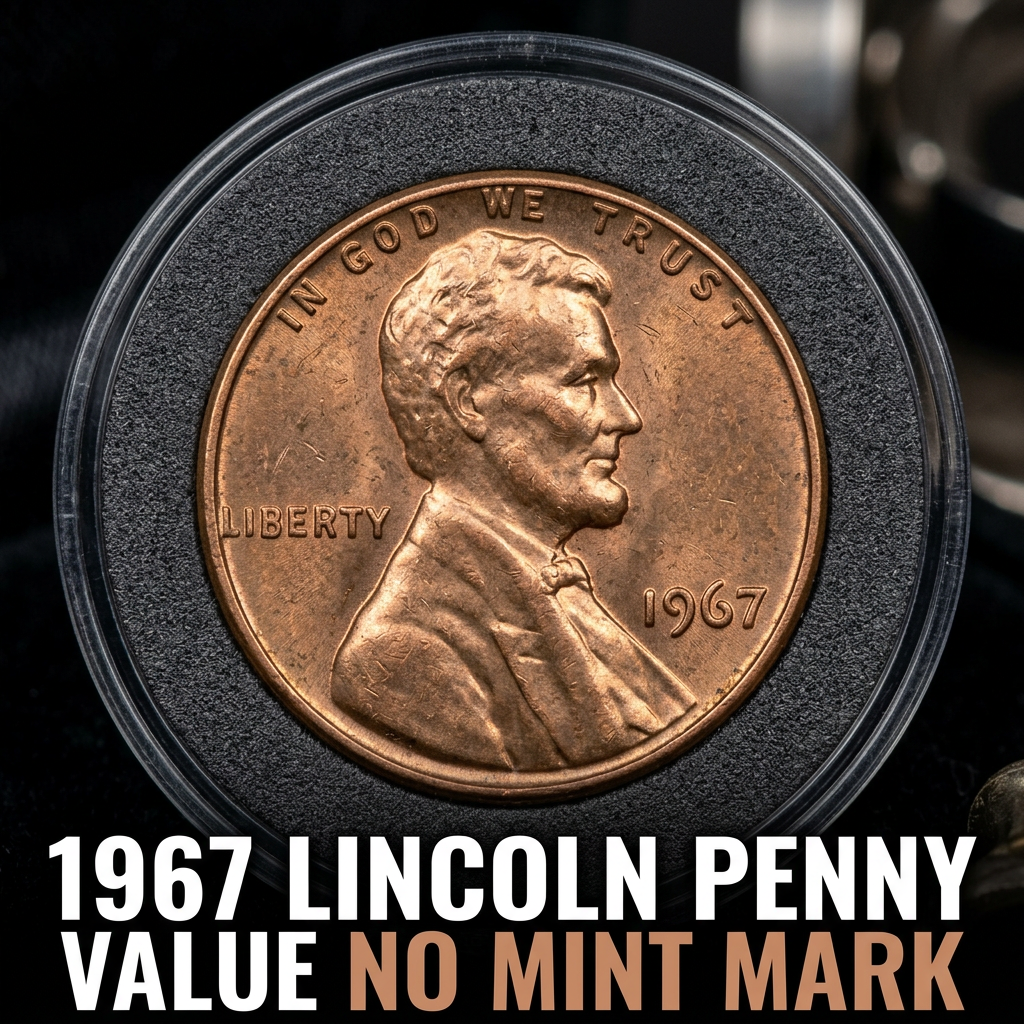
The 1967 Lincoln Penny with no mint mark is worth anywhere from 1 cent in heavily worn condition to over $15 or more in pristine uncirculated grades — and a handful of rare error coins can fetch hundreds. If you found one of these copper cents in your change jar or an old collection, you’re in the right place to find out exactly what you’ve got.
What Does No Mint Mark Mean on a 1967 Penny?
If you flip your 1967 penny over and look at the obverse (that’s the heads side, just below the date), you won’t find any letter stamped there. That’s completely normal for this coin.
In 1967, all Lincoln cents were struck at the Philadelphia Mint, and Philadelphia did not use a mint mark during this era. So the absence of a letter isn’t a mistake — it just tells you the coin came from Philly. The San Francisco and Denver Mints weren’t producing circulating cents that year.
This is one reason why 1967 Lincoln pennies are so common. The Philadelphia Mint struck well over 3 billion of them that year, making them one of the highest-mintage Lincoln cents of the decade. High mintage usually means lower value — but condition and errors can change everything.
If you’re not sure what you’re looking at, a free coin identifier app can help you quickly figure out where your coin was made and get a ballpark value in seconds.
1967 Lincoln Penny Value by Condition
The biggest factor in what your 1967 penny is worth is its condition. Coin collectors use a grading scale from 1 to 70, and even small differences in wear can mean big differences in price.
A coin that’s been rolling around in pockets and piggy banks for decades will show heavy wear on Lincoln’s cheekbones, hair details, and the lettering. These circulated coins are worth face value to maybe a few cents at most.
But if you’ve got a coin that never entered circulation — still has its original luster and sharp details — it could be worth real money to collectors. Here’s a quick breakdown:
| Grade / Condition | Description | Estimated Value |
|---|---|---|
| Good (G-4) | Heavy wear, design visible | $0.01 |
| Fine (F-12) | Moderate wear, some detail | $0.05–$0.10 |
| Extremely Fine (EF-40) | Light wear, sharp overall | $0.25–$0.50 |
| MS-63 (Uncirculated) | No wear, minor bag marks | $1–$3 |
| MS-65 (Gem Uncirculated) | Strong luster, few marks | $5–$15 |
| MS-67+ (Superb Gem) | Near-perfect, top registry | $100–$500+ |
For the most up-to-date pricing across all grades, you can check out the latest 1967 Lincoln Penny price data by grade to see what collectors are actually paying right now.
Are Any 1967 Pennies Worth Big Money? Look for Errors
Here’s where things get exciting. While the average 1967 penny isn’t going to pay your rent, certain error coins from this year have sold for significant premiums.
The most famous is the 1967 Lincoln Cent Special Mint Set (SMS) coin — these were specially produced with a more polished finish for collector sets and can be worth $10 to $50+ depending on condition.
Beyond the SMS coins, keep an eye out for:
– Doubled Die Obverse — Look for doubling in the lettering “IN GOD WE TRUST” or in the date. Even minor doubling can add $25–$100+ to the value.
– Off-Center Strikes — If Lincoln’s portrait isn’t centered properly, that’s a mint error. The more off-center, the more valuable.
– Die Caps and Brockages — Rare mechanical errors that can sometimes sell for several hundred dollars.
Use CoinHix to photograph your coin and get an instant assessment — the app is specifically designed to spot these kinds of mint errors that are easy to miss with the naked eye.
How to Check Your 1967 Penny’s Value at Home
You don’t need to be a professional numismatist to get a good sense of what your coin is worth. Start by examining it under good lighting, ideally with a 5x or 10x magnifier.
Look at Lincoln’s cheek and the high points of his hair — if the details are crisp and you can still see the fine lines, your coin is in better shape. Hold it at an angle under a light to see if it still has its original “cartwheel” luster. That shimmery effect is a sign the coin hasn’t circulated.
Once you’ve assessed the condition, you can look up a detailed 1967 penny value guide with current market prices to cross-reference your coin’s grade with what it’s realistically worth.
And if you want the fastest answer, CoinHix lets you snap a photo and get an estimated value right on your phone — no coin expertise needed.
FAQ About the 1967 Lincoln Penny
Q: Is a 1967 penny with no mint mark rare?
A: No, it’s actually one of the most common Lincoln cents ever made. Over 3 billion were struck at the Philadelphia Mint in 1967 alone. However, high-grade examples (MS-66 and above) and error coins can still be scarce and valuable.
Q: What’s the most valuable 1967 penny ever sold?
A: Top-grade 1967 Lincoln cents in MS-67 Red condition have sold at auction for several hundred dollars. Error coins — particularly dramatic doubled dies or off-center strikes — can occasionally reach four figures depending on the severity of the error and collector demand.
Q: Should I clean my 1967 penny before selling it?
A: Absolutely not. Cleaning a coin — even with gentle soap — destroys the natural patina and surface luster that collectors value. A cleaned coin is almost always worth less than an uncleaned one in the same grade. Leave it as-is and let a professional evaluate it first.