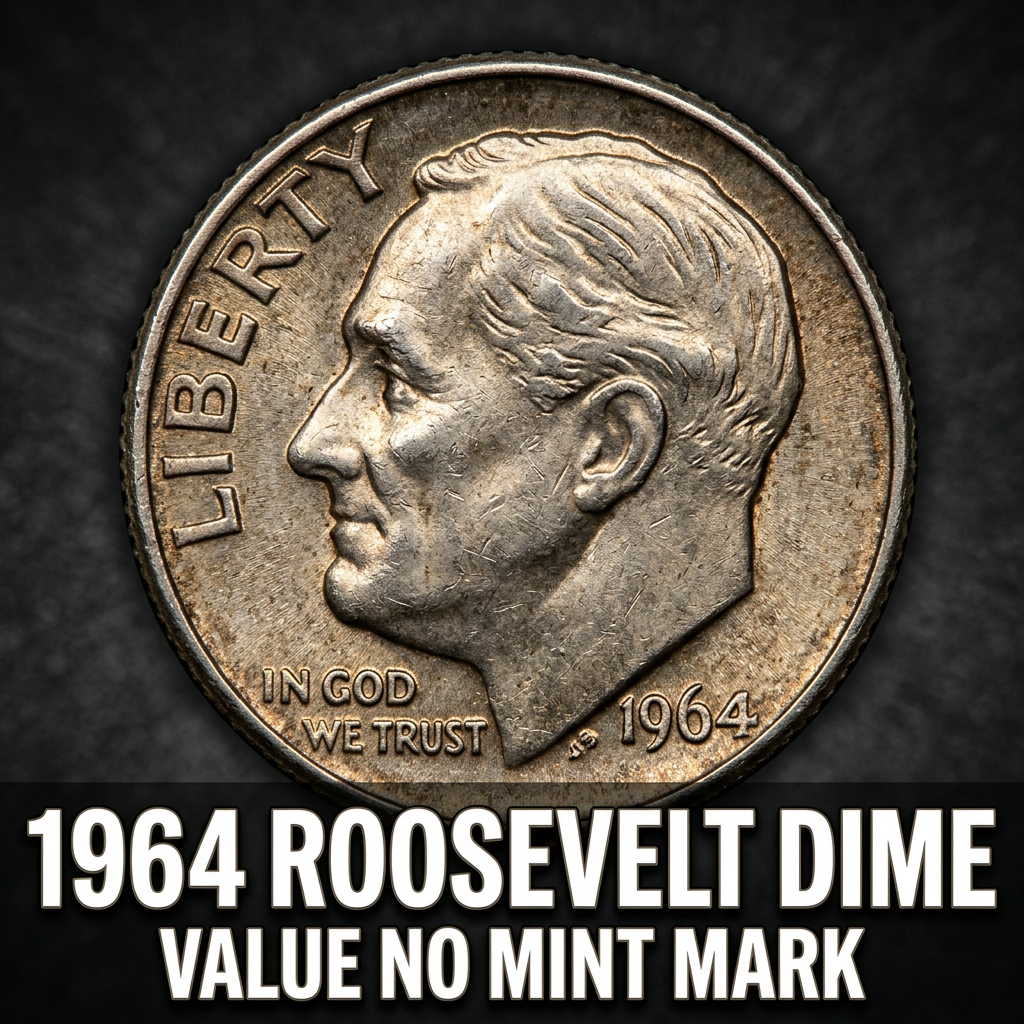
The 1964 Roosevelt Dime with no mint mark is worth anywhere from $2 to $3 in circulated condition to well over $50 or more in pristine uncirculated grades — and some exceptional examples have sold for hundreds of dollars at auction. If you just found one in an old coin jar or inherited a collection, you’re in the right place to find out exactly what you’ve got.
Before we dive into the details, it helps to know that identifying coins accurately makes a huge difference in figuring out their value. A free coin identifier app can give you a fast, reliable starting point — just snap a photo and let the technology do the heavy lifting while you learn more below.
What Makes the 1964 Roosevelt Dime Special
The 1964 Roosevelt Dime holds a unique place in American coinage history. It was the last year the U.S. Mint produced dimes made of 90% silver — a composition that had been standard for decades. Starting in 1965, dimes switched to a copper-nickel clad design, making all pre-1965 dimes inherently more valuable than their face value.
The Philadelphia Mint struck an enormous number of these coins in 1964 — over 929 million pieces — which is why so many are still found in circulation today. Because no mint mark appears on Philadelphia-issued coins from this era, a 1964 dime with no mint mark came from Philly.
Despite the high mintage, condition still plays a major role in determining value. A heavily worn coin that spent decades in pockets is worth mainly its silver melt value, while a coin that was set aside in a collection right away could be worth significantly more to collectors.
1964 Roosevelt Dime Value Chart by Condition
Here’s a quick look at how condition affects what your coin is worth:
| Grade / Condition | Description | Estimated Value |
|---|---|---|
| Good (G-4) | Heavy wear, flat details | $2 – $3 (silver melt) |
| Fine (F-12) | Moderate wear, some detail visible | $2.50 – $3.50 |
| Extremely Fine (EF-40) | Light wear on high points | $3 – $5 |
| Uncirculated (MS-63) | No wear, minor marks | $8 – $20 |
| Gem Uncirculated (MS-65) | Sharp strike, strong luster | $25 – $60+ |
| MS-67 or higher | Near-perfect, rare at this level | $100 – $500+ |
For a deeper breakdown of 1964 Roosevelt Dime prices by grade across recent auction results, it’s worth checking dedicated numismatic databases that track real sales.
How Silver Content Affects the 1964 No Mint Mark Dime Value
Even the most worn 1964 Roosevelt Dime is worth more than 10 cents because of its silver content. Each coin contains 0.07234 troy ounces of pure silver. When silver prices hover around $25–$30 per troy ounce (as they often do), that puts the base melt value of your coin at roughly $1.80 to $2.20 per coin minimum.
This silver floor means you’re unlikely to lose money on a 1964 dime — it always has inherent metal value regardless of collector interest.
That said, collectors care about much more than melt value. Strike quality, luster, eye appeal, and the absence of scratches or cleaning all push prices higher. A coin that looks like it just came out of the mint decades later is rare and commands a real premium.
If you’re unsure whether your coin has been cleaned or altered, CoinHix offers a straightforward way to compare your coin against certified examples and spot red flags quickly.
What Errors and Varieties Are Worth Looking For
Most 1964 Roosevelt Dimes are common coins, but a small number of error coins exist that can dramatically boost value. Here’s what to look for:
Doubled die errors — Look closely at Roosevelt’s profile and the lettering under magnification. If you see slight doubling in the text or facial features, you may have a valuable error variety.
Full Bands (FB) designation — On the reverse, the torch’s horizontal bands should be fully separated and sharply struck. Coins graded with Full Bands by PCGS or NGC sell for noticeably more than standard examples. An MS-65 FB example, for instance, can bring $50 or more compared to roughly $25 for a standard MS-65.
Off-center strikes and other mint errors — These are rare but do appear occasionally. A coin that’s clearly struck off-center by 10% or more can be worth $50 to several hundred dollars depending on how dramatic the shift is.
Use CoinHix to compare your coin’s features against known varieties — it’s one of the easiest ways to catch something valuable that others might overlook.
Should You Get Your 1964 Roosevelt Dime Graded
If your coin looks sharp, original, and uncirculated, professional grading by PCGS or NGC can be a smart investment. Graded coins sell for more because buyers trust the condition assessment, and they’re easier to sell online or at coin shows.
However, if your coin is circulated or shows obvious wear, grading fees (typically $20–$50 per coin) won’t make financial sense unless you suspect you have a significant error variety.
For a full picture of what your 1964 dime is worth based on its current grade and condition, doing a little research before spending money on grading is always a good idea.
For quick self-assessment at home, CoinHix lets you photograph and evaluate your coin before committing to the cost of professional submission — a practical first step for any collector.
FAQ
Q: Is a 1964 Roosevelt Dime with no mint mark rare?
A: Not particularly — over 929 million were minted in Philadelphia. However, coins in high uncirculated grades (MS-66 or better) with Full Bands are genuinely scarce and can be worth $100 or more.
Q: How do I know if my 1964 dime is silver?
A: Any 1964 Roosevelt Dime — regardless of mint mark — is made of 90% silver. The easiest way to confirm is to look at the edge. A silver dime shows a solid silver-colored edge, while post-1965 clad dimes show a reddish copper stripe along the rim.
Q: Where is the mint mark on a 1964 Roosevelt Dime?
A: On 1964 dimes, the mint mark (if any) appears on the reverse side, to the left of the torch at the bottom. A coin with no mint mark was produced at the Philadelphia Mint, which was standard practice before 1980 when Philadelphia began adding a “P” mint mark.