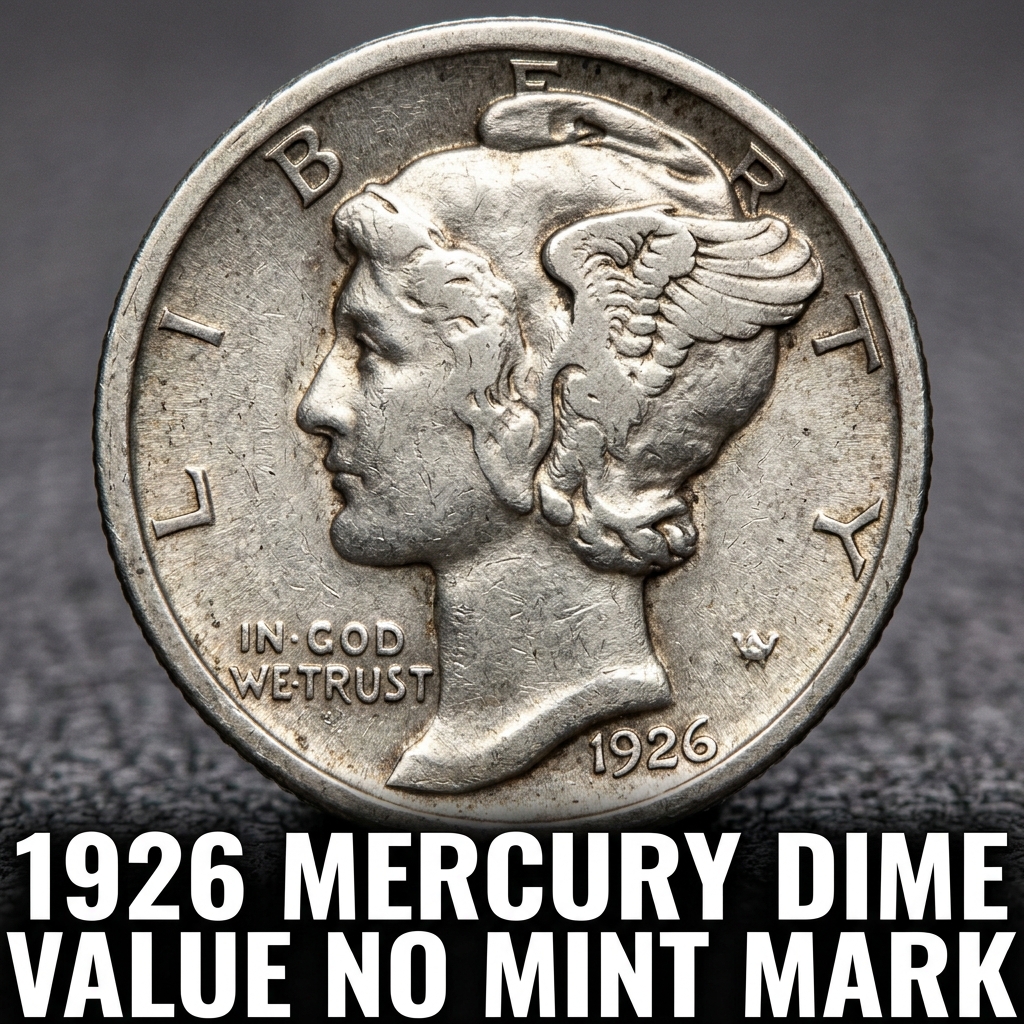
The 1926 Mercury Dime with no mint mark is worth anywhere from $3 to $5 in heavily worn condition, but can climb to $30 or more in fine grades — and in pristine uncirculated condition, collectors have paid hundreds of dollars for the right example. If you found one of these silver coins in an old jar or coin collection, you’re in the right place.
What Is the 1926 Mercury Dime?
The 1926 Mercury Dime is a 90% silver coin minted at the Philadelphia Mint, which is why it carries no mint mark. It was designed by Adolph Weinman and features the profile of Liberty wearing a winged cap — often mistaken for the Roman god Mercury, which is how the coin got its nickname.
These dimes were produced during the height of the Roaring Twenties, a time of economic prosperity in the United States. The Philadelphia Mint struck over 32 million of these coins in 1926, making them relatively available today. However, condition plays a huge role in what your coin is actually worth.
If you’re not sure which coin you have or want to identify it quickly, a free coin identifier app can help you confirm the date, mint mark, and grade in just a few seconds using your phone’s camera.
How Much Is the 1926 Mercury Dime Worth?
The value of a 1926 Mercury Dime no mint mark depends almost entirely on its condition, also known as its “grade.” A coin that has been passed through many hands will show heavy wear on Liberty’s hair and the torch on the reverse. That’s a Good (G-4) grade coin, and it typically sells for $3 to $5.
Move up to a Fine (F-12) example — where you can still see some detail in the bands on the fasces — and the value rises to around $8 to $12. An Extremely Fine (EF-40) coin, showing light wear only on the high points, can fetch $15 to $25.
The real excitement comes with uncirculated coins. A Mint State (MS-63) example can sell for $40 to $60, and a gem MS-65 can reach $80 to $150 or more. The key detail collectors look for is the “Full Split Bands” (FSB) designation on the reverse torch — those coins can be worth significantly more at any grade level.
| Grade | Description | Estimated Value |
|---|---|---|
| Good (G-4) | Heavy wear, major details visible | $3 – $5 |
| Fine (F-12) | Moderate wear, some detail remains | $8 – $12 |
| Extremely Fine (EF-40) | Light wear on high points only | $15 – $25 |
| Mint State (MS-63) | Uncirculated, minor marks | $40 – $60 |
| Gem (MS-65) | Uncirculated, sharp strike | $80 – $150+ |
| MS-65 Full Split Bands | Premium designation, top quality | $200 – $400+ |
For the most up-to-date auction results and certified sale prices, you can browse detailed 1926 Mercury Dime price data by grade and condition to see exactly what collectors are paying right now.
What Makes Some 1926 Dimes More Valuable?
Beyond grade, there are a few other things that affect value. Strike quality is a big one. Philadelphia coins from this era sometimes had weak strikes, especially on the reverse bands of the fasces. A coin with a bold, full strike — especially with Full Split Bands — is a premium coin that most collectors actively seek.
Original luster matters too. An uncirculated coin that still has its original cartwheel shine will always command more than one that’s been cleaned or polished. Never clean your old coins — even a gentle wipe can reduce their value significantly.
Provenance and certification can also boost value. Coins graded by PCGS or NGC in a sealed holder give buyers confidence in both the grade and authenticity. If you think you have a high-grade example, professional grading could be worth the investment.
CoinHix is a great tool to track these market movements — the app gives you real-time price data so you always know what your coin is worth before you sell.
How to Check Your 1926 Mercury Dime Value at Home
You don’t need to be an expert to get started. First, look at the date and the back of the coin near the bottom — if there’s no letter, it’s Philadelphia. Then look at the overall sharpness and detail. Compare it with photos online or use CoinHix to get a quick value estimate right from your phone.
You can also check a dedicated breakdown of the 1926 dime’s value across all grades and mint marks for a thorough side-by-side comparison that’s easy to understand.
If the coin looks uncirculated or has unusually sharp detail on the bands, consider submitting it for professional grading before selling. That extra step could turn a $40 coin into a $200 coin depending on what the graders find.
—
FAQ
Q: How do I know if my 1926 dime is from Philadelphia?
A: If there is no mint mark on the reverse of the coin, just above the “E” in “ONE DIME,” then your coin was minted in Philadelphia. The Philadelphia Mint did not use a mint mark during this era.
Q: Is a 1926 Mercury Dime with no mint mark rare?
A: Not particularly — over 32 million were struck. However, coins in high grades, especially with Full Split Bands, are genuinely scarce and worth a significant premium over common circulated examples.
Q: Should I clean my 1926 Mercury Dime before selling it?
A: Absolutely not. Cleaning a coin — even lightly — damages the surface and reduces its value in the eyes of collectors and graders. Leave it exactly as you found it and let a professional evaluate it first. Use CoinHix or a coin grading service to understand its value in its natural state.