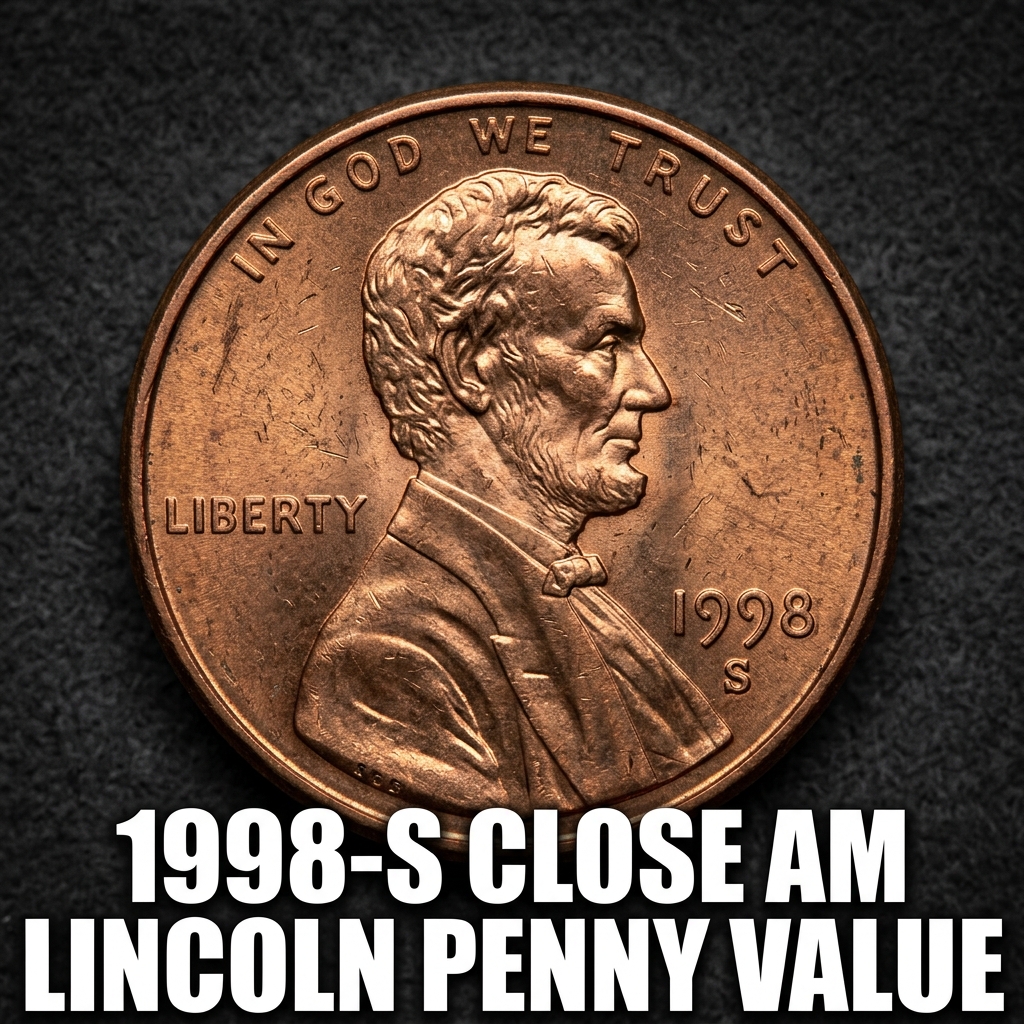
The 1998-S Close AM Lincoln Penny is worth anywhere from a few dollars in circulated condition to over $1,500 or more in pristine mint state — and some collectors are actively hunting for this rare proof variety right now. If you stumbled across one in an old coin collection or inherited a set of proof coins, you may be sitting on something genuinely valuable.
What Makes the 1998-S Close AM So Special?
To understand why this coin matters, you need to know a little backstory. Every Lincoln cent has the initials “AM” in “AMERICA” on the reverse side. On most pennies, those two letters have a visible gap between them — that’s the Wide AM design. But on the Close AM variety, the letters A and M nearly touch each other.
The Close AM design was actually intended for business-strike pennies (the ones made for everyday use), not proof coins. So when it showed up on the 1998-S proof coin — which was struck at the San Francisco Mint — it created an unexpected and now highly sought-after variety.
This kind of design mismatch happens when the wrong hub or die gets used during production. It’s a mint error in the broadest sense, and these mistakes are exactly what coin collectors love.
If you’re not sure what you have, using a free coin identifier app is a quick and easy way to get started before reaching out to a dealer or grading service.
How Much Is the 1998-S Close AM Lincoln Penny Worth?
The value of this coin depends heavily on its condition and grade. Since the 1998-S was a proof coin, most examples were carefully preserved by collectors — but that doesn’t mean every one is in perfect shape.
Here’s a general breakdown of values based on grade:
| Grade / Condition | Estimated Value |
|---|---|
| PR-60 (Proof, average) | $50 – $100 |
| PR-65 (Gem Proof) | $150 – $400 |
| PR-67 (Superb Gem Proof) | $500 – $900 |
| PR-68 or higher (Ultra Gem) | $1,000 – $1,500+ |
You can check real-time 1998 Lincoln penny price data across different grades to see how the market is moving right now. Coin values shift based on auction results and collector demand, so staying current matters.
How to Identify the Close AM on Your Penny
Identifying this variety requires a magnifying glass or loupe — at least 5x to 10x magnification. Flip the coin to the reverse and look closely at the word “AMERICA” near the bottom of the coin.
On a standard Wide AM proof penny, you’ll clearly see space between the letters A and M. On the Close AM variety, those two letters will almost be touching, with only a hairline of space between them (or none at all).
It also helps to compare the designer’s initials near Lincoln’s shoulder on the obverse side, but the AM spacing is the most reliable tell. If you’re unsure, CoinHix has a clean visual database where you can compare your coin against certified examples to make sure you’ve got the right variety.
Should You Get It Graded?
If your coin looks like a Close AM and is in solid proof condition, getting it professionally graded by PCGS or NGC is absolutely worth considering. A PR-67 or PR-68 example could be worth several hundred to over a thousand dollars — and having a certified grade makes the coin much easier to sell and protects you from lowball offers.
The grading fee typically runs $30–$50 for standard service, which is a small price to pay if your coin turns out to be a high-grade example.
For a full breakdown of what your 1998 penny might be worth in different conditions, this detailed 1998 penny value guide covers the variety differences and current price estimates in plain language. It’s a great resource before you make any decisions about selling.
You can also use CoinHix to track recent auction results for the 1998-S Close AM penny, which gives you a real-world sense of what buyers are actually paying — not just guide book estimates.
Where to Sell the 1998-S Close AM Lincoln Penny
If you’ve confirmed you have a Close AM variety and it’s in good shape, you have several solid options:
eBay is the most accessible marketplace, but you’ll need clear photos and accurate description of the grade. Heritage Auctions and Stack’s Bowers are better choices for high-grade certified examples — they attract serious collectors willing to pay top dollar.
Local coin shops are fine for a quick sale, but you’ll typically get 50–70% of retail value. If you’re not in a rush, the online auction route usually delivers better results for a coin like this.
CoinHix can also help you monitor what similar coins have sold for recently, so you walk into any negotiation knowing your coin’s fair market value.
—
FAQ
Q: How do I know if my 1998-S penny is a Close AM or Wide AM?
A: Use a magnifying glass and look at the letters A and M in “AMERICA” on the reverse. If those two letters are nearly touching or have no visible gap, you likely have the Close AM variety. The Wide AM version has a clear space between them.
Q: How many 1998-S Close AM pennies exist?
A: The exact mintage is unknown because these were not intentionally produced as a separate variety — they resulted from a die mismatch at the San Francisco Mint. They are considered scarce, which is a big part of why collectors pay a premium for them.
Q: Is the 1998-S Close AM penny worth getting professionally graded?
A: Yes, especially if your coin is in excellent proof condition. The difference between a PR-65 and a PR-68 can be hundreds of dollars, and certification from PCGS or NGC makes the coin far more attractive to serious buyers and auction houses.