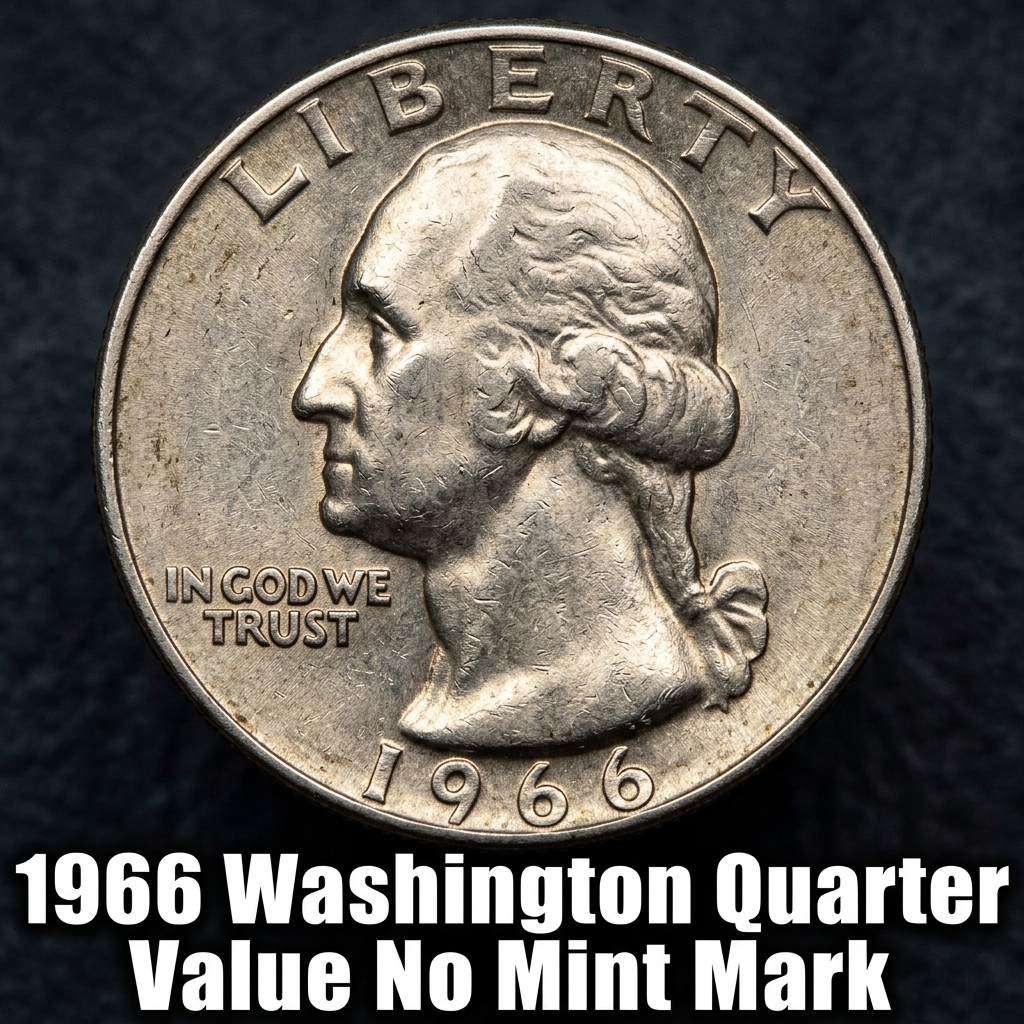
The 1966 Washington Quarter is worth anywhere from 25 cents in heavily worn condition to over $15,000 or more in pristine, uncirculated grades — and a few rare error coins have sold for even more. If you found one of these silver-looking quarters in an old jar or tucked in a drawer, you’re in the right place to find out exactly what you’ve got.
What Makes the 1966 Quarter Different From Other Years
The 1966 Washington Quarter has a unique backstory that makes it interesting to collectors. This was the second year after the U.S. Mint switched away from 90% silver in circulating quarters. Starting in 1965, quarters were made from a copper-nickel clad composition instead — so your 1966 quarter is NOT silver, despite looking shiny and similar in size.
One thing that confuses a lot of people is the missing mint mark. There is no mint mark on the 1966 quarter, and that’s completely normal. From 1965 to 1967, the U.S. Mint deliberately left off mint marks on all coins as part of a policy to discourage hoarding and speculation. So if you’re searching the coin and wondering why there’s no “D” or “S,” don’t worry — there’s nothing missing. It was made that way on purpose.
The Philadelphia Mint produced the majority of 1966 quarters, and a massive number entered circulation. Over 821 million were struck, which is why most examples aren’t rare in everyday grades.
How Much Is a 1966 Quarter Worth Without a Mint Mark
For most people, a 1966 quarter pulled from a coin jar is worth face value — 25 cents — or just slightly above it if it shows normal wear. But condition matters a great deal in coin collecting, and even a common date like this one can be worth real money in the right grade.
If you want to explore detailed 1966 Washington Quarter price data by MS grade, you’ll find that values jump significantly once you hit MS65 and above. Here’s a quick breakdown:
| Grade | Condition | Estimated Value |
|---|---|---|
| Good (G-4) | Heavy wear, design visible | $0.25 – $0.50 |
| Fine (F-12) | Moderate wear, some detail | $0.50 – $1.00 |
| Extremely Fine (EF-45) | Light wear on high points | $1.00 – $3.00 |
| MS-63 | Uncirculated, minor marks | $5 – $12 |
| MS-65 | Gem uncirculated | $20 – $60 |
| MS-67 | Superb gem | $200 – $1,500+ |
| MS-68 | Near-perfect | $5,000 – $15,000+ |
As you can see, the difference between a coin that circulated and one that never did is enormous. If your coin looks brand new with no scratches or wear, it could absolutely be worth getting professionally graded.
Special Mint Set Coins and Their Value
Here’s something many people overlook: in 1966, the U.S. Mint produced Special Mint Sets (SMS) instead of the traditional proof sets. These SMS coins were struck with more care and attention than regular circulation strikes, giving them a distinctive appearance — often with frosted devices and a semi-proof-like finish.
A 1966 SMS Washington Quarter in top condition can be worth significantly more than a regular business strike. SMS coins graded SP67 have sold for hundreds of dollars, and those graded SP68 have reached into the thousands at major auctions.
If your coin has an unusually sharp strike and mirror-like or satin fields, it might be an SMS example worth having evaluated. CoinHix is a great tool for getting a quick sense of what grade your coin might fall into before you invest in professional grading.
1966 Quarter Error Coins to Watch For
Error coins are where things get really exciting for everyday finders. The 1966 Washington Quarter no mint mark has produced some documented errors that can be worth far more than a standard example.
Look out for these types of errors:
– Doubled Die Obverse (DDO): Doubling visible on the date, motto, or Washington’s portrait
– Off-Center Strikes: The design is noticeably shifted off-center
– Die Cap Errors: Extremely rare, but dramatic and valuable
– Clipped Planchet: A curved or straight clip missing from the coin’s edge
Even minor doubling can add $50–$500 or more to a coin’s value depending on severity. Use a magnifying glass or loupe and check the lettering on the obverse closely. You can also use a free coin identifier app to get a fast, reliable read on what you’re looking at before heading to a dealer.
CoinHix is one of the most popular tools coin hunters use to quickly identify and estimate values for coins just like this one — no coin expertise required.
How to Get the Best Price for Your 1966 Quarter
If you think your coin is in top condition or might be an error, consider these steps:
1. Don’t clean it. Cleaning a coin destroys its value in the eyes of collectors and graders. Leave it as-is.
2. Get it graded. PCGS or NGC are the two leading professional grading services. A graded MS67 or higher coin will sell for much more than a raw (ungraded) coin.
3. Sell in the right place. eBay, coin shows, and auction houses like Heritage Auctions are good venues for valuable examples.
4. Do your research first. Check out up-to-date 1966 quarter value information so you know exactly what your coin is worth before selling.
CoinHix can also help you track recent sale prices so you never leave money on the table.
—
Frequently Asked Questions
Q: Why does my 1966 quarter have no mint mark — is it an error?
A: No, it’s not an error. From 1965 to 1967, the U.S. Mint removed mint marks from all coins by policy. Every 1966 quarter you find — no matter where it was made — will have no mint mark.
Q: Is the 1966 Washington Quarter made of silver?
A: No. The 1966 quarter is made of a copper-nickel clad composition. The U.S. Mint stopped using 90% silver in circulating quarters after 1964. So while it looks silver, it contains no silver content.
Q: How do I know if my 1966 quarter is worth getting graded?
A: If the coin looks brand new with no visible wear, scratches, or bag marks, it may be worth professional grading. Coins in MS65 and above can be worth $20 to thousands of dollars. Use a tool like CoinHix to get a preliminary idea of your coin’s grade and value before paying grading fees.