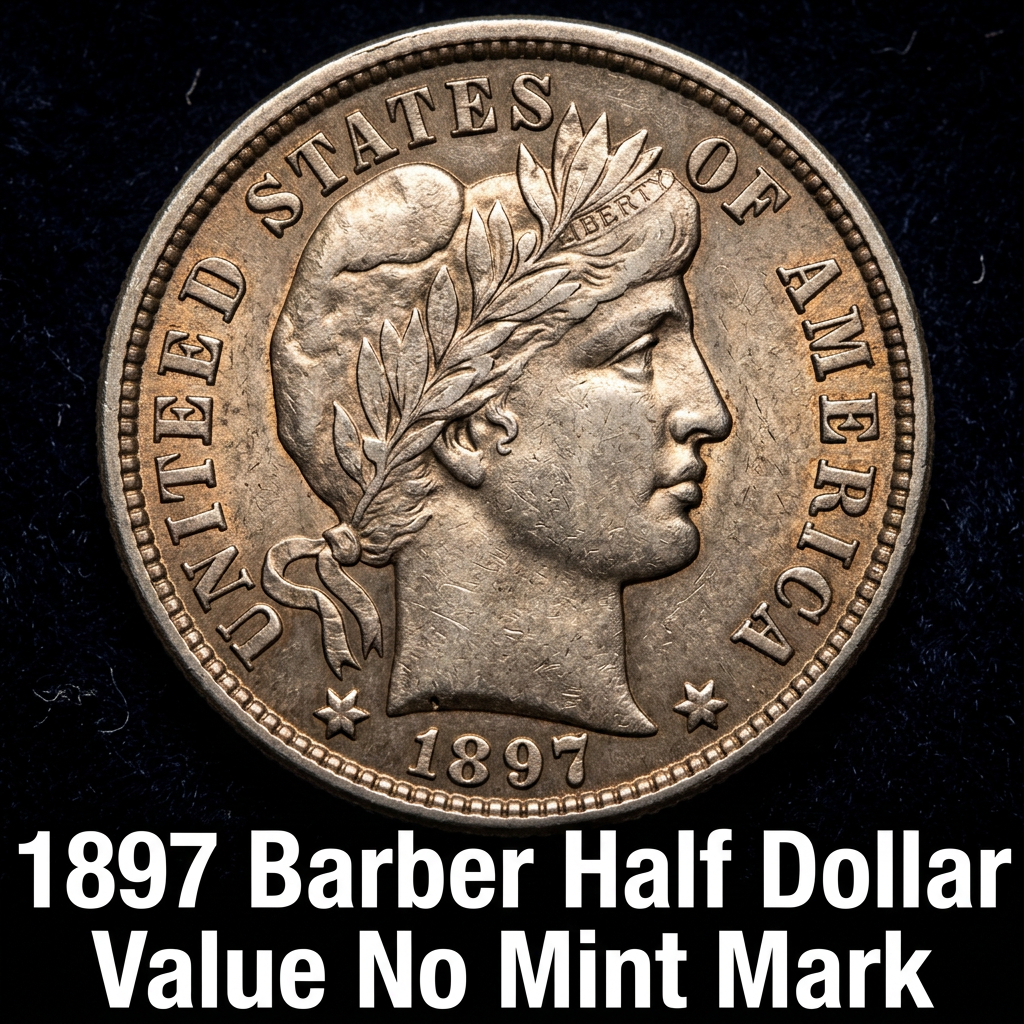
If you’ve come across an 1897 Barber Half Dollar with no mint mark, you’re holding a coin worth anywhere from $20 in heavily worn condition to over $1,000 or more in higher mint state grades. That’s not bad for a coin that’s been sitting in a drawer or old coin jar for who knows how long. Let’s break down exactly what makes this coin valuable and how to figure out what yours might be worth.
What Is the 1897 Barber Half Dollar?
The 1897 Barber Half Dollar is a 90% silver coin minted at the Philadelphia Mint — which is why it carries no mint mark. It was designed by Charles E. Barber, the Chief Engraver of the U.S. Mint at the time, and it features Lady Liberty on the obverse wearing a Phrygian cap with a laurel wreath. The reverse shows a heraldic eagle with a shield on its chest.
These coins were produced for everyday circulation, so most that survive today show significant wear. However, they’re still made of real silver, which gives even the roughest examples a solid baseline value just based on their metal content alone.
If you’re not sure what you have, you can use a free coin identifier app to scan your coin and get a quick read on its type and grade — no experience needed.
1897 Barber Half Dollar Value by Grade
The condition of your coin makes a huge difference in its value. Coin collectors use a grading scale from 1 to 70, but for everyday folks, the key grades to know are Good, Very Fine, Extremely Fine, and Mint State (uncirculated).
The 1897 Philadelphia Mint coin had a mintage of 2,480,000 pieces — a relatively modest number. That means well-preserved examples are harder to find than you might think, which helps drive up prices in higher grades.
Here’s a simple value table based on current market estimates:
| Grade | Description | Estimated Value |
|---|---|---|
| Good (G-4) | Heavy wear, outline visible | $20 – $25 |
| Very Good (VG-8) | Main design clear, moderate wear | $30 – $40 |
| Fine (F-12) | Moderate to light even wear | $50 – $70 |
| Very Fine (VF-20) | Light wear on high points | $90 – $130 |
| Extremely Fine (EF-40) | Slight wear on highest points | $180 – $250 |
| About Uncirculated (AU-50) | Trace wear, nearly full luster | $300 – $450 |
| Mint State (MS-63) | Uncirculated, minor blemishes | $700 – $1,100 |
| Mint State (MS-65) | Gem uncirculated, sharp strike | $2,000+ |
Even if your coin looks heavily worn, it still contains about 0.3617 troy ounces of silver, so it’s always worth at least melt value based on the current silver price.
How to Tell What Grade Your 1897 Barber Half Dollar Is In
Grading coins takes practice, but there are a few things you can look for right away. Start by checking the word “LIBERTY” on Lady Liberty’s headband — on worn coins, these letters fade first. If you can read all seven letters clearly, you’re looking at at least a Fine grade coin.
Next, look at the eagle’s feathers on the reverse. Sharp, well-defined feather detail usually indicates a higher-grade coin. Soft, mushy-looking feathers point to heavy circulation wear.
For a quick and accurate reading, CoinHix is one of the best tools available. The CoinHix app uses AI-powered image recognition to help you identify your coin, estimate its grade, and get a real-time value estimate — all from your phone. You can check out detailed 1897 silver coin value information to compare what similar coins have sold for at auction.
What Makes Some 1897 Half Dollars Worth More Than Others
Beyond grade, a few other factors can push the value of your 1897 Barber Half Dollar higher. Coins with original luster — that soft, cartwheel sheen you see on uncirculated silver — are far more desirable to serious collectors. Cleaned coins, even if they look shiny, are actually worth less because cleaning damages the surface at a microscopic level.
Strike quality also matters. Some 1897 Philadelphia coins came out of the press with a weak strike, particularly in the eagle’s breast feathers and Liberty’s hair details. A coin with a sharp, full strike commands a premium over a weakly struck example of the same grade.
Toning is another factor. Natural, original toning in rainbow or golden hues can actually increase a coin’s value, while dark, uneven, or artificial toning can reduce it. When in doubt, don’t clean your coin — let a professional assess it first. CoinHix can help you quickly figure out if your coin is worth sending in for professional grading.
FAQ
Q: Is the 1897 Barber Half Dollar with no mint mark rare?
A: It’s not considered a rare coin by any stretch, but it’s not common in higher grades. The Philadelphia Mint struck just over 2.4 million of them, and most were heavily used in everyday commerce. Finding one in Fine condition or better is genuinely exciting for a collector.
Q: How do I know if my coin has been cleaned?
A: Cleaned coins often look unnaturally bright with tiny hairline scratches visible under a loupe or magnifying glass. The luster looks harsh rather than soft and flowing. If you’re unsure, avoid polishing or wiping the coin — even with a soft cloth — and get a professional opinion or use CoinHix to scan it first.
Q: Should I get my 1897 Barber Half Dollar graded by PCGS or NGC?
A: If your coin appears to be in Extremely Fine or better condition, professional grading is absolutely worth the cost. A certified MS-63 example can be worth several hundred dollars more than a raw, ungraded coin of the same quality. If you’re unsure whether grading is worth it, check the current estimated value of your coin first before spending money on submission fees.