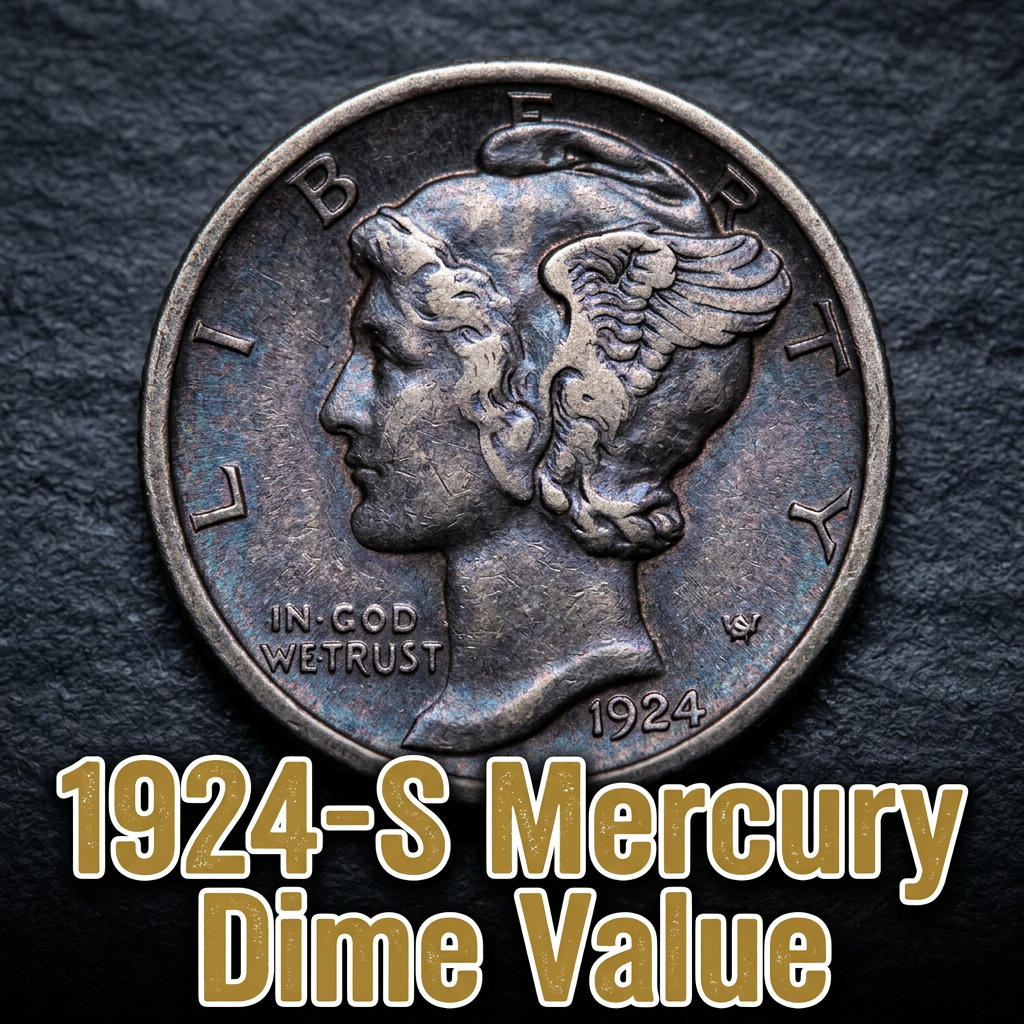
The 1924-S Mercury Dime is worth anywhere from $4 to $10 in heavily worn condition, but well-preserved examples can fetch $50 to $200 or more — and top-grade mint state coins have sold for thousands at major auctions. If you’ve found one in an old coin jar or inherited collection, you might be sitting on a genuinely valuable piece of American history.
What Makes the 1924-S Mercury Dime Special
The 1924-S Mercury Dime was struck at the San Francisco Mint, which is indicated by the small “S” mintmark on the reverse side of the coin, just above the “E” in “ONE DIME.” San Francisco produced 7,120,000 of these dimes that year — a relatively modest mintage compared to the Philadelphia issue — which contributes to its solid collector demand today.
Designed by Adolph Weinman, the Mercury Dime (officially called the Winged Liberty Head Dime) is widely regarded as one of the most beautiful coins ever produced by the U.S. Mint. The obverse features Liberty wearing a winged cap, often mistaken for the Roman god Mercury — hence the popular nickname.
If you’re unsure whether what you’re holding is actually a 1924-S, try using a free coin identifier app to confirm the date, mintmark, and series before deciding what to do with it.
1924-S Mercury Dime Value by Grade
The condition — or “grade” — of your coin has the biggest impact on its value. A coin pulled from circulation will look very different from one that was saved right away and never spent.
Here’s a general value breakdown based on coin grade:
| Grade | Description | Estimated Value |
|---|---|---|
| Good (G-4) | Heavy wear, design visible | $4 – $7 |
| Fine (F-12) | Moderate wear, details clear | $10 – $18 |
| Extremely Fine (EF-40) | Light wear on high points | $30 – $55 |
| About Uncirculated (AU-58) | Slight trace of wear | $70 – $120 |
| Mint State (MS-63) | Uncirculated, minor marks | $150 – $300 |
| Gem Mint State (MS-65+) | Superb condition | $500 – $2,000+ |
You can view up-to-date 1924-S Mercury Dime price data across mint state grades to see how recent sales compare to these ranges. Prices can shift based on market demand, so it’s worth checking current figures before selling.
How to Check the Condition of Your 1924-S Dime
Grading coins takes some practice, but you can get a general sense on your own. Start by examining the coin under good lighting — natural daylight or a single lamp works better than overhead fluorescent lights.
On a well-worn 1924-S Mercury Dime, the bands on the fasces (the bundle of rods on the reverse) will be flat and blended together. On a higher-grade coin, you’ll see clear separation between those bands — this is called “Full Bands” (FB) designation, and it significantly increases collector value.
The cheekbone and hair details on Liberty’s portrait are also key areas to examine. Smooth, flat surfaces in those zones indicate heavy circulation. Sharp, defined lines suggest the coin saw little to no use.
CoinHix is a great tool to help you compare your coin to graded examples in their database. With CoinHix, you can browse photos of certified coins by grade, which makes it much easier to estimate where your piece falls on the scale.
Silver Content and Melt Value
One thing many people don’t realize is that Mercury Dimes — including the 1924-S — are made of 90% silver. Each coin contains approximately 0.07234 troy ounces of pure silver.
That means even a heavily worn example has real metal value. When silver is trading around $28–$30 per troy ounce (as it has in recent years), the melt value of a single Mercury Dime comes out to roughly $2.00–$2.20.
So even if your coin is too worn to excite collectors, it’s still worth more than face value thanks to its silver content. Never spend these coins at face value — that would be like throwing money away.
For a full breakdown of how condition and silver value combine to determine what your coin is worth today, check out this detailed 1924 Mercury Dime value guide covering all mintmarks and grades.
Where to Sell a 1924-S Mercury Dime
If you’ve decided to sell, you have several good options. Online marketplaces like eBay allow you to reach collectors directly and often get the best price for higher-grade examples. Coin dealers — both local shops and online buyers — offer convenience but may pay closer to wholesale.
For coins in MS-63 or above, consider getting them professionally certified by PCGS or NGC before selling. A certified coin builds buyer confidence and often commands a meaningfully higher price, especially in the $300+ range.
CoinHix can also help you track recent auction results, so you’ll know what similar coins are actually selling for — not just what dealers list them at.
—
FAQ
Q: How do I know if my dime is a 1924-S and not a regular 1924?
A: Look on the reverse of the coin, just above the “E” in “ONE DIME.” If you see a small “S,” it was minted in San Francisco. No mintmark means it came from Philadelphia. A magnifying glass makes this much easier to confirm.
Q: Is the 1924-S Mercury Dime rare?
A: It’s not considered rare in lower grades, but it becomes genuinely scarce in high mint state grades — especially with Full Bands designation. Finding a well-preserved example is uncommon, which is why prices jump significantly for coins graded MS-65 and above.
Q: Should I clean my 1924-S Mercury Dime before selling it?
A: No — never clean old coins. Cleaning removes the natural patina and surface texture that collectors look for, and it permanently lowers the coin’s grade and value. Even a gentle rinse can do real damage. Sell it as-is, and let the buyer or grading service assess its natural condition.