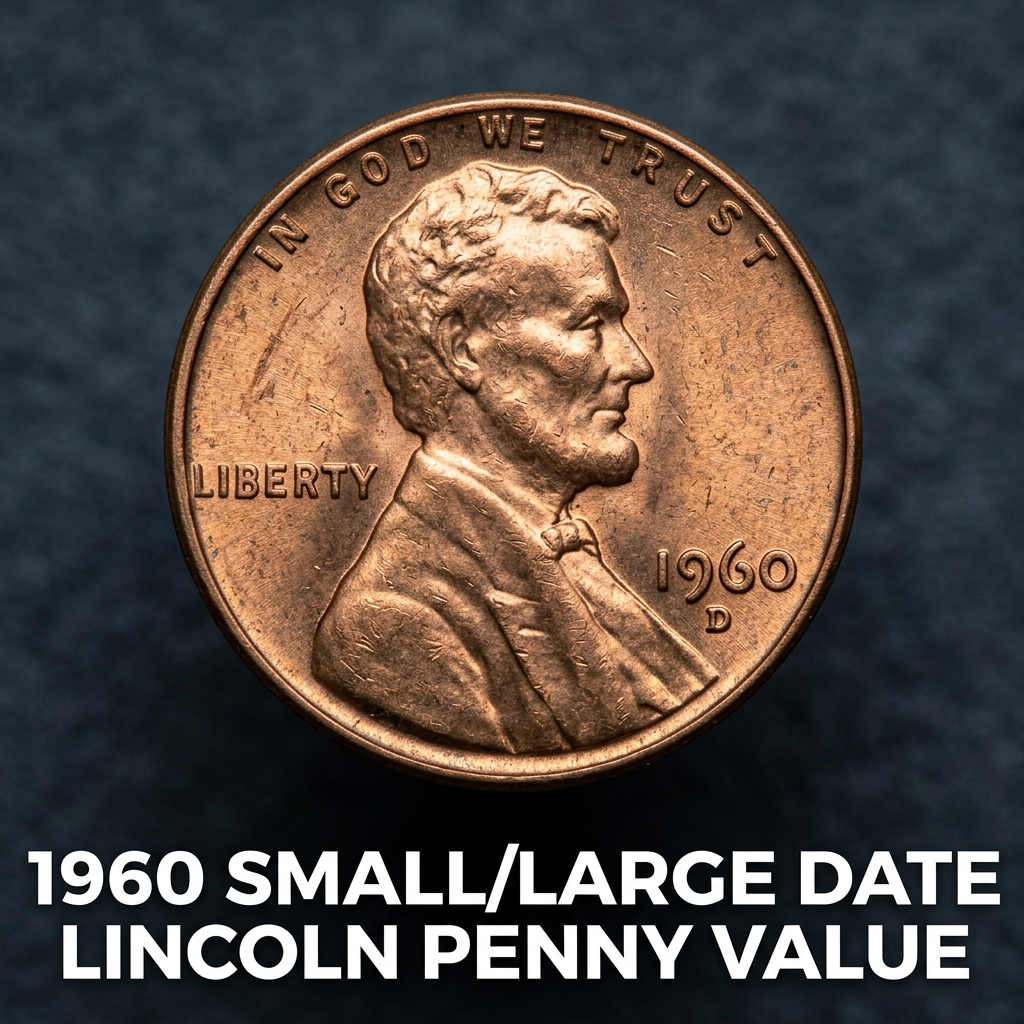
The 1960 Lincoln Penny is worth anywhere from a few cents in heavily worn condition to over $100 or more in pristine mint state — but here’s the twist: not all 1960 pennies are the same. The difference between a Small Date and a Large Date can mean a significant jump in value, and knowing which one you have could make all the difference.
How to Tell the Small Date and Large Date Apart
The most important thing you need to know about the 1960 Lincoln penny is that both the Philadelphia and Denver mints produced two distinct varieties: the Small Date and the Large Date. The date size refers to the size of the numerals “1960” stamped on the coin.
On the Large Date variety, the “9” sits higher and the numbers appear bolder and more spread out. On the Small Date, the numbers look slightly smaller and more compact, with the “9” appearing to drop lower compared to the other digits.
A magnifying glass is your best friend here. If you’re not sure which variety you have, you can use a free coin identifier app to help you figure it out quickly without any guesswork. Once you know your variety, you’ll have a much better idea of what your coin might be worth.
1960 Small Date vs Large Date Value Breakdown
The 1960-P (Philadelphia) Small Date penny is generally the more valuable variety. In circulated condition, it might bring $1 to $5. But in higher mint state grades, certified examples can sell for $50 to $100 or more. The Denver mint Small Date is also collectible but tends to trade at slightly lower premiums.
The Large Date is far more common and is the variety most people find in old jars and drawers. In worn condition, it’s worth face value to maybe a few cents. In MS-65 Red condition, it can still fetch a few dollars to $20 or more depending on eye appeal.
For a detailed look at certified auction prices and current market data, check out this 1960 Large Date Lincoln Penny price guide with MS-RD grades and recent sales.
| Variety | Circulated (Good–Fine) | MS-63 Red | MS-65 Red |
|---|---|---|---|
| 1960-P Large Date | $0.05 – $0.25 | $2 – $5 | $10 – $20 |
| 1960-P Small Date | $1 – $5 | $15 – $35 | $50 – $100+ |
| 1960-D Large Date | $0.05 – $0.15 | $1 – $4 | $8 – $18 |
| 1960-D Small Date | $0.50 – $2 | $8 – $20 | $30 – $75 |
What Makes a 1960 Penny More Valuable
Condition is king when it comes to coin values. A 1960 Lincoln penny that has never been circulated — what collectors call “mint state” — will always be worth significantly more than one that’s been rattling around in someone’s pocket for decades.
Color also plays a major role. Lincoln cents are graded as Red (RD), Red-Brown (RB), or Brown (BN). Red coins have retained their original copper luster and are worth the most. Brown coins have fully toned and tend to sell for the least. Always look for bright, untouched examples.
Errors and varieties can also bump up value considerably. Some 1960 pennies have doubled die features or repunched mint marks that collectors actively seek out. If your coin looks a little “off” or the date looks like it was stamped twice, it’s worth a closer look.
CoinHix is a great tool for checking current market values across different grades. Whether you have a raw coin or a professionally graded slab, CoinHix lets you track real auction results so you know exactly what buyers are actually paying — not just estimated book values.
How to Get Your 1960 Lincoln Penny Appraised
If you believe you have a Small Date variety in excellent condition, it may be worth getting it professionally graded. Services like PCGS and NGC will authenticate and grade your coin, which can significantly increase its resale value and buyer confidence.
For most everyday collectors, though, a quick check using CoinHix or reviewing recent eBay sold listings will give you a solid ballpark. You can also explore a full breakdown of 1960 penny values by date, mint mark, and grade to see how your coin stacks up.
Don’t clean your coin before getting it appraised. Cleaning removes the original surface and can dramatically lower the grade and value. Let a professional handle it first.
—
FAQ
Q: How do I know if my 1960 penny is a Small Date or Large Date?
A: Look closely at the “1960” on the obverse. On the Large Date, the numbers are bold and the “9” sits high. On the Small Date, the digits are slightly smaller and the “9” dips lower. A magnifying glass or loupe makes this much easier to see.
Q: Is the 1960-D Small Date penny rare?
A: It’s scarcer than the Large Date but not extremely rare in circulated condition. High-grade mint state examples, especially in Red, are where the real demand is. Certified MS-65 RD examples can sell for $30 to $75 or more.
Q: Should I get my 1960 Lincoln penny graded?
A: If it appears uncirculated and shows strong red color with no visible marks or spots, it may be worth the cost of grading. For worn or lower-quality examples, grading fees likely won’t be worth it. Use a tool like CoinHix first to estimate potential value before committing to professional grading.