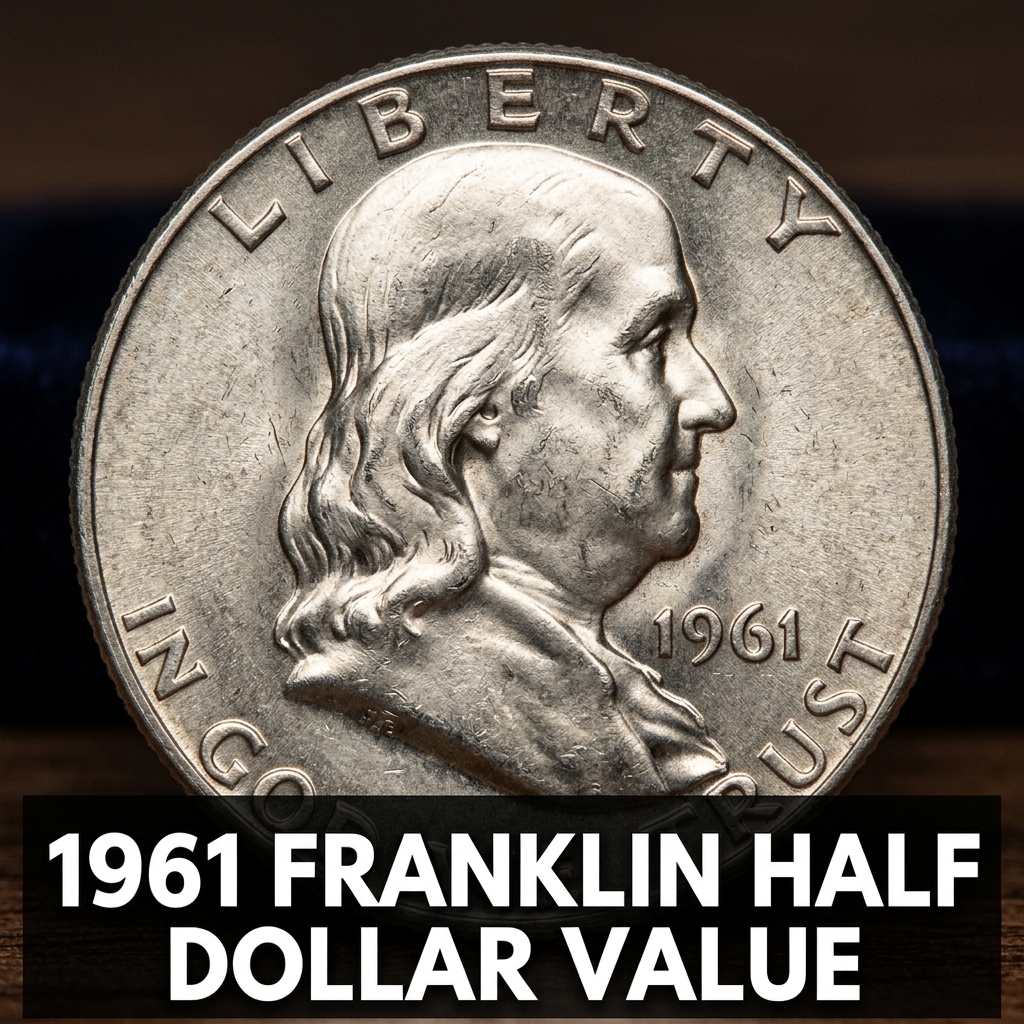
The 1961 Franklin Half Dollar is worth anywhere from around $10 in heavily worn condition to well over $100 in mint state — and certain high-grade examples have sold for thousands at auction. If you’ve got one sitting in a drawer or coin jar, you might be holding more than pocket change.
What Is the 1961 Franklin Half Dollar?
The Franklin Half Dollar was minted from 1948 to 1963, making the 1961 issue one of the later entries in this beloved series. Designed by John R. Sinnock, the coin features Benjamin Franklin on the obverse and the Liberty Bell on the reverse — a classic American design that collectors genuinely love.
The 1961 half dollar contains 90% silver, which alone gives it real melt value regardless of its collector grade. At current silver prices, even a worn example is worth several times its face value of 50 cents.
Two mint facilities produced coins in 1961: the Philadelphia Mint (no mint mark) and the Denver Mint (marked with a “D”). Both are relatively common in circulated grades, but uncirculated examples with sharp details are a different story entirely.
If you’re not sure what you have, a free coin identifier app can help you figure out the date, mint mark, and condition before you spend time hunting down a price guide.
How Much Is the 1961 Franklin Half Dollar Worth?
The value of your 1961 Franklin Half Dollar depends on three key factors: the mint mark, the grade, and whether it has any special designations like Full Bell Lines (FBL).
Full Bell Lines refers to the completeness of the horizontal lines at the bottom of the Liberty Bell. Coins with sharp, unbroken bell lines command a serious premium in higher grades — sometimes 10x or more compared to non-FBL examples.
Here’s a general value breakdown based on condition:
| Grade | 1961 (Philadelphia) | 1961-D (Denver) |
|---|---|---|
| Good (G-4) | $10–$12 | $10–$12 |
| Very Fine (VF-30) | $12–$16 | $12–$16 |
| Extremely Fine (EF-45) | $14–$20 | $14–$20 |
| MS-63 | $25–$45 | $25–$40 |
| MS-65 | $80–$150 | $70–$130 |
| MS-65 FBL | $400–$1,500+ | $200–$800+ |
For a deeper look at certified mint state pricing data for the 1961 Franklin Half Dollar, it’s worth checking auction records and graded coin sales to see where the market currently sits.
Proof Coins and Special Versions
In 1961, the U.S. Mint also produced Proof Franklin Half Dollars for collectors. These were struck at the Philadelphia Mint with extra care, resulting in mirror-like surfaces and sharp details. Proof coins from 1961 typically sell for $30–$60 in standard grades, but Proof-66 and Proof-67 examples with Cameo or Deep Cameo designations can reach $500 or more.
Cameo proofs have frosted design elements contrasting with mirror-like fields — they’re visually striking and highly sought after by collectors. If your coin has a brilliant, almost reflective look with no evidence of circulation, you may have a proof on your hands.
The easiest way to tell is to examine the edge and surface under good lighting. A genuine proof will show no wear and usually has razor-sharp lettering.
What Affects the Value Most?
Condition is king when it comes to the 1961 Franklin Half Dollar value. A coin that looks shiny to an untrained eye might actually be a cleaned coin — and cleaning dramatically reduces collector value. Numismatists (coin experts) can almost always spot a cleaned surface, and grading services like PCGS and NGC will note it on the holder.
Mint marks matter, but less so for 1961 than for some other years in the Franklin series. Both the Philadelphia and Denver issues had relatively high mintages, so neither is considered rare in lower grades.
The real value driver — especially for collectors — is the Full Bell Lines designation. This makes certain 1961 halves dramatically more valuable than their otherwise similar counterparts.
To get a well-rounded picture of your coin’s worth, you can also visit this detailed guide to 1961 half dollar values across all grades and mint marks, which breaks things down in plain language.
CoinHix is another excellent resource. The CoinHix app gives you real-time market pricing, auction comparables, and grading guides all in one place — making it one of the easiest ways to track the value of your Franklin half dollar without needing to be an expert.
Tips for Selling or Getting Your Coin Graded
If you believe your coin might be in uncirculated or proof condition, getting it professionally graded by PCGS or NGC is often worth the investment. A certified MS-65 or higher coin is far easier to sell and commands more buyer confidence than a raw ungraded coin.
For lower-grade circulated coins, you can sell to local coin shops, online marketplaces like eBay, or coin shows. Most dealers will offer silver melt value at minimum for a 90% silver coin, which ensures you never walk away empty-handed.
Use CoinHix to compare recent sale prices before you sell — knowing what similar coins have actually sold for (not just asking prices) puts you in a much stronger negotiating position.
—
Frequently Asked Questions
Q: Is a 1961 Franklin Half Dollar made of silver?
A: Yes. All Franklin Half Dollars, including the 1961 issue, are composed of 90% silver and 10% copper. This means even a heavily worn example has meaningful silver melt value, typically around $8–$12 depending on current silver spot prices.
Q: What does “Full Bell Lines” mean and why does it matter?
A: Full Bell Lines (FBL) refers to the complete, sharp horizontal lines at the bottom of the Liberty Bell on the reverse of the coin. These lines were often weak due to striking pressure and die wear. Coins with fully defined bell lines are scarcer and much more valuable, especially in higher mint state grades.
Q: How can I tell if my 1961 Franklin Half Dollar is proof or business strike?
A: Proof coins have highly reflective, mirror-like surfaces and were made specifically for collectors — not for circulation. They typically show no wear and have extremely sharp design details. Business strike coins, meant for everyday use, have a more satiny or frosty finish. If you’re unsure, a professional grader or a tool like CoinHix can help you identify which type you have.