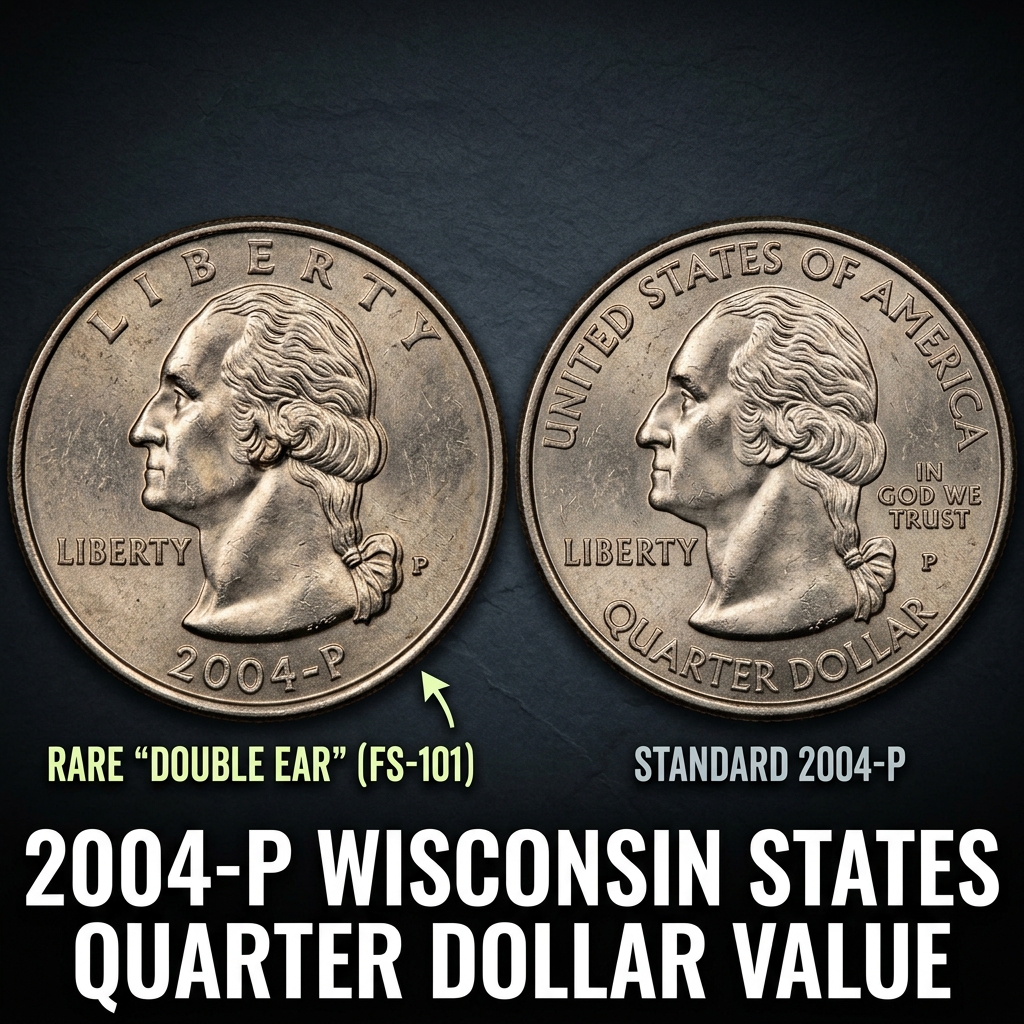
The 2004-P Wisconsin State Quarter is worth anywhere from 25 cents in heavily circulated condition to over $50 or more for high-grade mint state examples — and certain rare error varieties can fetch hundreds of dollars from the right collector.
If you recently dug this coin out of a drawer, found it in change, or inherited a collection, you’re in the right place. This guide breaks down exactly what your 2004-P Wisconsin State Quarter is worth, what to look for, and how to tell if you have something special on your hands.
What Is the 2004-P Wisconsin State Quarter?
The 2004-P Wisconsin State Quarter was struck at the Philadelphia Mint as part of the United States Mint’s 50 State Quarters Program, which ran from 1999 to 2008. Wisconsin was the 30th state featured in the series, and its quarter showcases a cow, a round of cheese, and a corn stalk — a nod to the state’s proud agricultural heritage.
The “P” mintmark stands for Philadelphia, and the coin was produced in massive quantities. In fact, over 453 million of these quarters were minted in Philadelphia alone. Because so many were made, most circulated examples are worth only face value or just slightly above it.
That said, condition is everything in coin collecting. A coin pulled straight from a bank roll in pristine, uncirculated condition is a completely different animal than one that’s been jingling around in pockets for 20 years.
To quickly identify what you have, try a free coin identifier app — it can scan your coin and give you an instant grade estimate right from your phone.
2004-P Wisconsin Quarter Value by Grade
Here’s where things get interesting. The value of your 2004-P Wisconsin State Quarter depends heavily on its condition, also known as its “grade” in coin collecting terms. Below is a breakdown of typical market values across different grades:
| Grade / Condition | Description | Estimated Value |
|---|---|---|
| Circulated (Average) | Worn, used in everyday transactions | $0.25 – $0.50 |
| Extremely Fine (EF-45) | Light wear, most details sharp | $0.75 – $2 |
| Mint State 63 (MS-63) | Uncirculated, minor contact marks | $2 – $8 |
| Mint State 65 (MS-65) | Gem uncirculated, strong luster | $10 – $25 |
| Mint State 67 (MS-67) | Superb gem, nearly perfect | $40 – $75+ |
| Error Varieties (High Leaf / Low Leaf) | Known die errors on corn stalk | $200 – $1,500+ |
For the most up-to-date auction results and certified coin prices, you can check recent sale prices for 2004-P State Quarters in mint state grades to see what collectors are actually paying right now.
The Famous Wisconsin Error Quarters — Are You Holding One?
This is the big one. The 2004-P Wisconsin State Quarter has two well-documented error varieties that have captured collectors’ attention for years: the Extra Leaf High and Extra Leaf Low varieties.
On a normal Wisconsin quarter, the corn stalk on the reverse has a specific number of leaves. On the error coins, an extra leaf appears on the left side of the corn — either pointing upward (High Leaf) or curving downward (Low Leaf). These errors are believed to have been caused by intentional or accidental die gouging at the Denver Mint (note: some error coins also appeared from Denver, marked with a “D” mintmark, but Philadelphia-minted examples exist too and carry collector premiums).
To check yours, flip the coin over and look closely at the corn stalk. Use a magnifying glass if you have one. The extra leaf is subtle but unmistakable once you know what you’re looking for.
If you spot something unusual, don’t spend it! These error quarters regularly sell for $200 to over $1,500 depending on grade and certification. Getting the coin authenticated by PCGS or NGC is strongly recommended before selling.
CoinHix is a great tool to scan your coin and quickly compare it against known error varieties in their database — it takes the guesswork out of the process.
How to Get the Best Price for Your 2004-P Wisconsin Quarter
If you believe you have a high-grade or error example, there are a few steps you should take before selling.
First, handle the coin as little as possible and avoid cleaning it. Cleaning a coin can dramatically reduce its value — collectors and graders can spot it immediately, and a cleaned coin will always grade lower than an original, uncleaned one.
Second, consider getting your coin professionally graded by PCGS or NGC if it looks like it could be MS-65 or higher, or if you suspect it’s an error variety. The certification adds credibility and often doubles or triples the selling price.
Third, sell in the right places. eBay, Heritage Auctions, and specialized coin shows are all solid options for reaching serious buyers. For a quick value estimate before you list, check the current 2004 quarter value data here to set a realistic asking price.
And if you’re just starting out and want a simple way to identify and value your coins, CoinHix offers an easy-to-use interface that’s perfect for beginners and experienced collectors alike. It’s one of the fastest ways to know what you have before making any decisions.
Proof and Special Mint Set Versions
Beyond the standard circulation strike, the U.S. Mint also produced special versions of the 2004 Wisconsin quarter for collectors. These include:
– Clad Proof: Struck at the San Francisco Mint (S mintmark), mirror-like finish, sold in proof sets. Value: $3–$10.
– Silver Proof: Also from San Francisco, made of 90% silver. Value: $8–$20 depending on silver spot price.
– Satin Finish: Included in Mint Sets, with a distinctive non-reflective finish. Value: $2–$6.
These collector editions are generally not found in circulation, so if you have one, it likely came from an original government-issued set.
—
FAQ About the 2004-P Wisconsin State Quarter
Q: Is my 2004-P Wisconsin quarter worth more than face value?
A: Most circulated examples are worth only 25 to 50 cents. However, uncirculated coins can be worth $2 to $75 or more depending on grade, and error varieties with the extra leaf can sell for hundreds of dollars.
Q: How do I know if I have the extra leaf error variety?
A: Look at the corn stalk on the reverse of the coin. On error coins, there is an additional leaf on the left side of the stalk that doesn’t appear on normal coins. It points either upward (High Leaf) or curls downward (Low Leaf). A magnifying glass and good lighting will help you spot it clearly. You can also use CoinHix to scan and compare your coin.
Q: Should I clean my 2004-P Wisconsin quarter before selling it?
A: Absolutely not. Cleaning coins removes the natural surface and luster that collectors value. A cleaned coin will always be worth less than an unaltered one in the same condition. Leave it as-is and let a professional grader assess its true condition.