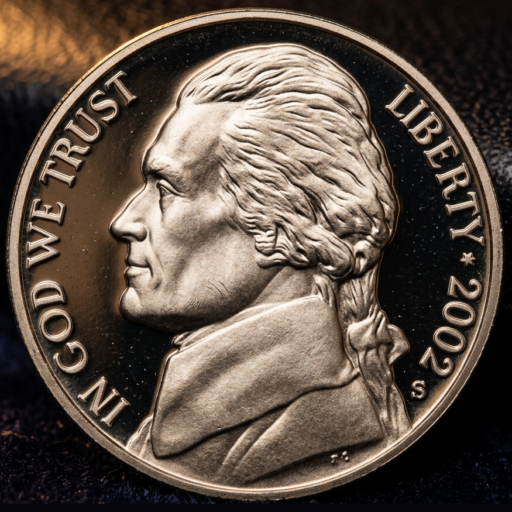
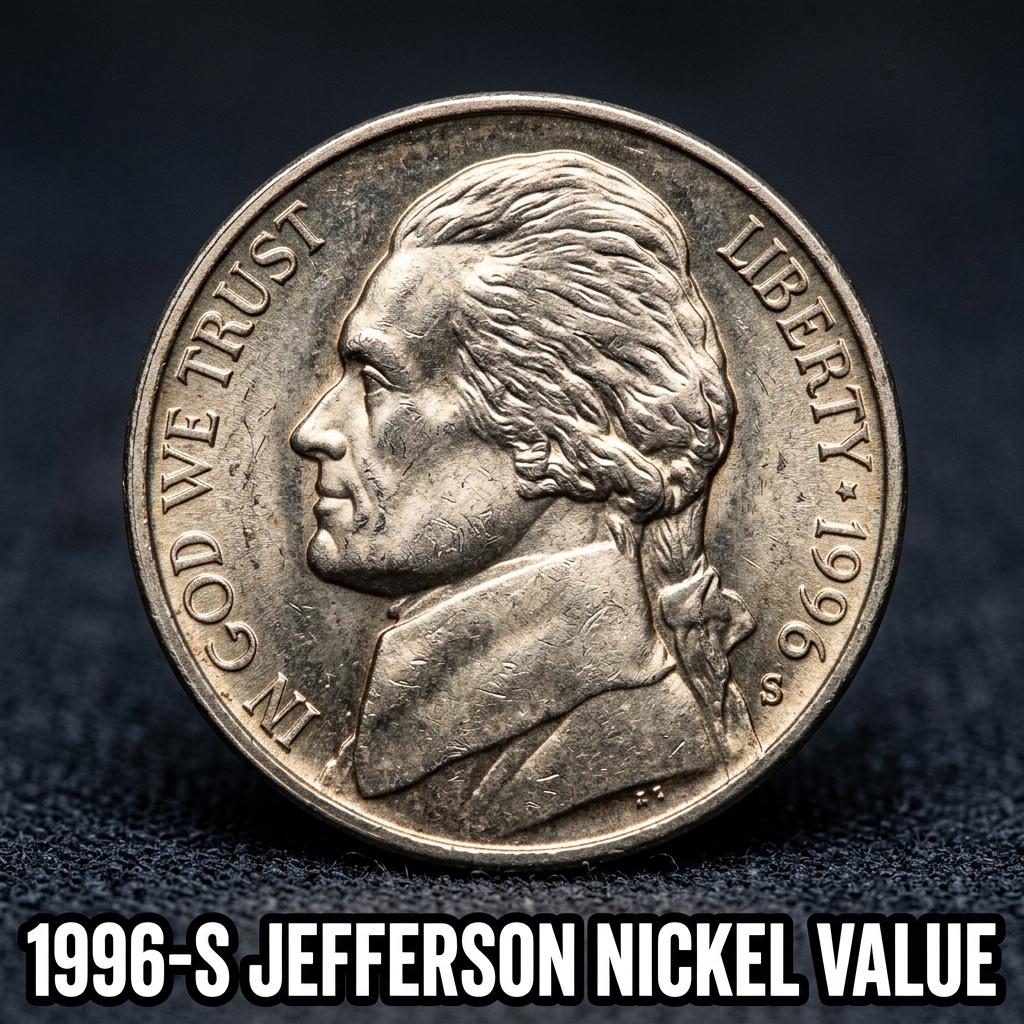
The 1996-S Jefferson Nickel is worth anywhere from $3 to $15 for most examples, but proof versions — which is exactly what the “S” mint mark means — can fetch $5 to $25 or more depending on condition and eye appeal. If you found one of these in a coin folder or inherited a proof set, you might have something nicer than your average pocket change.
What the “S” Mint Mark Actually Means
Not everyone knows this, but the “S” on a 1996 Jefferson Nickel stands for the San Francisco Mint. And here’s the key thing — San Francisco didn’t make nickels for general circulation that year. Every 1996-S nickel was made specifically as a proof coin, struck with extra care using polished dies and specially prepared planchets.
That means if you have a 1996-S nickel, it almost certainly came from a proof set sold directly by the U.S. Mint to collectors. It was never meant to jingle around in someone’s pocket.
These coins have a mirror-like background and frosted raised design, giving them a crisp, almost glassy look. That finish is what makes them different — and worth more than the five cents stamped on the face.
If you’re not sure what you’re holding, a free coin identifier app can help you confirm the mint mark, grade, and approximate value within seconds. CoinHix is one of the most popular tools for this — just snap a photo and it does the work for you.
How Much Is a 1996-S Jefferson Nickel Worth?
Value depends almost entirely on condition. Since these were never circulated, most examples still sit in their original proof sets and grade quite well. Here’s a general breakdown:
| Grade / Condition | Estimated Value |
|---|---|
| PR-65 (standard proof) | $3 – $6 |
| PR-67 (gem proof) | $6 – $12 |
| PR-68 (superb gem) | $10 – $20 |
| PR-69 DCAM (deep cameo) | $15 – $30 |
| PR-70 DCAM (perfect grade) | $50 – $100+ |
The “DCAM” designation — short for Deep Cameo — refers to coins with especially strong contrast between the frosted devices and mirror fields. These are the most visually striking and the most desirable to collectors.
For the most up-to-date market pricing, you can check current 1996 Jefferson Nickel price trends across grades to see what these are actually selling for right now.
How Many Were Made?
The U.S. Mint produced approximately 2,525,265 proof nickels at the San Francisco facility in 1996. While that sounds like a lot, keep in mind these were only sold in collector sets — not distributed through banks or stores.
Over the decades, many proof sets get broken up, sold, or passed down through families without anyone realizing what’s inside. Some coins get damaged or lost. The surviving population in top grades (PR-69 and above) is actually much smaller than the original mintage suggests.
That’s why high-grade certified examples — especially those in PCGS or NGC slabs — can command real premiums. A raw (uncertified) coin in an old proof set might only bring a few dollars, but the same coin graded PR-70 DCAM by a major grading service has sold for significantly more at auction.
What to Look For on Your 1996-S Nickel
If you’re examining your coin, here’s what matters most:
Cameo contrast — The portrait of Thomas Jefferson and Monticello on the reverse should look frosty white against a deeply reflective, mirror-like background. Strong contrast = higher value.
No hairlines — Even tiny scratches from improper cleaning can knock a proof coin from PR-68 down to PR-65. Never clean a proof coin. Ever.
Original packaging — If your 1996-S nickel is still in its original U.S. Mint proof set packaging, that’s a good sign it hasn’t been handled or mishandled.
You can get a detailed look at what your 1996 nickel is worth based on its specific condition using online guides that walk through each grade level with photos.
And if you want an instant opinion right from your phone, CoinHix lets you photograph your coin and get a grade estimate and value range without having to visit a coin shop.
Should You Get It Certified?
Probably not — unless you believe your coin grades PR-69 or PR-70. Grading fees from PCGS or NGC typically run $20 to $40 per coin for standard service. Since most 1996-S nickels are worth $5 to $15, it only makes financial sense to submit if you’re confident the grade is exceptional.
That said, if you have a full 1996 proof set in pristine condition, it may be worth getting the entire set appraised. CoinHix can give you a starting point before you decide whether professional grading makes sense.
—
FAQ
Q: Is the 1996-S Jefferson Nickel rare?
A: It’s not rare by strict definition — over 2.5 million were made. But it was never circulated, so finding one in everyday change is essentially impossible. Among proof coins, high-grade examples with deep cameo contrast are notably scarce.
Q: Can I find a 1996-S nickel in circulation?
A: Almost certainly not. The San Francisco Mint only struck proof versions in 1996, which were sold exclusively in collector proof sets. They were never released into circulation through banks or retail stores.
Q: What’s the difference between a regular Jefferson Nickel and a proof?
A: Regular circulation nickels (from Philadelphia or Denver) are struck once with standard dies on ordinary planchets. Proof coins are struck multiple times using highly polished dies on specially prepared blanks, producing a sharper, more detailed coin with a distinct mirror-like finish. The 1996-S is a proof coin.