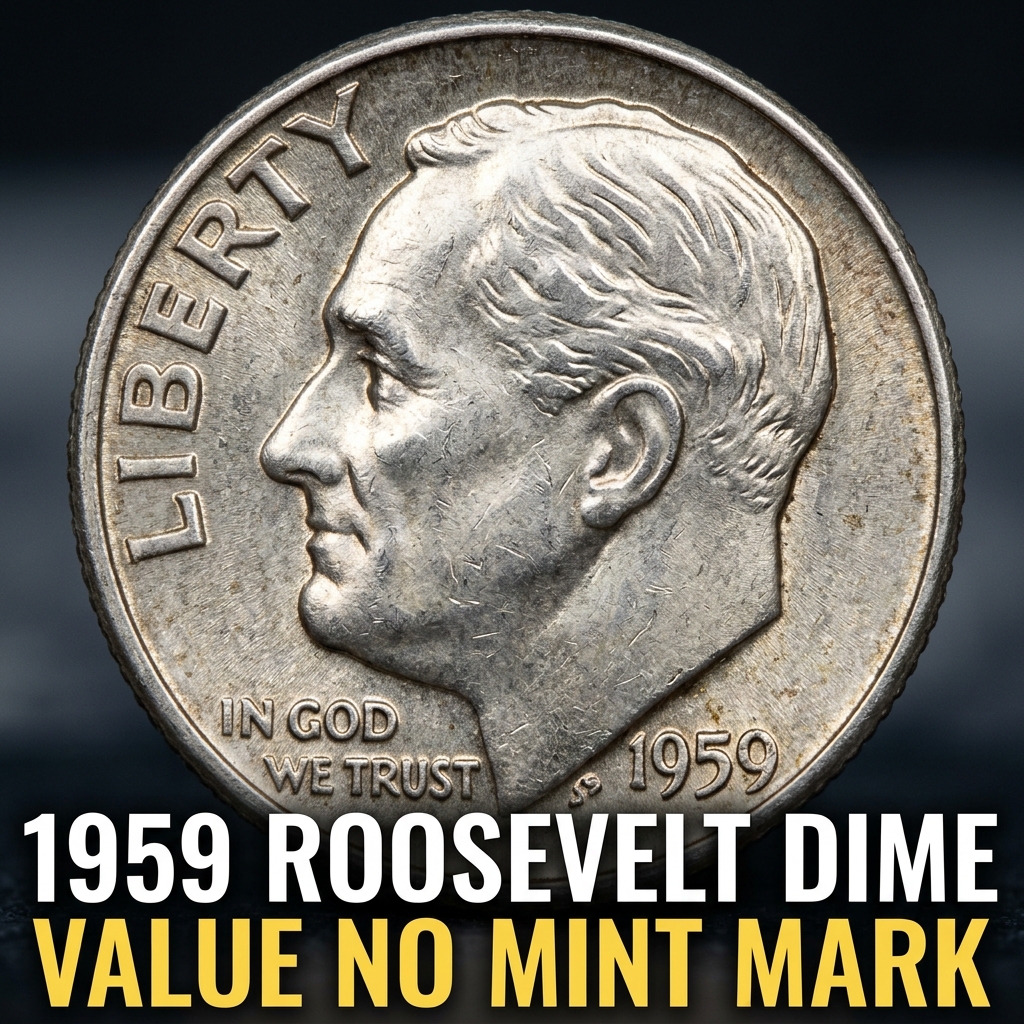
If you’ve found a 1959 Roosevelt dime with no mint mark, you’re looking at a coin worth anywhere from $2 in heavily worn condition to over $30 or more in top mint state grades — and a few exceptional examples have sold for hundreds at auction.
What the No Mint Mark Means on a 1959 Dime
When you flip over a 1959 Roosevelt dime and notice there’s no mint mark on it, that’s not a mistake or a rare error — it simply means the coin was struck at the Philadelphia Mint. Back in 1959, Philadelphia was the only U.S. Mint facility that did not add a mint mark to its coins. That changed decades later, but for this era, a blank spot where a mint mark would appear is completely normal.
The Philadelphia Mint produced a massive number of dimes that year — over 85 million 1959 Roosevelt dimes were struck without a mint mark. Because of that high mintage, these coins are fairly common in circulated grades. But don’t write it off just yet. Condition plays a huge role in determining real value.
If you want to quickly check what your coin might be worth before reading further, you can use a free coin identifier app right from your phone. It takes just a second and gives you a solid starting estimate.
How Much Is the 1959 Roosevelt Dime Worth by Grade
Coin value is almost entirely driven by condition. Collectors grade coins on a scale from 1 (barely identifiable) to 70 (perfect). For everyday people, the simplest way to think about it is: circulated vs. uncirculated.
A circulated 1959 dime — one that was actually used in commerce and shows wear on Lincoln’s portrait and the torch design — is typically worth just above its silver melt value. Since these dimes are made of 90% silver, the melt value alone hovers around $1.50 to $2.00 depending on the current silver spot price.
Once you get into uncirculated territory (also called mint state), the value climbs noticeably. Here’s a general breakdown:
| Grade | Condition Description | Estimated Value |
|---|---|---|
| Good (G-4) | Heavy wear, design visible | $1.75 – $2.50 |
| Fine (F-12) | Moderate wear, details clear | $2.00 – $3.00 |
| Extremely Fine (EF-40) | Light wear on high points | $3.00 – $5.00 |
| Mint State (MS-63) | Uncirculated, minor marks | $10 – $20 |
| Mint State (MS-65) | Gem uncirculated | $25 – $40 |
| Mint State (MS-67+) | Near perfect, very rare | $200+ |
For the most current pricing on certified examples, check out detailed 1959 Roosevelt dime auction price data by grade on CoinHix. The numbers can shift with silver prices and collector demand.
The Silver Content and Melt Value Factor
One thing that makes the 1959 Roosevelt dime interesting — even in worn condition — is that it’s a 90% silver coin. Each dime contains roughly 0.07234 troy ounces of pure silver.
When silver prices rise, so does the floor value of your coin. At $25 silver per troy ounce (a commonly referenced benchmark), the melt value alone is about $1.81. This means even a heavily worn 1959 no mint mark dime is never truly worth just ten cents — it always carries real silver value beneath the surface.
Coin dealers and buyers often refer to these as “junk silver” dimes, but don’t let that name fool you. They’re a legitimate way to hold physical silver, and many everyday collectors buy rolls of them specifically for that reason.
What Makes a 1959 Roosevelt Dime More Valuable
While most 1959 Philadelphia dimes are common, a few factors can push a coin’s value higher than the average.
Full Bands (FB) designation is one of the most important. On Roosevelt dimes, the torch on the reverse features horizontal bands. When those bands are fully struck and sharply defined, professional grading services like PCGS and NGC award the coin a “Full Bands” designation. This can double or even triple the value compared to a regular example in the same grade.
Eye appeal and luster matter too. A coin with original, brilliant luster and no distracting marks will always attract stronger bids. Storage, cleaning history, and original surfaces all play into this.
For a complete breakdown of how condition affects the 1959 dime value across all grades and mint marks, it’s worth reviewing a dedicated price guide.
If you want to identify and value coins like this on the go, CoinHix is a great tool to have in your pocket. The CoinHix app lets you look up certified coin prices quickly, so you always know what you’re holding.
Should You Hold or Sell Your 1959 Roosevelt Dime?
For most people who find a circulated 1959 Roosevelt dime with no mint mark, the honest answer is that it’s worth a few dollars — mostly for its silver content. That’s still a solid return on a coin that spent decades in someone’s pocket or change jar.
If your coin looks uncirculated — bright, shiny, with no visible wear — it’s worth taking a closer look. Compare it to graded examples online or consider submitting it to a grading service if it appears to be a gem example.
Use CoinHix or another coin price resource to stay updated on current silver prices and recent auction results before making any selling decisions. Knowledge is what separates a good deal from leaving money on the table.
—
Frequently Asked Questions
Q: Is a 1959 Roosevelt dime with no mint mark rare?
A: No, it is not rare. Over 85 million were minted at the Philadelphia Mint in 1959. However, high-grade examples — especially those with Full Bands — are significantly scarcer and can be worth considerably more.
Q: How do I know if my 1959 dime is uncirculated?
A: Look at the coin under good lighting. An uncirculated coin will have an original shine or luster with no flat, dull spots from wear on the high points of the design (Roosevelt’s cheekbone and the torch flame). Any rubbing or dulling indicates circulation.
Q: What is the most valuable 1959 Roosevelt dime ever sold?
A: A 1959 Philadelphia dime graded MS-68 Full Bands by PCGS has sold at auction for several hundred dollars. These top-pop examples are extremely rare and represent the very best of what the Philadelphia Mint produced that year.