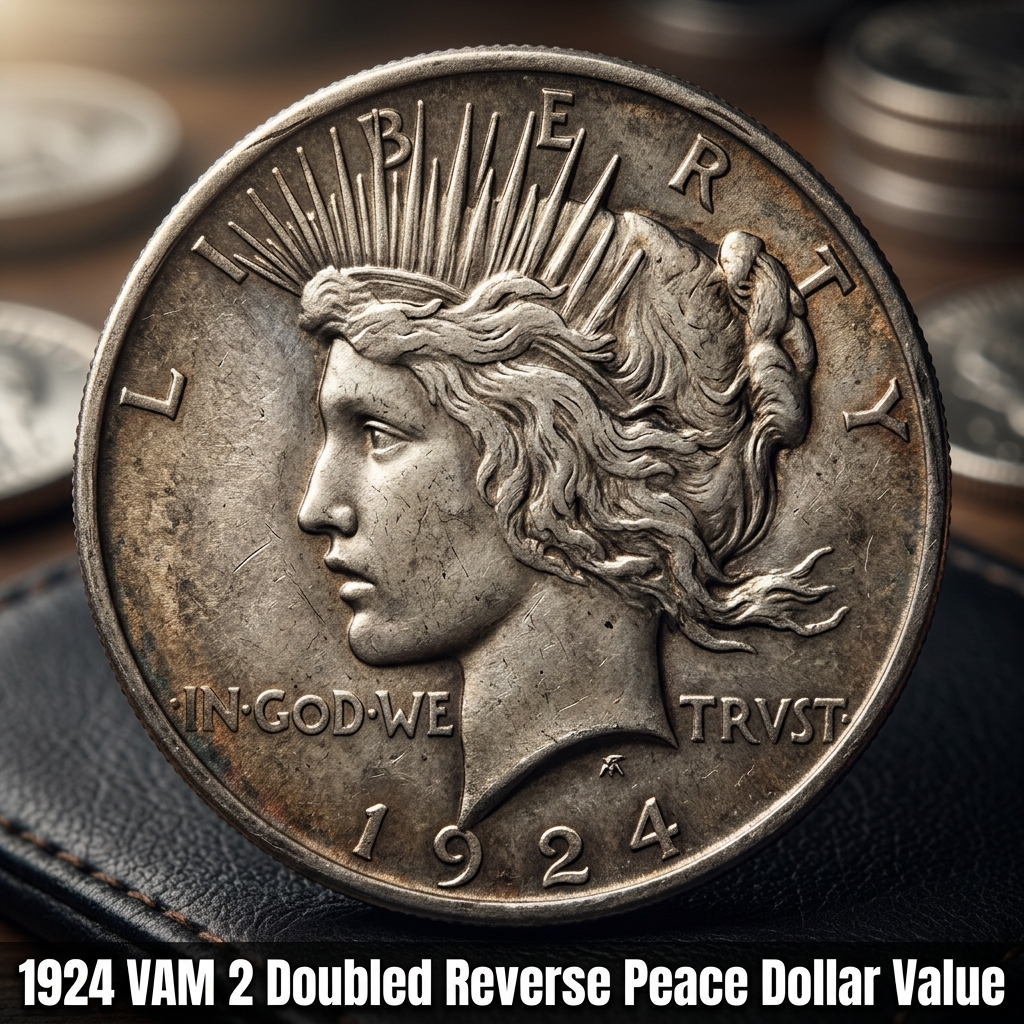
If you’ve stumbled across a 1924 Peace Dollar and noticed something unusual about the lettering on the back, you might be holding a 1924 VAM 2 Doubled Reverse Peace Dollar — a variety worth anywhere from $30 in heavily worn condition to well over $500 or more in higher mint state grades.
Most people find old Peace Dollars tucked away in shoeboxes, coin jars, or inherited collections and wonder if they’ve hit the jackpot. Sometimes, they have. The VAM 2 variety is one of those cases where a small detail makes a big difference in value. If you want to get a quick read on what you’re holding, try a free coin identifier app before heading to a coin dealer.
What Is the 1924 VAM 2 Doubled Reverse Peace Dollar?
VAM stands for Van Allen-Mallis, named after the two researchers who catalogued die varieties in Morgan and Peace dollars. The VAM 2 variety on the 1924 Peace Dollar is identified by a visible doubling on the reverse (tails) side of the coin — most noticeably in the lettering of “PEACE,” “DOLLAR,” and sometimes in the eagle’s feathers.
This doubling happened during the minting process when the die was hubbed more than once and shifted slightly between impressions. The result is a coin with slightly doubled letters or design elements that look almost like a shadow.
It’s not damage. It’s a manufacturing quirk — and collectors love it.
To see a full breakdown of 1924 Peace Dollar prices by grade and variety, it helps to compare where the VAM 2 falls relative to the standard issue coins.
How to Identify the VAM 2 Doubled Reverse
You’ll need at least a 5x loupe or a magnifying glass to spot the doubling clearly. Look at the reverse of the coin and focus on the word “PEACE” near the bottom of the eagle. On a VAM 2, you’ll notice a slight secondary image slightly offset from the primary letters.
Also check the rays above the eagle’s head and the word “DOLLAR” along the bottom. The doubling can be subtle, so take your time and use good lighting.
If you’re not sure what you’re seeing, CoinHix is an excellent resource. The app lets you compare known VAM varieties side by side and even helps you determine if your coin’s condition matches a gradable example. It’s one of the easiest tools available for everyday collectors trying to sort out die varieties.
1924 VAM 2 Peace Dollar Value by Grade
Condition matters enormously with VAM coins. A well-worn example has charm but limited premium value. The real money is in lightly circulated or mint state examples where the doubling is still visible and sharp.
Here’s a general value table based on current market data:
| Grade | Description | Estimated Value |
|---|---|---|
| G-4 (Good) | Heavy wear, design visible | $28 – $35 |
| VF-20 (Very Fine) | Moderate wear, details present | $35 – $55 |
| EF-40 (Extremely Fine) | Light wear, doubling may show | $55 – $90 |
| AU-55 (About Uncirculated) | Slight wear on high points | $90 – $150 |
| MS-63 (Mint State) | No wear, minor contact marks | $200 – $375 |
| MS-65 (Gem Mint State) | Sharp strike, excellent luster | $450 – $600+ |
Note: These values reflect the VAM 2 variety premium. A standard 1924 Peace Dollar in the same grades typically runs 10–20% lower.
Is the VAM 2 Worth Getting Professionally Graded?
If your coin looks like it might be in AU or Mint State condition, professional grading from PCGS or NGC is absolutely worth considering.
Grading costs around $30–$50 per coin depending on the service level, but a certified MS-63 or higher VAM 2 can bring two to three times more at auction than an ungraded example. Buyers trust certified coins, and the label will note the VAM attribution if confirmed.
Before spending money on grading, check out detailed 1924 Silver Dollar value information to make sure the grade estimate on your coin warrants the cost.
You can also use CoinHix to get a real-time price estimate and compare recent sales of similar certified VAM coins before making that decision.
Where to Sell a 1924 VAM 2 Peace Dollar
Your best options are Heritage Auctions, Stack’s Bowers, or eBay if you want market-rate pricing. Local coin dealers will often offer 60–70% of retail, which is fair if you want a quick sale.
If the coin is certified, online auction is almost always the better route. VAM collectors are a dedicated community and will pay well for clean, attributed examples.
CoinHix also lists active market prices and can help you time your sale based on recent comparable transactions.
Frequently Asked Questions
Q: How do I know if my 1924 Peace Dollar is actually a VAM 2?
A: Look for doubled lettering on the reverse, especially in the word “PEACE” and around the eagle. Use a 5x or 10x magnifier. You can also compare your coin to known VAM 2 images using the VAMWorld database or a coin identification app like CoinHix.
Q: Does the 1924 VAM 2 Peace Dollar have a mint mark?
A: The Philadelphia Mint struck Peace Dollars in 1924 without a mint mark, and that’s the mint associated with the VAM 2 variety. San Francisco (S) and Denver (D) issues have their own separate VAM listings.
Q: Is silver melt value relevant to this coin?
A: Yes. Every Peace Dollar contains 0.7734 troy ounces of silver, so even a heavily worn VAM 2 has a floor value based on the silver spot price. As of recent silver prices around $28–$30 per ounce, the melt value alone sits around $22–$23. The collector premium for the VAM 2 variety adds to that baseline.