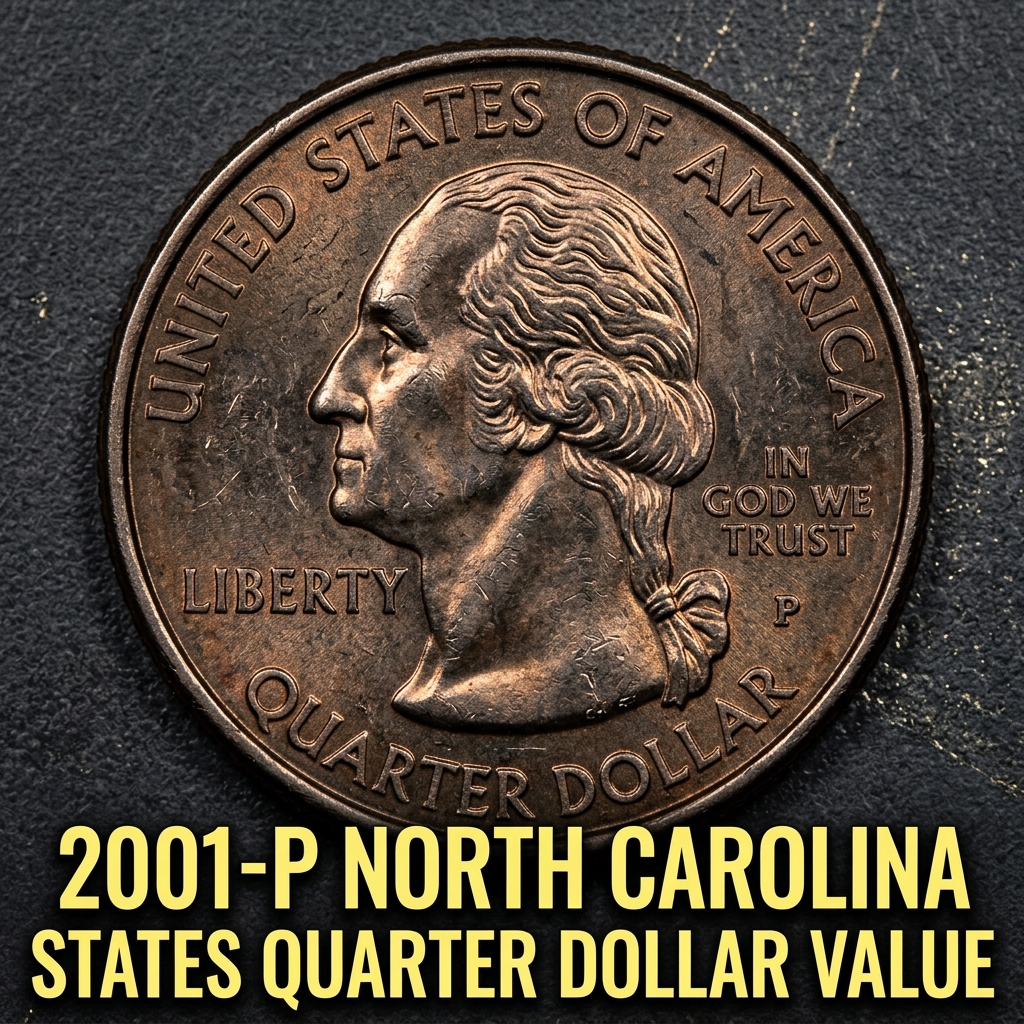
The 2001-P North Carolina State Quarter is worth anywhere from 25 cents in heavily circulated condition to $10 or more in gem uncirculated grades — and a handful of certified mint state examples have sold for significantly higher at auction. If you just found one of these coins in your pocket change or a forgotten jar, this guide will walk you through exactly what you’re holding and whether it’s worth setting aside.
What Is the 2001-P North Carolina State Quarter?
The 2001-P North Carolina State Quarter was struck at the Philadelphia Mint as part of the United States Mint’s 50 State Quarters Program, which ran from 1999 to 2008. The “P” mintmark simply means it was produced in Philadelphia. North Carolina was the 12th state released in the program, and its quarter features the Wright Brothers’ first flight at Kitty Hawk, along with the inscriptions “First in Flight” and “2001.”
The reverse design was chosen to honor one of the most iconic moments in American history — December 17, 1903, when Orville Wright lifted off for 12 seconds and changed the world forever.
More than 427 million of these coins were minted at the Philadelphia facility alone, which is important when it comes to value. High mintage generally means the coin is widely available, and that affects the price collectors are willing to pay.
If you’re unsure which mint produced your coin or want to quickly look it up, a free coin identifier app can help you scan and identify it in seconds, giving you basic value information right from your phone.
How Much Is the 2001-P North Carolina Quarter Worth?
For most people who find a 2001-P North Carolina quarter in circulation, the honest answer is that it’s worth face value — 25 cents. That’s because billions of state quarters entered everyday commerce, and worn examples without special errors or exceptional strike quality simply don’t attract serious collector premiums.
That said, condition changes everything in coin collecting. A coin pulled from a mint bag or roll that was never used — known as Mint State (MS) — can be worth a few dollars or more depending on the grade.
Here’s a quick breakdown of typical values by grade:
| Grade / Condition | Estimated Value |
|---|---|
| Circulated (worn) | Face value ($0.25) |
| About Uncirculated (AU-55/58) | $0.50 – $1.00 |
| Mint State MS-63 | $1.50 – $3.00 |
| Mint State MS-65 | $4.00 – $8.00 |
| Mint State MS-67 or higher | $20.00 – $100+ |
For up-to-date auction prices and certified population data on similar coins, you can explore detailed mint state pricing for 2001-P State Quarters at CoinHix, which tracks real market sales across major grading services.
Error Coins That Could Be Worth Real Money
Here’s where things get exciting. Some 2001-P North Carolina quarters were struck with errors, and those pieces can be worth far more than a standard example.
Known errors to look for include:
Die cracks and cuds — raised lines or blobs on the coin surface caused by a cracked die. Minor ones add small premiums, but dramatic cuds near the rim can bring $20–$50 or more.
Off-center strikes — if the design is noticeably shifted from center, collectors want them. A 10–20% off-center error might sell for $15–$40, while a dramatic 50% off-center piece can fetch $75 or higher.
Doubled die — look closely at lettering like “NORTH CAROLINA” or “IN GOD WE TRUST” for doubling. Some verified doubled die varieties of state quarters have sold well above typical market values.
Always examine your coin under good lighting and a loupe if possible. CoinHix makes it easy to compare your coin’s details against known varieties and recent sold prices, so you can quickly tell if you’ve got something unusual.
Understanding the Coin’s Design and History
The North Carolina quarter’s design is one of the more visually compelling ones in the entire 50 State Quarters series. The image shows the Wright Flyer lifting off while a figure runs alongside — it’s a dynamic, historically rich scene.
Designed by the U.S. Mint under the artistic direction of John Mercanti, the coin features the standard Washington portrait on the obverse. The reverse was based on the famous photograph taken by John T. Daniels on that historic morning in Kitty Hawk.
Collectors who focus on the State Quarters series often target the higher-grade examples of these coins, particularly those certified by PCGS or NGC at MS-67 or above. Population reports show that very few 2001-P North Carolina quarters exist in grades of MS-68 or higher, which is what drives significant premiums at that level.
For a full picture of what 2001 state quarters are worth across different mints and grades, it’s worth cross-referencing a few sources before making any buying or selling decisions.
How to Check Your Coin’s Grade at Home
You don’t need to be a professional numismatist to get a rough sense of your coin’s grade. Start by looking at the high points of the design — the Wright Flyer’s wings and the figures on the reverse — under natural light. If you see significant wear or dulling, it’s circulated. If the coin has its original luster and no obvious marks or scratches, it could be mint state.
Using CoinHix is one of the fastest ways to compare your coin to certified examples and see where it might fall on the grading scale. The app shows images of graded coins alongside actual auction results, so you’re not just guessing.
For casual coin hunters, the bottom line is this: if your 2001-P North Carolina quarter looks sharp and shiny with no wear, hang onto it and consider getting it evaluated. If it looks like it’s been through years of pocket use, it’s worth 25 cents — but it’s still a small piece of American aviation history.
—
FAQ
Q: Is the 2001-P North Carolina State Quarter rare?
A: Not in general circulation. With over 427 million minted in Philadelphia, it’s one of the more common state quarters. However, high-grade certified examples (MS-67 and above) are genuinely scarce and can be worth $20 to over $100.
Q: What does the “P” mintmark mean on my North Carolina quarter?
A: The “P” indicates the coin was struck at the Philadelphia Mint. The 2001 North Carolina quarter was also produced at the Denver Mint (marked “D”). Philadelphia and Denver coins have different mintages and can have slightly different market values at higher grades.
Q: Should I clean my 2001-P North Carolina quarter before getting it appraised?
A: Never clean a coin before having it evaluated. Cleaning removes original surface luster and can drastically reduce its collector value. Even a gentle rinse can lower a coin’s grade in the eyes of professional graders. Leave it exactly as you found it.