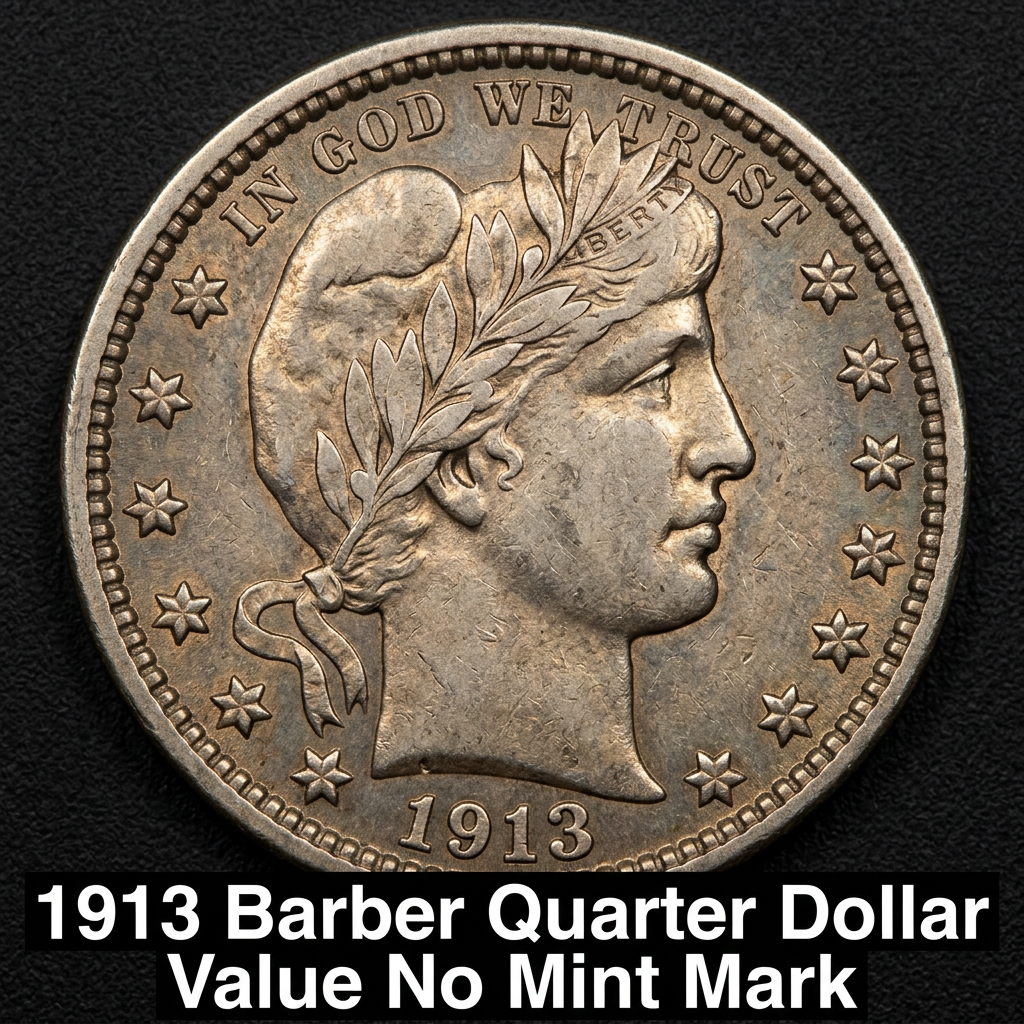
The 1913 Barber Quarter Dollar with no mint mark is worth anywhere from $6 to $15 in heavily worn condition, climbing to $50 or more in fine grades, and potentially hundreds of dollars in mint state — making it a coin worth taking a closer look at if you found one in an old collection.
What Makes the 1913 Barber Quarter Special
The 1913 Barber Quarter was struck at the Philadelphia Mint, which is why coins from this year carry no mint mark. Designed by Charles E. Barber, who served as Chief Engraver of the U.S. Mint, this coin features Lady Liberty wearing a Greco-Roman helmet on the obverse and a heraldic eagle on the reverse.
By 1913, the Barber Quarter series was nearing the end of its run — it was replaced in 1916 by the Standing Liberty Quarter. That gives the 1913 issue a certain “final era” appeal for collectors who enjoy completing classic sets.
If you’re not sure whether the coin in your hand is a Philadelphia issue or from another mint, a free coin identifier app can help you quickly confirm the details before you start digging into values.
How Much Is the 1913 Barber Quarter Worth Today
Value depends almost entirely on condition. A coin that has been circulated heavily — showing flat design details and worn surfaces — is still worth money, but not a huge amount. As you move up the grade scale, values rise significantly.
Here’s a quick breakdown of approximate retail values for the 1913 Barber Quarter (Philadelphia, no mint mark):
| Grade | Description | Approximate Value |
|---|---|---|
| Good (G-4) | Heavy wear, major details visible | $6 – $10 |
| Very Good (VG-8) | Moderate wear, clearer design | $12 – $18 |
| Fine (F-12) | Even wear, most details clear | $22 – $35 |
| Very Fine (VF-20) | Light wear on high points | $45 – $65 |
| Extremely Fine (EF-40) | Slight wear, strong details | $90 – $130 |
| Mint State (MS-60+) | No wear, uncirculated | $200 – $500+ |
These are general market estimates. Actual sale prices can vary based on eye appeal, strike quality, and current collector demand.
How to Check the Condition of Your 1913 Barber Quarter
The easiest way to start is by looking at the high points of the design — the hair above Liberty’s ear and forehead, and the eagle’s breast feathers on the reverse. If those areas are flat and featureless, your coin is likely in Good or Very Good condition.
If you can still see individual hair strands and the feathers have some separation, you’re probably looking at Fine to Very Fine. Coins with almost no wear at all are rare survivors — the 1913 Barber Quarter was a working coin in everyday America, and most examples saw plenty of pocket time.
CoinHix is a great tool for getting a fast visual grade estimate. Just snap a photo of both sides of your quarter and CoinHix will analyze the surface wear and compare it against thousands of similar coins in its database.
The 1913 Mint Mark Comparison — Philadelphia vs. Other Mints
While this article focuses on the Philadelphia issue (no mint mark), it’s worth knowing that 1913 Barber Quarters were also struck in Denver (D) and San Francisco (S). The Denver mint produced a lower mintage that year, making the 1913-D slightly more desirable in some grades.
If you’re collecting the full Barber Quarter series, you might also be interested in related silver coinage from the same era — for example, fans of early 20th-century coins often look at the 1913 nickel value guide to understand what other coins from that same year are worth.
The 1913 Philadelphia Quarter had a mintage of roughly 484,000 coins — not a tiny number, but not huge either. Combined with over 100 years of circulation and attrition, surviving high-grade examples are genuinely scarce.
Tips for Selling or Keeping Your 1913 Barber Quarter
If your coin is in circulated condition, it’s worth holding onto as a solid piece of American silver history. At 90% silver content and weighing 6.25 grams, there’s always a baseline silver melt value — currently somewhere in the $4–$5 range depending on spot prices, though collector value almost always exceeds that.
If your coin appears to be in Extremely Fine or better condition, consider having it professionally graded by PCGS or NGC. A certified coin is easier to sell and typically commands a premium over raw (ungraded) examples.
You can also use CoinHix to get a real-time market estimate and connect with potential buyers who specialize in early 20th-century U.S. silver coins.
—
Frequently Asked Questions
Q: Does the 1913 Barber Quarter with no mint mark mean it was made in Philadelphia?
A: Yes. In this era, the Philadelphia Mint did not place a mint mark on coins. So a 1913 Barber Quarter with no mint mark was definitely struck in Philadelphia.
Q: Is my 1913 Barber Quarter made of real silver?
A: Absolutely. All Barber Quarters are composed of 90% silver and 10% copper, giving them an intrinsic metal value in addition to any collector premium they carry.
Q: How do I know if my coin is worth getting professionally graded?
A: If your 1913 Barber Quarter shows minimal wear and strong detail on both sides, it may grade EF-40 or higher — at that level, professional grading can add significant value. For a quick first opinion, try scanning it with CoinHix before spending money on a formal submission.