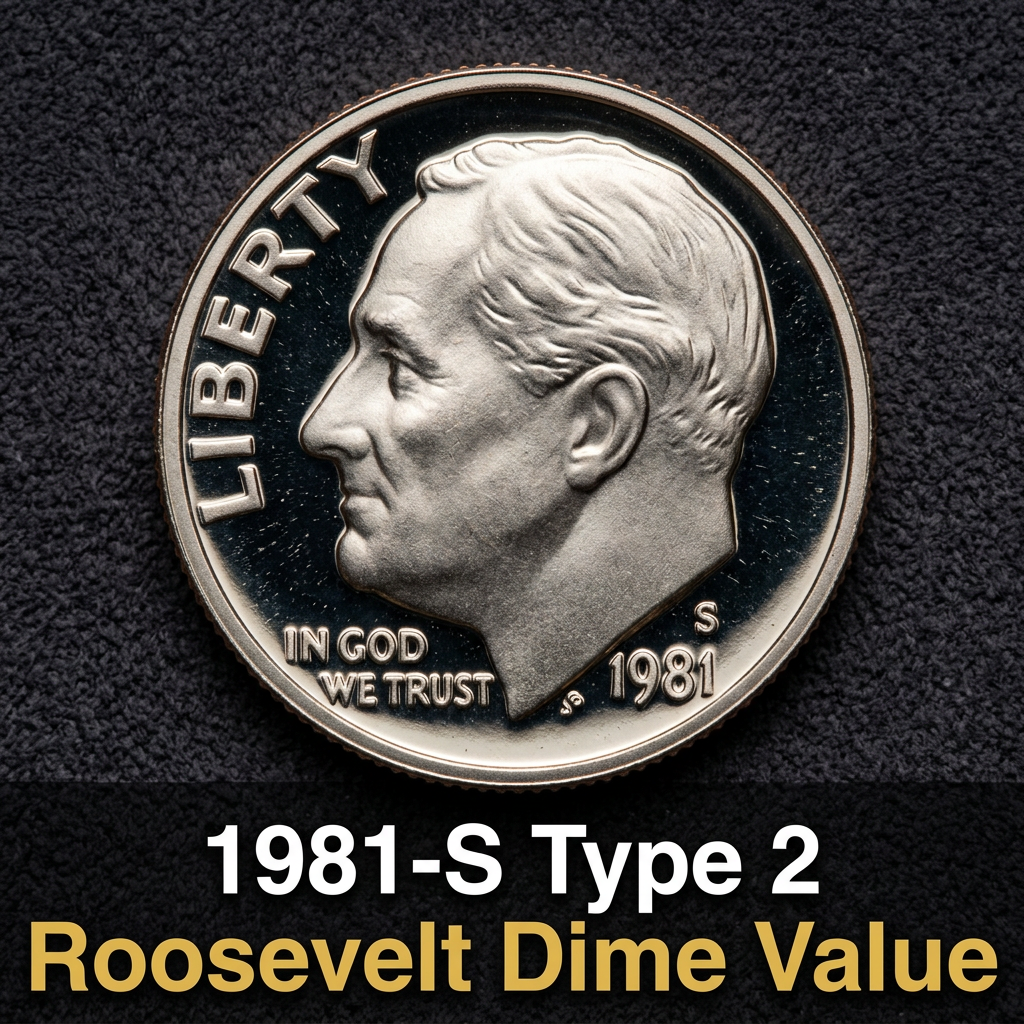
The 1981-S Type 2 Roosevelt Dime is worth anywhere from $3 in lightly circulated condition to over $70 or more in perfect proof grades — and if you’ve got one sitting in an old collection, it might be more special than you think. This coin is a favorite among proof set collectors, and the “Type 2” designation makes it particularly sought after. Read on to find out exactly what you’re holding and whether it’s worth selling.
What Makes the 1981-S Type 2 Different From Type 1
If you’ve ever looked closely at a 1981-S Roosevelt Dime and wondered why some are labeled “Type 1” and others “Type 2,” you’re not alone. The difference comes down to the shape of the mintmark — that tiny “S” on the coin’s obverse (the front side, near Roosevelt’s neck).
The Type 1 mintmark has a rounded, blobby look — it was used at the beginning of the year. The Type 2 mintmark, introduced mid-year, features a sharper, more defined “S” with clear serifs and better definition overall.
This might sound like a small detail, but in the coin collecting world, it matters a lot. The 1981-S Type 2 was produced in smaller quantities than the Type 1, which makes it the scarcer of the two. That scarcity translates directly into higher value for collectors who care about completeness and variety.
Both versions were only available in proof sets — meaning they were never released for general circulation. These coins were struck specifically for collectors, which is why they typically have that brilliant, mirror-like finish you may have noticed.
How Much Is the 1981-S Type 2 Roosevelt Dime Worth
Let’s talk numbers. Because this coin was only issued as part of proof sets, condition is pretty consistent — most examples grade between PR65 and PR69. But even within that range, value can vary significantly depending on grade and eye appeal.
Here’s a general value breakdown based on current market data:
| Grade | Description | Estimated Value |
|---|---|---|
| PR65 | Gem Proof, minor blemishes | $3 – $6 |
| PR66 | Gem Proof, slight imperfections | $5 – $10 |
| PR67 | Superb Gem Proof | $10 – $20 |
| PR68 | Near perfect proof | $20 – $40 |
| PR69 | Nearly flawless | $40 – $75+ |
| PR70 | Perfect proof (extremely rare) | $100+ |
For a deeper look at current market prices and auction records for 1981 Roosevelt Dimes, it’s worth checking recent sales data before making any decisions about buying or selling.
How to Identify Your 1981-S Type 2 Dime
Not sure if you have a Type 1 or Type 2? Here’s what to look for.
Flip your coin over to the obverse side and look at the “S” mintmark below the date. Use a magnifying glass if you have one — the difference is subtle but visible.
On the Type 2, the “S” will look crisp and clean, with clearly defined upper and lower loops and a strong serif style. It looks like a professionally engraved letter. On the Type 1, the “S” appears thicker and less refined, almost like it’s slightly filled in.
If you’re struggling to tell them apart, a free coin identifier app can help you analyze the coin using your phone’s camera. Apps like CoinHix are designed exactly for this — snap a photo, and the app will help you identify the variety, grade range, and estimated value in seconds. It’s a handy tool for anyone new to coin collecting.
Once you’ve confirmed the Type 2 variety, you’re already looking at a coin that’s worth more than its Type 1 counterpart in the same grade.
Where to Sell or Get Your 1981-S Type 2 Dime Appraised
If you’ve confirmed you have a Type 2 and want to sell it or learn more about its value, you have a few solid options.
First, consider getting the coin professionally graded by PCGS or NGC. A certified grade adds credibility and can significantly increase what a buyer is willing to pay — especially in higher grades like PR68 or PR69.
You can also sell directly on platforms like eBay, where proof coins in attractive holders consistently attract buyers. Search completed listings for “1981-S Type 2 Roosevelt Dime” to see what people have actually paid recently.
For a quick reference on what 1981 dimes are worth across different grades and mint marks, coin price guides and collector databases are great starting points.
And if you want to track coin values on the go, CoinHix offers up-to-date pricing data and collection management tools — all in one app. It’s especially useful if you’re working through an old proof set and want to know the value of each coin without doing hours of research.
Is the 1981-S Type 2 Roosevelt Dime Worth Keeping
For most people who find this coin in an inherited collection or old proof set, the answer is yes — at least for now. It won’t make you rich overnight, but it’s a genuinely collectible variety with a distinct numismatic story behind it.
Proof coins in original sets often retain or grow in value when kept in pristine condition. If yours is still sealed in the original 1981 U.S. Mint proof set packaging, don’t open it. The original packaging adds value and protects the coin’s surfaces.
Whether you’re a casual finder or a budding collector, CoinHix is a great resource to keep tabs on your coin’s value over time. With thousands of coin varieties tracked and real auction data built in, it’s the kind of tool that turns coin curiosity into confident knowledge.
—
FAQ
Q: How do I know if my 1981-S Roosevelt Dime is Type 1 or Type 2?
A: Look at the “S” mintmark on the obverse of the coin under magnification. The Type 2 has a sharper, more clearly defined mintmark with visible serifs, while the Type 1 appears rounder and less detailed. If you’re unsure, a coin identifier app can help you compare.
Q: Are all 1981-S Roosevelt Dimes proof coins?
A: Yes. The San Francisco Mint only produced proof versions of the Roosevelt Dime in 1981. These coins were sold exclusively in proof sets and were never released for general circulation, which is why they typically show that distinctive mirror-like finish.
Q: Is it worth getting my 1981-S Type 2 dime professionally graded?
A: It depends on the coin’s apparent condition. If the coin looks flawless with no visible marks or haze, and you believe it could grade PR68 or higher, professional grading can increase its value and marketability. For coins likely to grade PR65 or PR66, the grading fee may not justify the added value.