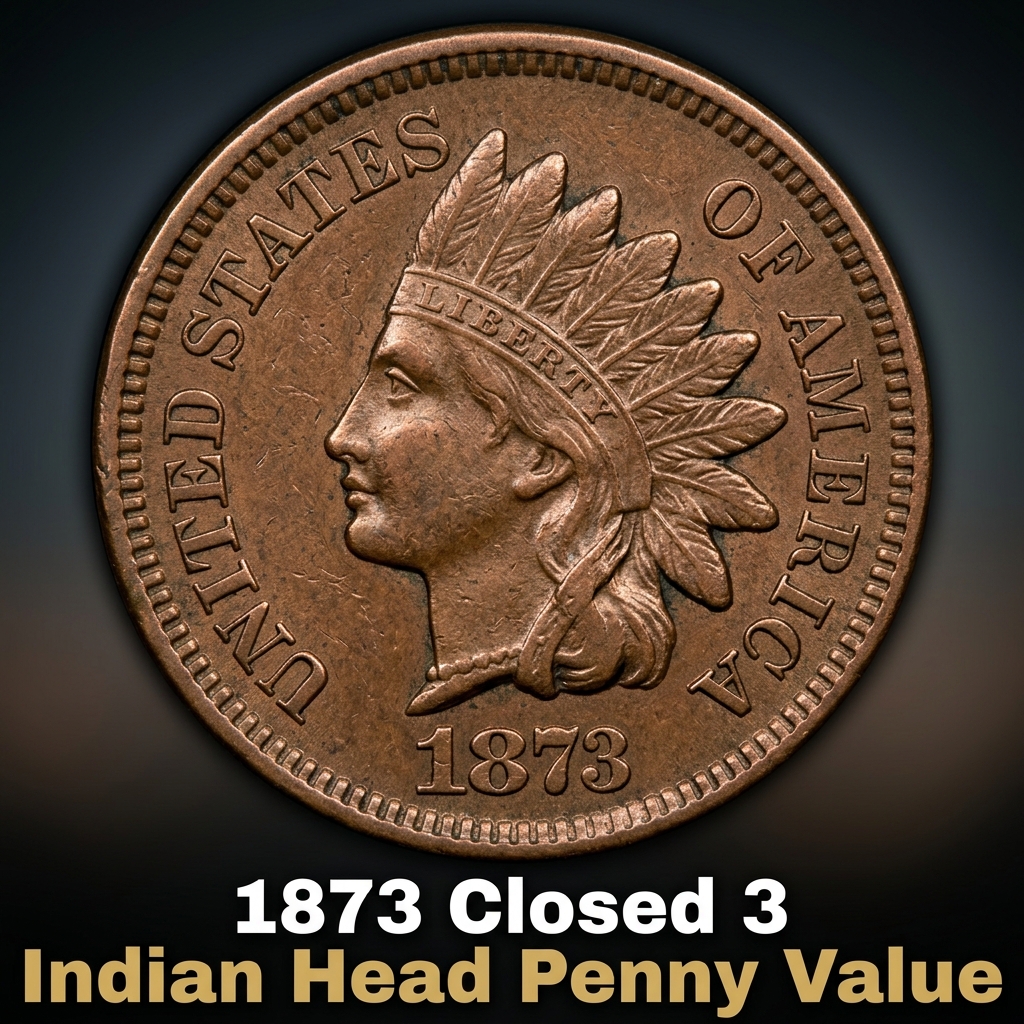
The 1873 Closed 3 Indian Head Penny is worth anywhere from $20 in heavily worn condition to well over $500 in uncirculated grades — and in top mint state examples, it can fetch thousands of dollars at auction. If you just found one of these old cents, you may be sitting on a surprisingly valuable piece of American history.
What Makes the 1873 Closed 3 So Special?
Not all 1873 Indian Head Pennies are created equal. This particular year came in two distinct varieties: the Closed 3 and the Open 3, referring to the shape of the number “3” in the date. On the Closed 3 variety, the top loop of the “3” nearly touches the bottom loop, making it look almost like an “8” at first glance.
The Closed 3 is generally considered the scarcer of the two 1873 varieties, which directly affects its value. Collectors actively seek it out, and that demand pushes prices higher than you might expect for a coin that’s over 150 years old.
If you’re not sure which variety you have, a magnifying glass or loupe can help you inspect the date closely. You can also use a free coin identifier app to get a quick read on what you’re holding before you decide what to do with it.
How Much Is the 1873 Closed 3 Indian Head Penny Worth?
Value depends heavily on condition, also called “grade” in the coin collecting world. A coin that’s been in circulation for decades will show wear on the high points — Lady Liberty’s feathers, hair details, and the lettering. The better the detail, the more the coin is worth.
Here’s a general value breakdown based on grade:
| Grade | Description | Estimated Value |
|---|---|---|
| Good (G-4) | Heavy wear, outline visible | $20 – $35 |
| Fine (F-12) | Moderate wear, some detail | $50 – $90 |
| Extremely Fine (EF-40) | Light wear, sharp detail | $175 – $275 |
| Mint State (MS-63) | No wear, minor marks | $550 – $900 |
| Gem Mint State (MS-65+) | Exceptional luster and strike | $2,000+ |
For the most up-to-date market data, you can check current 1873 Indian Head Penny price trends across mint state grades to see how the market is moving right now.
How to Check the Condition of Your Coin
Grading coins takes practice, but you don’t need to be an expert to get a rough idea of what you have. Start by looking at the design under good lighting.
On the obverse (front), look at the feathers in Lady Liberty’s headdress and the strands of her hair near the ribbon. If those areas are flat and smooth, the coin has significant wear. If you can still make out individual feather lines and hair detail, you’re likely looking at a Fine or better grade.
On the reverse (back), the wreath and the shield above the word “ONE CENT” are the areas that show wear first. A coin with crisp, well-defined leaves and bold lettering is always worth more.
CoinHix is a great tool for collectors and curious finders alike — it can help you compare your coin’s condition against graded examples and give you a realistic value estimate without needing to visit a dealer right away.
How Does the 1873 Closed 3 Compare to Other Indian Head Pennies?
The Indian Head Penny series ran from 1859 to 1909, and most dates from the 1870s and 1880s tend to be more valuable than later issues simply because fewer were saved. The 1873 Closed 3 sits in a particularly interesting spot in the series.
It’s not as rare as a key date like the 1877, but it’s significantly harder to find than common dates like the 1900 or 1906. If you’re curious how values compare across the series, see how a late-series Indian Head Penny from 1898 stacks up in value — it gives you a useful benchmark for understanding how condition and date rarity interact.
The 1873 Closed 3 also benefits from variety collector interest. Many hobbyists specifically chase both the Closed 3 and Open 3 versions to complete their type sets, which keeps demand steady.
Should You Get It Graded or Sell It As-Is?
If your coin appears to be in Extremely Fine or better condition, professional grading through PCGS or NGC could significantly increase its sale value and make it easier to sell to serious collectors. Grading costs money upfront — usually $20 to $50 per coin depending on the service level — but for a coin that might be worth $300 or more, it’s often worth it.
For coins in lower grades, selling raw (ungraded) is usually the simpler option. Local coin dealers, online marketplaces like eBay, and coin shows are all reasonable places to start.
CoinHix can help you track recent sale prices and compare what similar coins have sold for, so you don’t walk into a negotiation blind.
—
FAQ
Q: How do I tell if my 1873 Indian Head Penny is the Closed 3 variety?
A: Look closely at the “3” in the date with a magnifying glass. On the Closed 3, the two loops of the “3” nearly touch each other, making it look almost like an “8.” On the Open 3, there is a clear gap between the loops. The difference is subtle but important for value.
Q: Is the 1873 Closed 3 Indian Head Penny rare?
A: It’s not considered a key date like the 1877, but it is scarcer than most Indian Head Pennies from the 1880s and 1900s. Its variety status and lower survival rate in high grades make it desirable among collectors, which supports stronger prices.
Q: Where is the best place to sell my 1873 Closed 3 Indian Head Penny?
A: For lower-grade examples, eBay or a local coin dealer are convenient options. For higher-grade coins, consider submitting to a professional grading service first and then listing through a major coin auction house. Using CoinHix to research recent sale prices beforehand will help you set realistic expectations and avoid underselling.