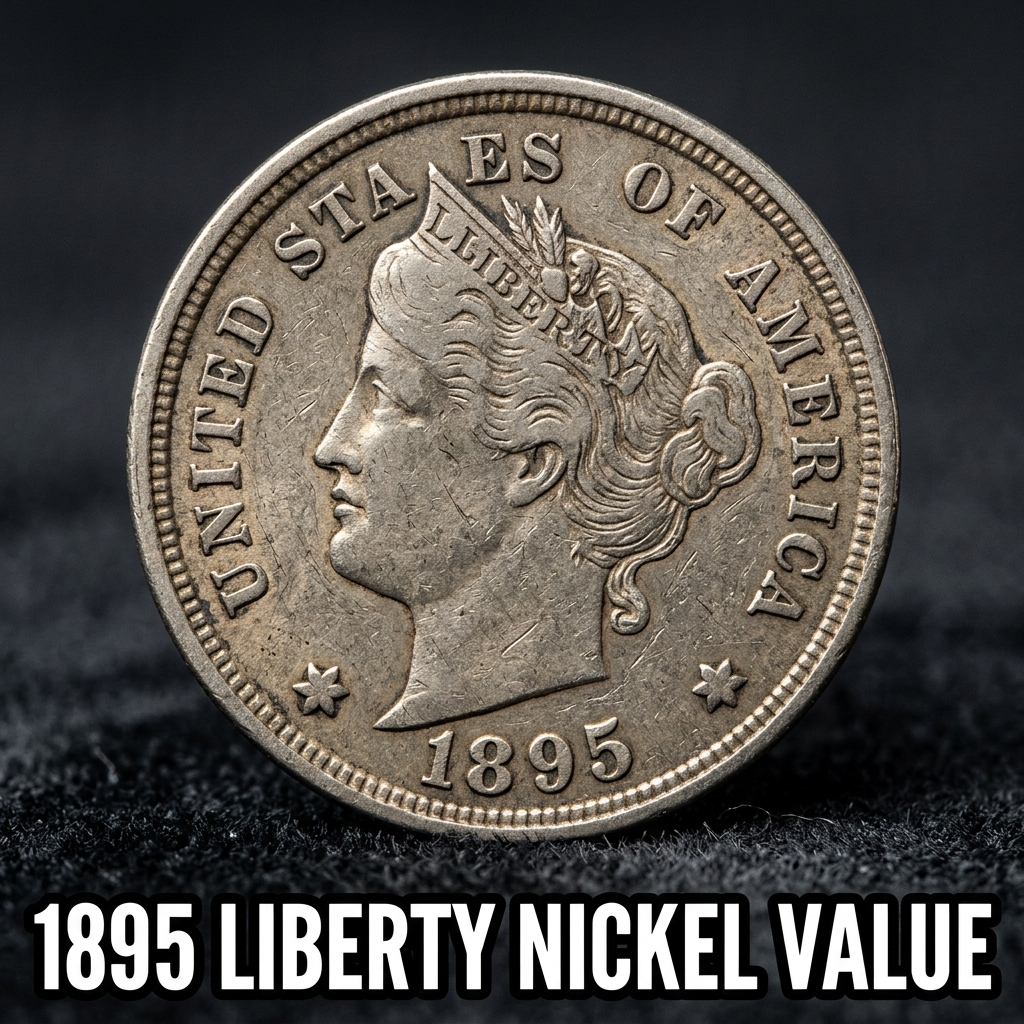
The 1895 Liberty Nickel is worth anywhere from $5 in heavily worn condition to well over $1,000 or more in higher mint state grades. If you’ve found one of these coins in a drawer, old jar, or inherited coin collection, you’re holding a piece of genuine American history — and it might be worth more than you think.
What Is the 1895 Liberty Nickel?
The 1895 Liberty Nickel is part of the Liberty Head nickel series, also known as the “V Nickel” because of the large Roman numeral V on the reverse. These coins were minted from 1883 to 1912 and are one of the most recognizable nickel designs in U.S. coin history.
The obverse features a left-facing portrait of Lady Liberty surrounded by stars, while the reverse displays the Roman numeral V within a wreath. The coin is made of 75% copper and 25% nickel, weighs 5 grams, and measures 21.2mm in diameter.
The 1895 issue had a mintage of just over 9.9 million coins from the Philadelphia Mint — no mint mark was used. While that sounds like a lot, most of those coins circulated heavily and are now found in well-worn condition. Nice examples are harder to come by than you might expect.
If you’re not sure what you have, try a free coin identifier app to scan and identify your coin before spending time on research.
1895 Liberty Nickel Value by Grade
Coin grading plays a huge role in value. A coin’s grade describes its level of wear, from “Good” (heavily worn) all the way up to “Mint State 65” or higher (essentially uncirculated). The difference between a Good example and a Mint State example can be hundreds of dollars.
Here’s a general value breakdown for the 1895 Liberty Nickel based on grade:
| Grade | Description | Estimated Value |
|---|---|---|
| Good (G-4) | Heavy wear, design visible but flat | $5 – $8 |
| Very Good (VG-8) | Moderate wear, some detail remains | $10 – $15 |
| Fine (F-12) | Light to moderate wear, clearer design | $18 – $28 |
| Very Fine (VF-20/30) | Light wear on high points | $35 – $55 |
| Extremely Fine (EF-40) | Slight wear on highest points only | $70 – $110 |
| About Uncirculated (AU-50) | Trace wear, nearly full luster | $150 – $220 |
| Mint State (MS-63) | No wear, minor bag marks | $350 – $550 |
| Mint State (MS-65) | Gem uncirculated, strong luster | $900 – $1,500+ |
For the most up-to-date market data, you can check live 1895 Liberty Nickel prices across mint state grades to see what collectors are currently paying at auction.
What Makes Some 1895 Liberty Nickels Worth More?
Beyond grade, a few other factors can push the value of your 1895 Liberty Nickel higher. Eye appeal matters a great deal to collectors — a coin with original, natural luster and no cleaning or polishing will always fetch a premium over one that has been cleaned.
Strike quality is another factor. Some 1895 nickels came from the mint with a sharper, more defined strike while others are a bit soft or weak in the hair and star details. A well-struck coin in VF or EF condition can sometimes outperform a poorly struck coin at a higher technical grade.
Coins that have been certified and graded by a third-party grading service like PCGS or NGC tend to sell for more because buyers feel confident in the grade. Raw (ungraded) coins often sell at a discount unless you’re dealing with a trusted expert. If you’re thinking about submitting a coin for grading, CoinHix can help you estimate whether the potential value increase justifies the submission cost before you commit.
Proof Versions and Special Strikes
In 1895, the U.S. Mint also produced a small number of Proof Liberty Nickels for collectors. These coins were struck on specially prepared planchets with highly polished dies, resulting in mirror-like fields and frosted design elements.
Only 2,100 Proof examples were made in 1895, making them significantly rarer than the business strike coins. A Proof 1895 Liberty Nickel in PR-63 condition typically sells for $300 to $500, while gems in PR-65 or better can reach $800 to $1,200 or more depending on cameo contrast.
If your coin has unusually sharp detail and reflective surfaces, it’s worth having it looked at more closely. Use CoinHix to photograph and analyze your coin, and see whether it matches known Proof characteristics before assuming you have a standard circulated piece.
How Does the 1895 Liberty Nickel Compare to Other Coins of the Era?
It’s always useful to put coin values in context. The 1895 dime, for example, is another popular coin from the same year and also carries solid collector interest. If you found a coin from 1895 and aren’t sure whether it’s a nickel or a dime, you’ll want to check size and design closely. You can also learn about the 1895 dime’s value and what makes it collectible to see how the two coins compare as collectibles from the same era.
Within the Liberty Head nickel series itself, the 1895 is a mid-series date with moderate value. It’s not a key date like the ultra-rare 1913 Liberty Nickel (which sells for millions), but it’s a respectable collectible coin that holds solid value across most grades.
For everyday collectors and casual finders, the 1895 Liberty Nickel is one of those coins that rewards research. A worn example might only be worth a few dollars, but a well-preserved piece can be a genuine treasure hiding in plain sight.
—
Frequently Asked Questions
Q: Is my 1895 Liberty Nickel rare?
A: The 1895 Liberty Nickel is not considered a rare date within the Liberty Head series, with a mintage of nearly 10 million. However, finding one in good condition is less common since most circulated heavily. Proof examples with only 2,100 minted are genuinely scarce.
Q: How can I tell if my 1895 Liberty Nickel has been cleaned?
A: A cleaned coin often looks unnaturally bright or shiny with fine hairline scratches visible under magnification. Original uncleaned coins have a more muted, even luster. Cleaning significantly reduces collector value, so it’s important to identify it before trying to sell. Apps like CoinHix can help you evaluate the surface condition of your coin.
Q: Where is the mint mark on a 1895 Liberty Nickel?
A: The 1895 Liberty Nickel was only produced at the Philadelphia Mint, which did not use a mint mark during this era. So there is no mint mark to look for — if your coin says 1895 and looks like a Liberty Head nickel, it came from Philadelphia.