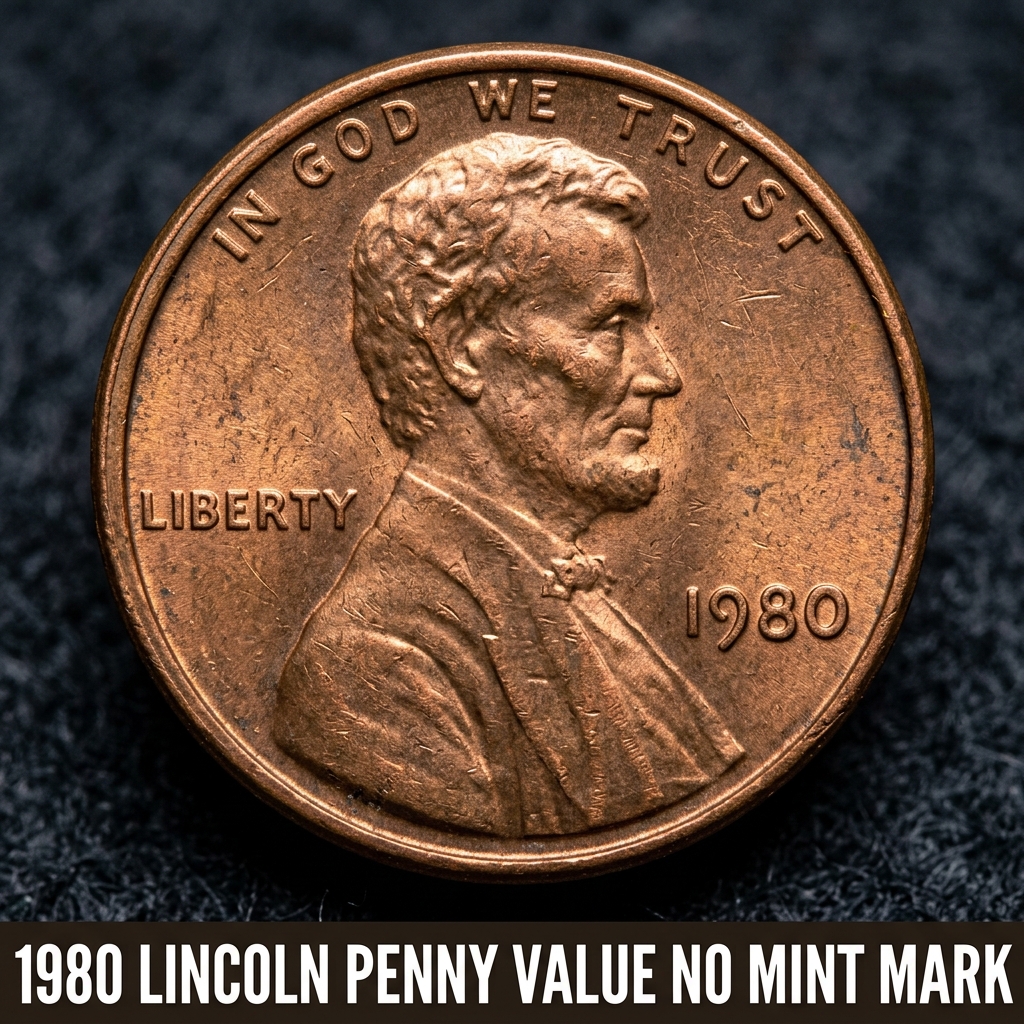
The 1980 Lincoln Penny with no mint mark is worth anywhere from a few cents in heavily worn condition to around $1–$5 in uncirculated grades, with top-quality examples graded MS-67 Red occasionally selling for $50 or more at auction. If you’ve found one of these coins in a drawer or coin jar, you’re in the right place to find out exactly what you’ve got.
—
What the No Mint Mark Actually Means on a 1980 Penny
When you see a 1980 Lincoln cent with no mint mark, that tells you it was struck at the Philadelphia Mint. Philadelphia has a long tradition of not stamping a “P” mint mark on Lincoln cents, so the absence of a letter doesn’t mean anything is missing or unusual — it’s completely normal for this era.
The coin you’re holding was made during a time when the U.S. Mint was producing billions of pennies every year to meet demand. In 1980 alone, Philadelphia struck over 7.7 billion Lincoln cents, which is why most of them are worth only face value today.
That said, the condition of your coin matters a lot. Even a common date like the 1980 penny can carry real collector value if it was never spent and has remained in pristine condition. If you want a quick and easy way to check, you can use a free coin identifier app to scan your coin right from your phone and get an instant grade estimate.
—
1980 No Mint Mark Penny Value by Grade
Here’s where condition really separates the common from the collectible. A well-worn 1980 penny with flat details and no luster is essentially worth face value — one cent. But as condition improves, so does the price.
The grading scale runs from Poor (P-1) at the bottom to Mint State (MS-70) at the top. For circulated coins, you’re mostly looking at coins that went through everyday use — in wallets, vending machines, parking meters. Uncirculated examples are coins that never left the mint bag and have their original shine intact.
Here’s a simple breakdown of the 1980 Lincoln Penny (No Mint Mark) price data across key grades:
| Grade | Condition Description | Estimated Value |
|---|---|---|
| Good (G-4) | Heavy wear, flat design | $0.01 |
| Fine (F-12) | Moderate wear, some detail | $0.05–$0.10 |
| Extremely Fine (EF-40) | Light wear, most detail visible | $0.25–$0.50 |
| Uncirculated (MS-63 RB) | No wear, some toning | $0.50–$1.50 |
| Gem Uncirculated (MS-65 RD) | Full red luster, sharp strike | $3–$8 |
| Superb Gem (MS-67 RD) | Near perfect, full red | $50–$150+ |
—
Are There Any Rare 1980 Penny Errors Worth Looking For?
This is where things get interesting. Even though the standard 1980 no mint mark penny is common, certain error coins can push the value dramatically higher. Collectors actively search for these varieties, and some sell for hundreds of dollars.
The most talked-about errors include doubled die obverse coins, where Lincoln’s portrait or the lettering appears slightly doubled due to a misalignment during the die hubbing process. You’ll want to look closely at the words LIBERTY and IN GOD WE TRUST with a magnifying glass.
Other errors to watch for include off-center strikes (where the design is shifted to one side), clipped planchets (a chunk missing from the coin blank), and broadstrikes (coins struck outside the collar). Even a minor error can add $10–$50 in value, while dramatic errors may fetch $100 or more depending on collector interest. For a complete overview of 1980 penny values including error varieties and mint mark differences, it’s worth doing a thorough check before spending the coin.
CoinHix is a great tool here — you can photograph your coin and let the app’s database flag potential error characteristics that are easy to miss with the naked eye.
—
How to Tell If Your 1980 Penny Is Uncirculated
Most people aren’t sure whether their old pennies were ever circulated, and that’s totally understandable. Here are a few things to look for when examining your 1980 Lincoln cent.
First, check the surface for luster — genuine uncirculated coins will have a subtle cartwheel shine when you tilt them under a light. Any dulling, rubbing, or wear on Lincoln’s cheekbone or the high points of the Memorial building on the reverse is a sign it was circulated.
Color also matters. Uncirculated copper cents are graded as Red (RD), Red-Brown (RB), or Brown (BN). Full red coins command the highest premiums because they’ve retained their original mint color. Once a penny starts darkening or developing spots, it falls into the lower color tiers.
Using CoinHix to compare your coin against graded examples in their database can make this process much faster and more accurate than trying to judge by eye alone.
—
FAQ
Q: Is a 1980 penny with no mint mark worth anything?
A: Most circulated 1980 no mint mark pennies are worth only face value — one cent. However, uncirculated examples can be worth $1–$8, and high-grade gems (MS-67 RD) can reach $50–$150 or more in the collector market.
Q: How do I know if my 1980 penny is an error coin?
A: Use a magnifying glass to closely examine Lincoln’s portrait and the lettering for doubling, and check the coin’s shape for off-center strikes or missing areas. Apps like CoinHix can also help you identify potential error characteristics quickly.
Q: Where is the mint mark on a 1980 penny?
A: The mint mark appears on the obverse (front) of the coin, just below the date on the right side. A coin from Philadelphia will have no mint mark, while a Denver coin shows a “D.” No mint mark is completely normal for Philadelphia-minted cents from this era.