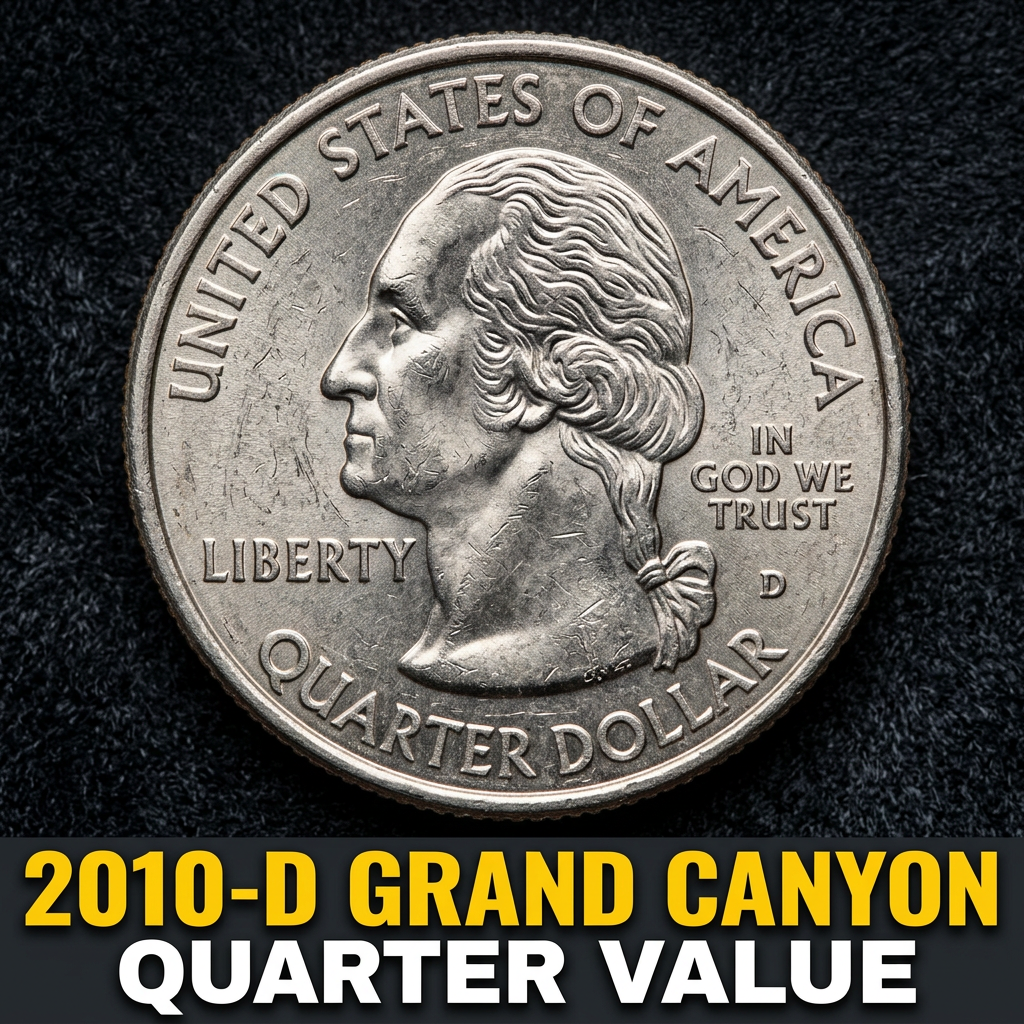
The 2010-D Grand Canyon Quarter is worth anywhere from 25 cents in circulated condition to over $15 or more in pristine mint state — and a few rare error coins have sold for significantly higher. If you found one in your pocket change or tucked away in an old coin jar, you’re in the right place to find out exactly what you’ve got.
What Is the 2010-D Grand Canyon Quarter?
The 2010-D Grand Canyon Quarter is part of the America the Beautiful Quarters Program, a series launched by the U.S. Mint in 2010 to honor national parks and sites across all 50 states, territories, and the District of Columbia. The Grand Canyon design was the fourth coin released in 2010, representing Arizona.
The “D” mint mark means it was struck at the Denver Mint. These coins were made for everyday circulation, so hundreds of millions were produced — which is part of why most examples aren’t worth a fortune.
That said, condition is everything in the coin world. A worn, scratched quarter pulled from a vending machine tray is just face value. A beautifully preserved example that never touched a pocket? That’s a different story entirely.
If you’re not sure how to grade your coin or identify its mint mark, a free coin identifier app can help you get a quick read on what you’re holding before you dig deeper.
2010-D Grand Canyon Quarter Value by Condition
The value of your 2010-D Grand Canyon Quarter depends almost entirely on its grade — the official term for how well-preserved a coin is. Here’s a simple breakdown to give you a realistic sense of what yours might be worth:
| Grade / Condition | Description | Estimated Value |
|---|---|---|
| Circulated (Good–Fine) | Visible wear, flat details | $0.25 – $0.50 |
| Extremely Fine (EF-45) | Light wear, most detail visible | $0.50 – $1.50 |
| Mint State (MS-63) | Uncirculated, minor bag marks | $2 – $5 |
| Mint State (MS-65) | Gem uncirculated, sharp strike | $8 – $15 |
| Mint State (MS-67+) | Near-perfect, professional grade | $50 – $200+ |
For a more detailed look at how the 2010-D Grand Canyon Quarter compares to its sister coin, you can check out certified MS grade pricing data for the 2010-P Yellowstone Quarter — a useful benchmark since both coins come from the same series and year.
How Many Were Made and Why That Matters
The Denver Mint struck approximately 222 million 2010-D Grand Canyon Quarters. That’s a lot of coins, and high mintage numbers generally keep values modest for circulated examples. When a coin is this common, collectors aren’t scrambling to find one — they’re looking for the best possible condition.
However, coins that were saved straight from mint rolls or purchased in uncirculated sets can still command solid premiums. The top-tier grades (MS-67 and above) become genuinely scarce because even a small handling mark or weak strike can drop a coin out of that elite category.
This is why two coins that look almost identical to the naked eye can have very different values once a professional grader examines them under magnification.
Error Coins and Special Varieties Worth More
Every now and then, a 2010-D Grand Canyon Quarter pops up with a minting error — and those coins can be worth real money.
Common errors to look for include:
Double die obverse — where Washington’s portrait or lettering appears slightly doubled. These can sell for $25 to $100 or more depending on how dramatic the doubling is.
Off-center strikes — where the design is clearly misaligned on the blank. Depending on the degree of error, these can bring $30 to $150 at auction.
Wrong planchet errors — extremely rare cases where the coin was struck on a blank meant for a different denomination. These are serious finds.
If you think your coin might have an error, CoinHix is a great tool to start your research. The CoinHix app lets you scan your coin and compare it against known varieties and error types, so you’re not guessing blind.
For a broader overview of what 2010 quarters are worth across all five designs and mint marks, that resource breaks down the full picture nicely.
Is Your 2010-D Grand Canyon Quarter Worth Getting Graded?
Professional grading through services like PCGS or NGC costs money — typically $20 to $50 per coin at entry-level tiers. That means it only makes financial sense if your coin has a realistic shot at grade MS-66 or higher.
If your coin looks completely untouched — brilliant luster, no scratches, sharp details on the canyon walls and condor in the design — it might be worth the investment.
For everything else, the honest answer is that most circulated 2010-D Grand Canyon Quarters are worth exactly 25 cents. But knowing that with confidence is still valuable, and using CoinHix to run a quick check costs you nothing.
—
FAQ
Q: Is the 2010-D Grand Canyon Quarter rare?
A: Not in general circulation. With over 222 million minted, it’s a common coin. High-grade examples (MS-67 and above) are genuinely scarce, but you won’t find those in pocket change.
Q: What does the “D” mint mark mean on my quarter?
A: The “D” stands for Denver, meaning your coin was produced at the Denver Mint. The Philadelphia Mint also made Grand Canyon Quarters in 2010 (with no mint mark or a “P”), and San Francisco made special proof versions with an “S” mint mark.
Q: Where is the best place to sell a valuable 2010-D Grand Canyon Quarter?
A: For high-grade or error coins, eBay auctions and reputable coin dealers are your best options. Get the coin professionally graded first to maximize its selling price. For everyday circulated examples, spending it is honestly your most practical move.